Offline Mushroom Farming Training at Our Farm
At Dr. Dahiya Mushroom Farm, Sonipat
The full syllabus, on a working farm
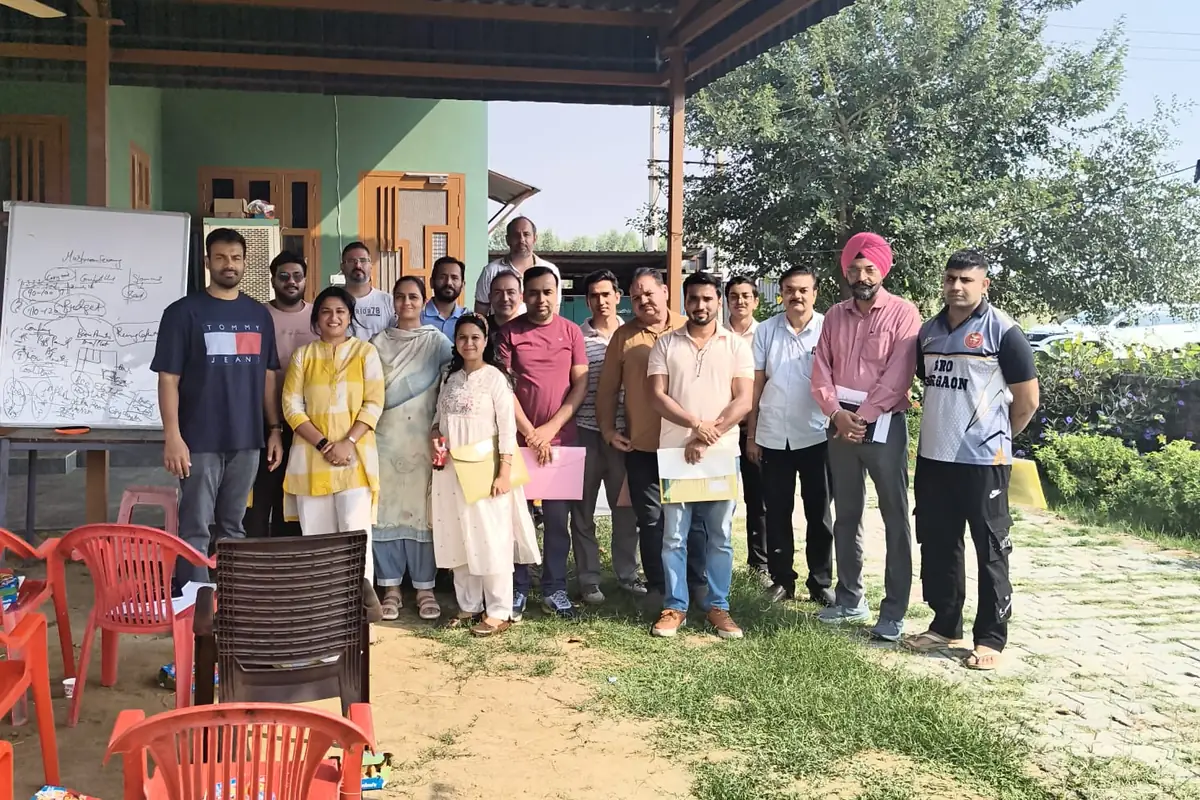
This is training on a working mushroom farm, not in a classroom. You come to our farm at Barwasni in Sonipat on a Sunday morning, and Dr. Sonia Dahiya walks you through the operation as it is actually running: the compost, the growing rooms, the crop at whatever stage it is in that week, and the money that runs through all of it.
In short: the farm training teaches the same syllabus as our live online course: the biology of the button mushroom crop and the economics of running a unit. Nothing is held back from either. What the farm adds is the farm itself. You stand in the compost shed, walk the growing rooms, see a live crop and the packing table, and ask your questions in front of the thing you are asking about.
Sessions run on one Sunday a month, 11 AM to 1 PM. The next one is on 6 December 2026 (Sunday).
The farm training at a glance
When
6 December 2026 (Sunday), 11 AM – 1 PM. One Sunday a month.
Where
Dr. Dahiya Mushroom Farm, V.P.O Barwasni, Sonipat, Haryana. About an hour and a half from Delhi by road.
Fee
₹2,000 a seat. Book as many seats as you need.
What you learn
The full button mushroom syllabus: the biology of the crop and the economics of a unit.
Certificate
A digital certificate signed by Dr. Sonia Dahiya.
Who it suits
Anyone deciding whether to start a unit, or partway through setting one up. No experience needed.
What only the farm can show you
Our online course and this session cover the same ground. The difference is that some of mushroom farming is learned through the eyes, the nose and the hands, and a screen carries only part of that. These are the four places the session takes you, and what each one teaches that a slide cannot.
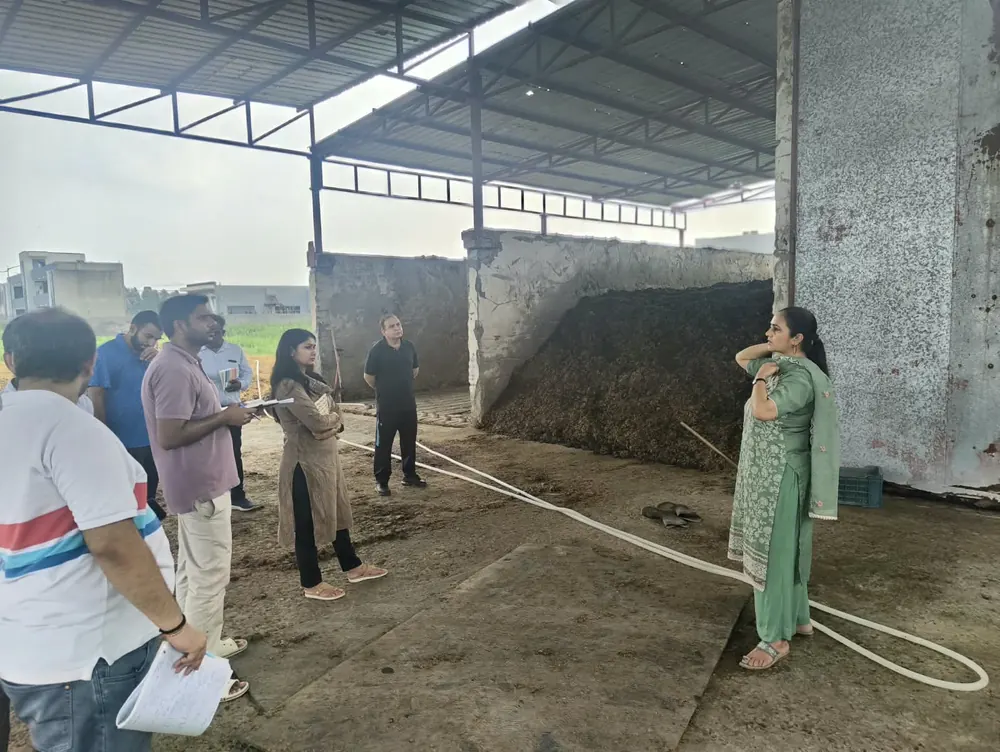
1. The compost shed
Compost is where most failed crops start, and judging it is a sensory skill. You see compost at different ages behind the bunker walls, and learn what finished compost looks, feels and smells like: dark brown, soft but still holding its structure, and without the sting of ammonia. Once you have smelled the difference, you do not forget it.
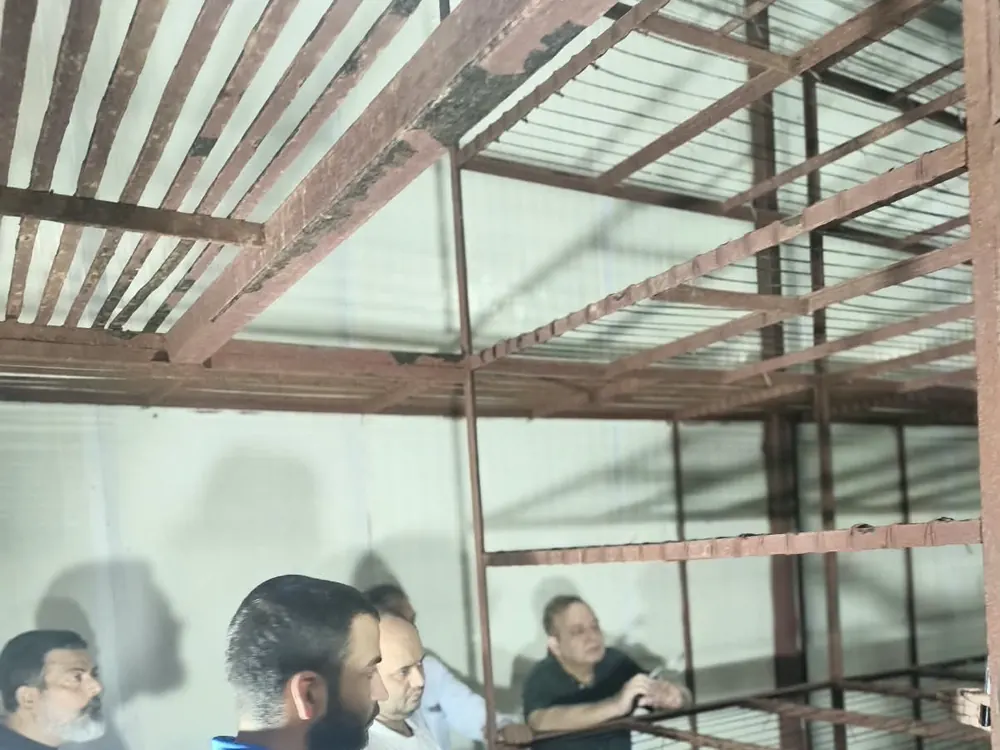
2. The growing rooms
Insulated rooms with tiered racks, where the crop spends most of its life. You feel what 14–18°C and 85–90% humidity actually are, see how fresh air moves across the tiers, and see the hygiene that keeps a room clean between crops. Numbers on a slide become a room you have stood in.
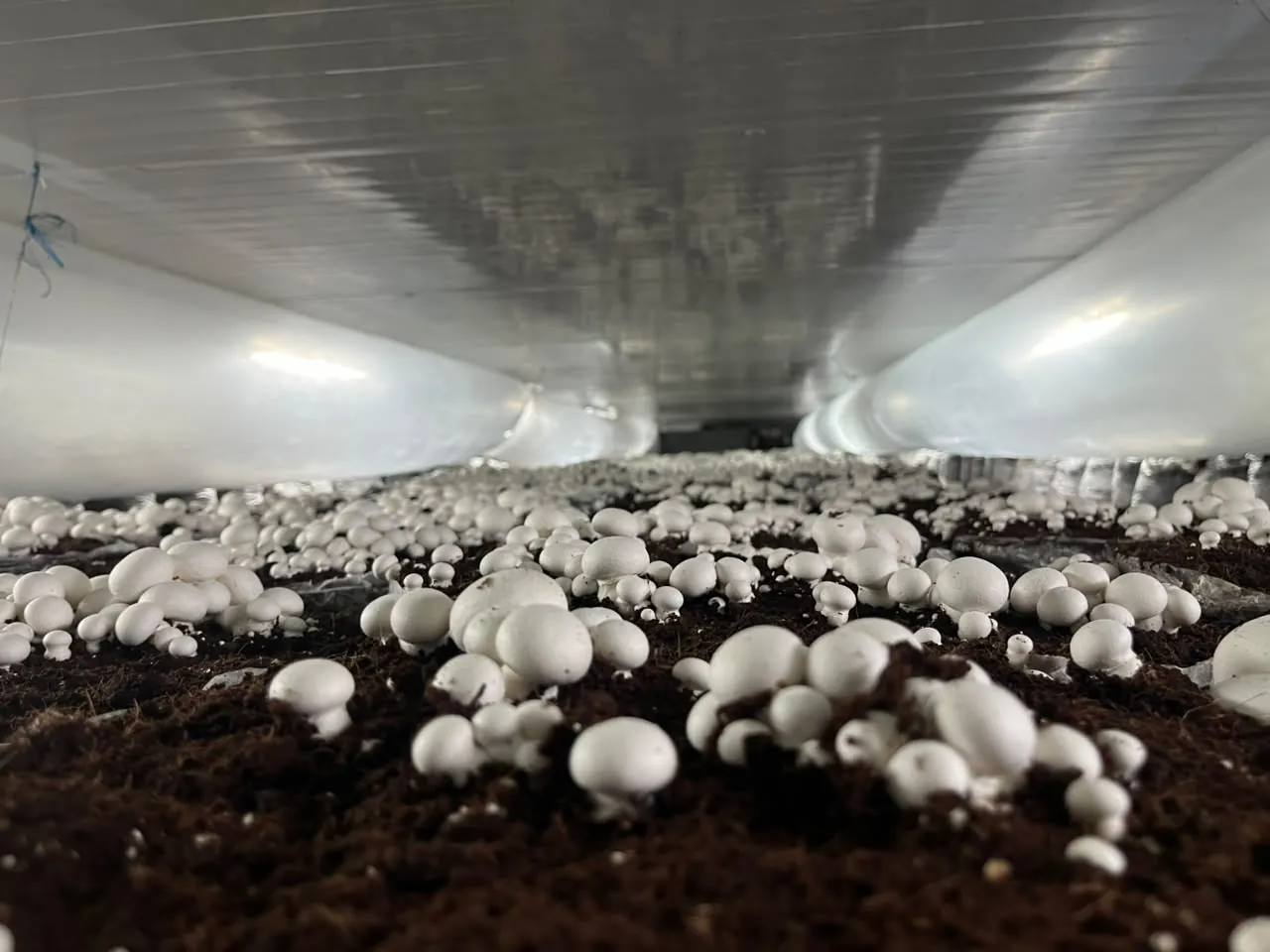
3. A live crop
Depending on where the crop calendar is that week, you see bags in spawn run, a fresh casing layer, pinheads or a flush ready to pick. You see the size at which a button is picked, how it is twisted out rather than pulled, and what a healthy bed looks like next to one where a problem is starting.
4. The packing table
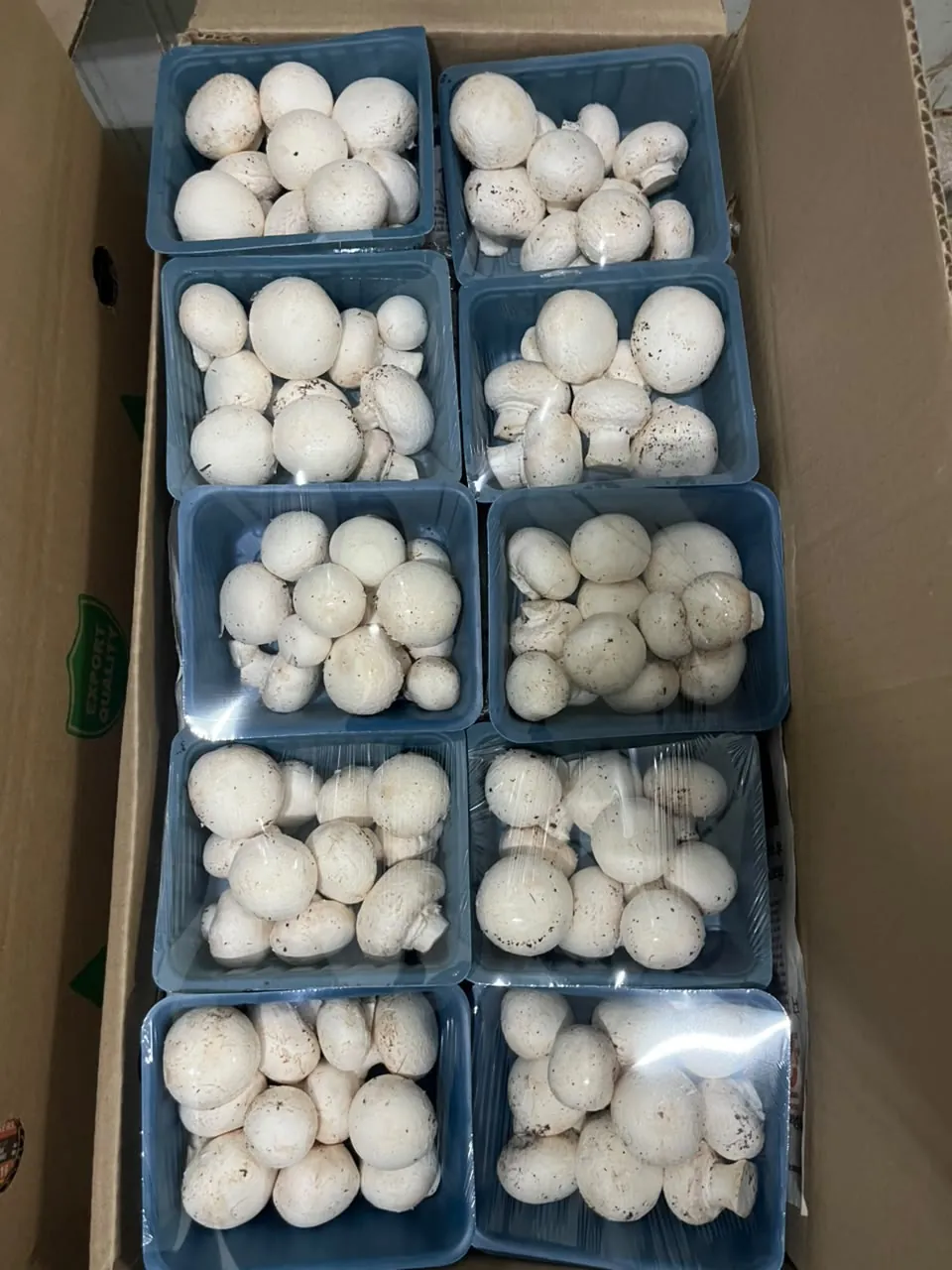
Where the morning’s pick is trimmed, graded and packed into punnets, then kept cold until it leaves the farm. It is the least glamorous corner of the farm and the one where the price is won or lost: a well-graded punnet sells for more than the same mushrooms in a loose crate.
What is running on the day depends on the crop calendar, so not every stage is at its peak in every session. Whatever is not on show that day is taught under the teaching shed with the same figures.
What we teach: the biology of the crop
The first half of the syllabus is the crop itself: what a button mushroom is, what it needs at each stage, and why. Each topic is also a chapter of our free Button Mushroom Booklet, which is the course handout, so you can read ahead before you come or revise afterwards.
How a button mushroom lives
The button mushroom, Agaricus bisporus, is not a plant. It has no chlorophyll and cannot make its own food, so it lives on composted straw, digesting it through a fine network of threads called mycelium. The mushroom you pick is only the fruiting body of that network. Commercial growing comes down to three jobs: make a compost the mycelium can eat and its competitors cannot, let the mycelium take that compost over completely, and then give it the signals that make it fruit. Every stage below is one of those three jobs.
Compost, Phase I
Wheat straw (or paddy or mustard straw) supplies the carbon and the structure; poultry manure, urea and cotton seed cake supply the nitrogen; gypsum stops the compost turning greasy. The straw is pre-wetted for two to three days, then mixed, stacked and turned every two to three days for 12 to 14 days while microbes drive the core of the heap to 70–80°C. At the farm, this is the compost you see behind the bunker walls. Chapter 2: Phase I composting →
Compost, Phase II
In an insulated tunnel, the compost is pasteurised at 57–60°C for six to eight hours to kill pests and disease, then conditioned at 45–50°C for four to six days while microbes turn the leftover ammonia into food the mushroom can use. It is ready when the ammonia reading is close to 0 ppm, and it is cooled to about 22–25°C for spawning. Phase II takes eight or nine days, and it is the step new growers most often rush. Chapter 3: Phase II →
Spawning and spawn run
Spawn is grain coated with mushroom mycelium: the seed of the crop. It is mixed through the compost at 0.7–1% of its weight, which is 7–10 g for every kilo, and the bags are held with the compost at 22–25°C. In 12 to 15 days the compost turns white with mycelium and golden droplets appear, the sign of a healthy run. The course also covers how to judge spawn before you pay for it. Chapter 4: Spawning →
Casing and ruffling
Button mushrooms will not fruit on bare compost. A 3–5 cm casing layer is spread on top: at our farm, coco peat with slaked lime and gypsum, treated before use and brought to a pH of about 7–7.5. The mycelium grows up into it over six or seven days at 22–25°C and 85–90% humidity, and ruffling the surface evens out where the pins will form. Chapter 5: Casing →
Cool-down, pinning and cropping
Two changes tell the mycelium to fruit: the room is cooled from 22–25°C to 14–18°C over a day or two, and fresh air brings carbon dioxide down to about 800–1,000 ppm. Pins form and grow into buttons. From then on the crop needs an even temperature across every tier, 85–90% humidity, and watering judged by eye and hand, which is a craft in itself. Chapter 6: Cropping →
Flushes and harvest
Picking usually starts 18 to 21 days after casing. Mushrooms come in waves called flushes, usually three or four over three to four weeks of picking, about a week apart, with the first two giving most of the yield. Picked mushrooms are trimmed, graded and moved to 2–5°C, ideally within an hour. A whole crop occupies a room for 65 to 70 days. Chapter 7: Harvesting →
Diseases and pests
The course covers the eleven problems that matter most: six diseases (dry bubble, wet bubble, green mould, cobweb, bacterial blotch and false truffle) and five pests (sciarid flies, phorid flies, springtails, mites and nematodes). The emphasis is on the hygiene system that keeps them out, because by the time most of them are visible, a flush is already at risk. Chapter 8: Diseases and pests →
The crop cycle at a glance
| Stage | How long | Temperature | What tells you it is done |
|---|---|---|---|
| Phase I compost | 12–14 days, after 2–3 days of pre-wetting | Heap core 70–80°C | Turned every 2–3 days until even and brown |
| Phase II compost | 8–9 days | 57–60°C for 6–8 hours, then 45–50°C | Ammonia close to 0 ppm |
| Spawn run | 12–15 days | 22–25°C in the compost | White throughout, golden droplets |
| Case run | 6–7 days | 22–25°C, 85–90% humidity | Mycelium through the casing |
| Cool-down and pinning | Picking starts 18–21 days after casing | Down to 14–18°C; CO₂ 800–1,000 ppm | Even pinning across the bed |
| Cropping | 3–4 weeks, 3–4 flushes | 14–18°C, 85–90% humidity | Flushes slow and the room is closed |
| Storage | Until dispatch | 2–5°C | Cold within an hour of picking |
What we teach: the economics of a unit
Growing mushrooms and running a mushroom business are different skills, and the second is where most units fail. The second half of the session is about money: what a unit costs, what it earns, who pays for the crop and how to finance it. The figures are our farm’s own, and they are the same ones used across this website.
What a unit costs to build
The course costs three scales, because the right answer depends on your space and your budget:
- A one-room starter unit costs about ₹50,000 to set up and can produce 150–300 kg a month.
- A commercial setup of four to five rooms costs ₹2.6–4.6 lakh, including cooling, racks and a composting yard.
- A three-room hi-tech unit with its own Phase II tunnel is a ₹38–40 lakh project before land, the scale at which subsidy and bank finance come in. The 3-room project report →
What a kilo costs to grow, and what it sells for
Producing a kilo of button mushrooms costs about ₹45–70 once compost, spawn, cooling and packing are counted. Shops sell at ₹150–200 a kilo, but a grower selling across every channel is paid less than the shop price: our farm realises about ₹120 a kilo on average, and every sum in the course uses that figure. Prices are softest in mid-winter, when every seasonal grower is harvesting at once, and firmer in summer, when only climate-controlled farms are producing. Our mushroom price page tracks the market.
One crop, costed line by line
The worked example is a crop of 1,500 bags, about 15 tonnes of bought-in compost, which costs about ₹3 lakh to grow. At 2 kg a bag it yields 3,000 kg, worth ₹3.6 lakh at ₹120 a kilo. Break-even is 2,500 kg, and that is the point the course drives home: a yield of 1.6 kg a bag, or a month in which the average price slips to ₹100, wipes out the profit. That is why the biology half of the day matters so much to the economics half. Chapter 10: Cost and profit →
Who buys the crop
The rule we teach is to find your buyers before your first harvest. The starting mix we recommend is 40% local retail, 30% hotels and restaurants, 20% wholesale and 10% online and home delivery, so that a glut in one market only touches part of your crop. The course also covers grading for price, packing in punnets, and value-added products such as dried mushrooms, powder and pickle, which rescue the lower grades and the surplus of a heavy flush. Chapter 9: Marketing →
Subsidy, bank finance and the project report
Under the Mission for Integrated Development of Horticulture (MIDH), a mushroom production unit qualifies for 40% of a cost norm of up to ₹30 lakh, so at most ₹12 lakh, rising to 50% in the North-Eastern and Himalayan states. There is also a ₹2 lakh norm for a small unit, at 50%. The subsidy is credit-linked and paid after the unit is built, so a bank loan and a detailed project report come first. The course explains how the three fit together; our MIDH subsidy calculator and business plan guide let you run your own figures before you come.
How the session runs
Two hours, 11 AM to 1 PM, moving between the teaching shed and the farm. The order shifts with what the crop is doing that day, but every session covers the same ground:
- Under the teaching shed: the crop cycle. The biology above, from compost to harvest, worked through on the whiteboard with the farm’s own figures.
- Through the farm. The compost shed, the growing rooms, the crop at its current stage, and the packing table.
- Back under the shed: the money. What a unit costs at your scale, what it earns, who buys, and how subsidy and bank finance work.
- Your questions. Bring rough figures for your own plan, such as the space you have and your budget, and ask about your situation rather than a textbook one.
Photos from the farm sessions
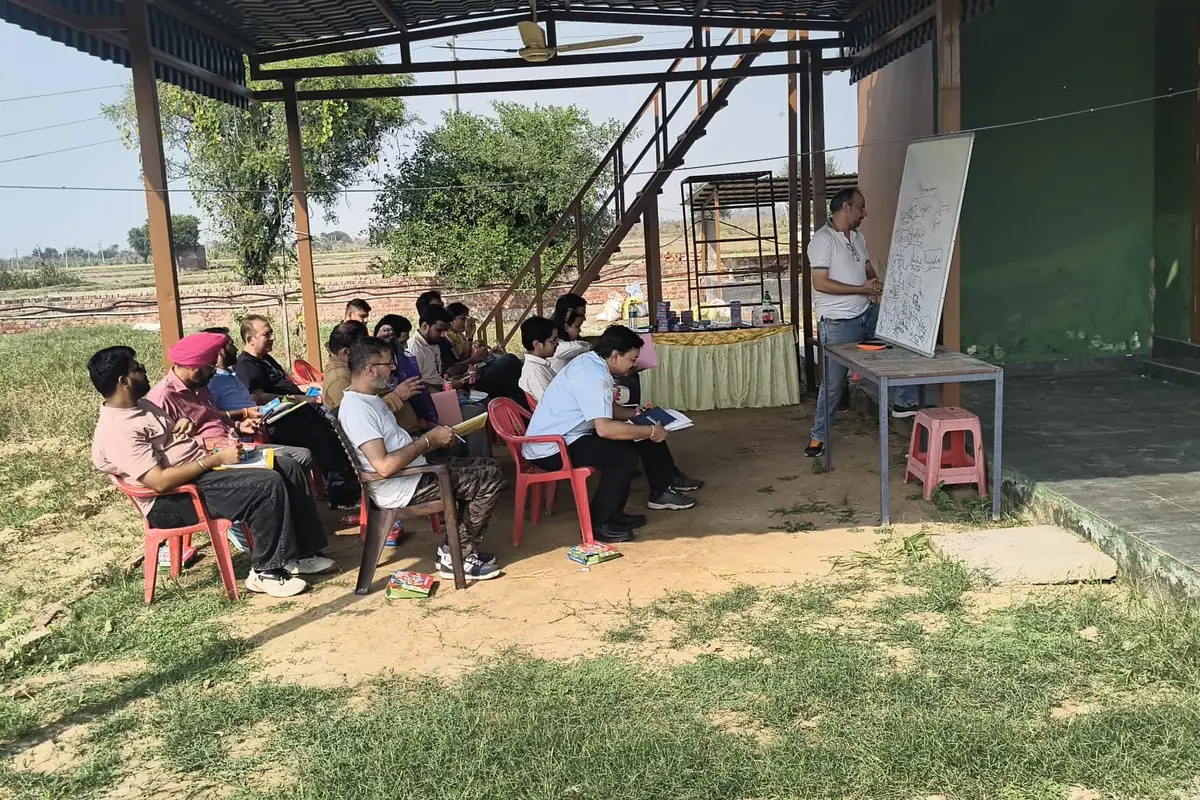
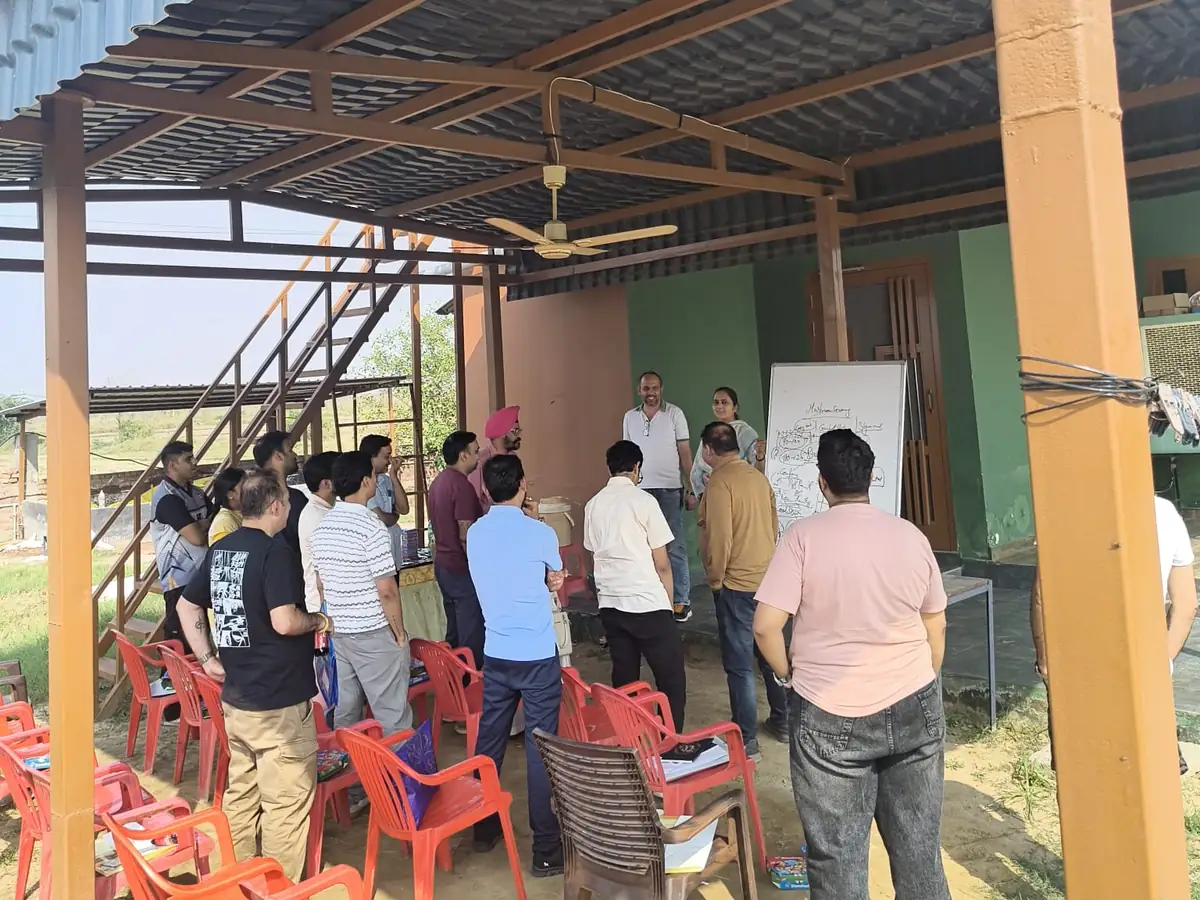
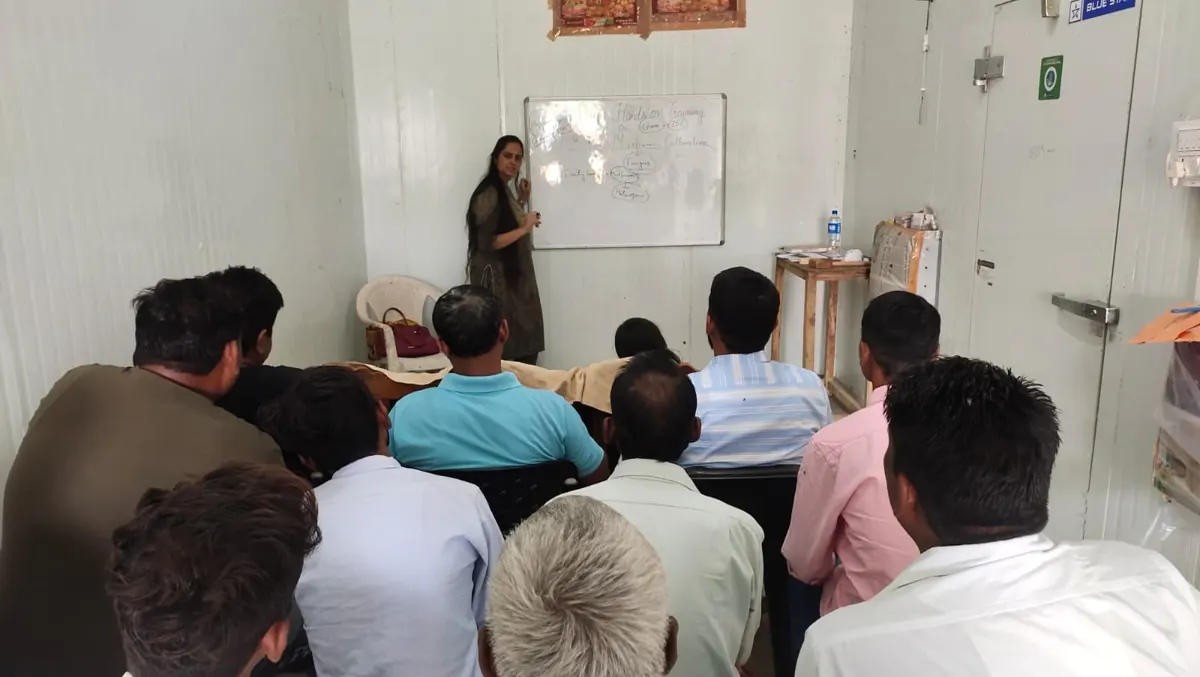
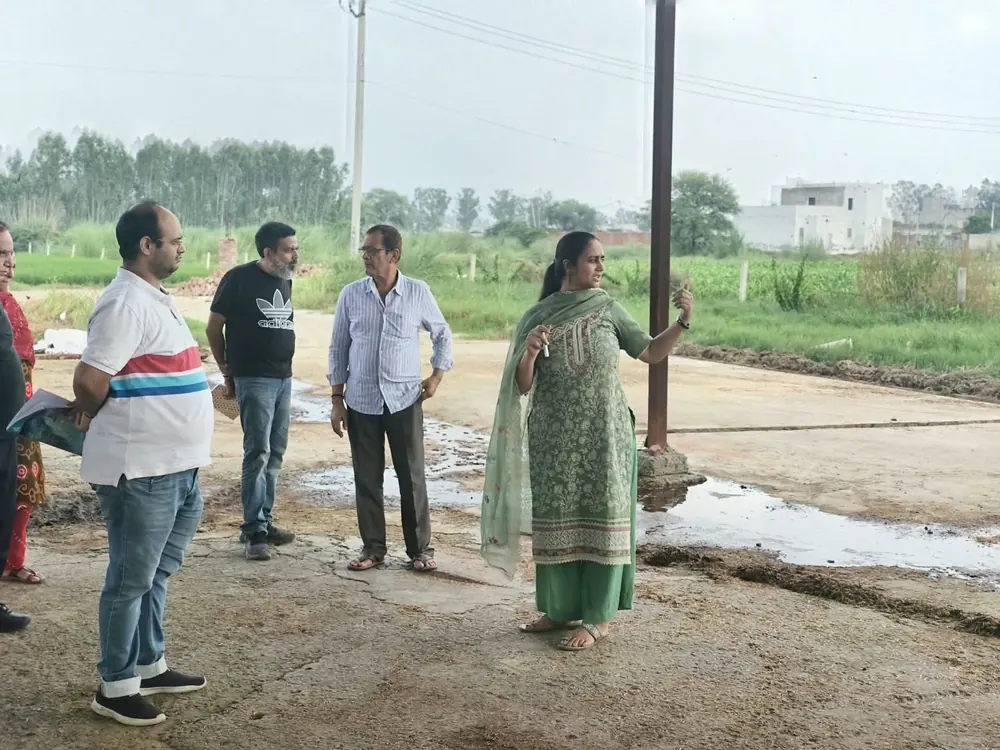
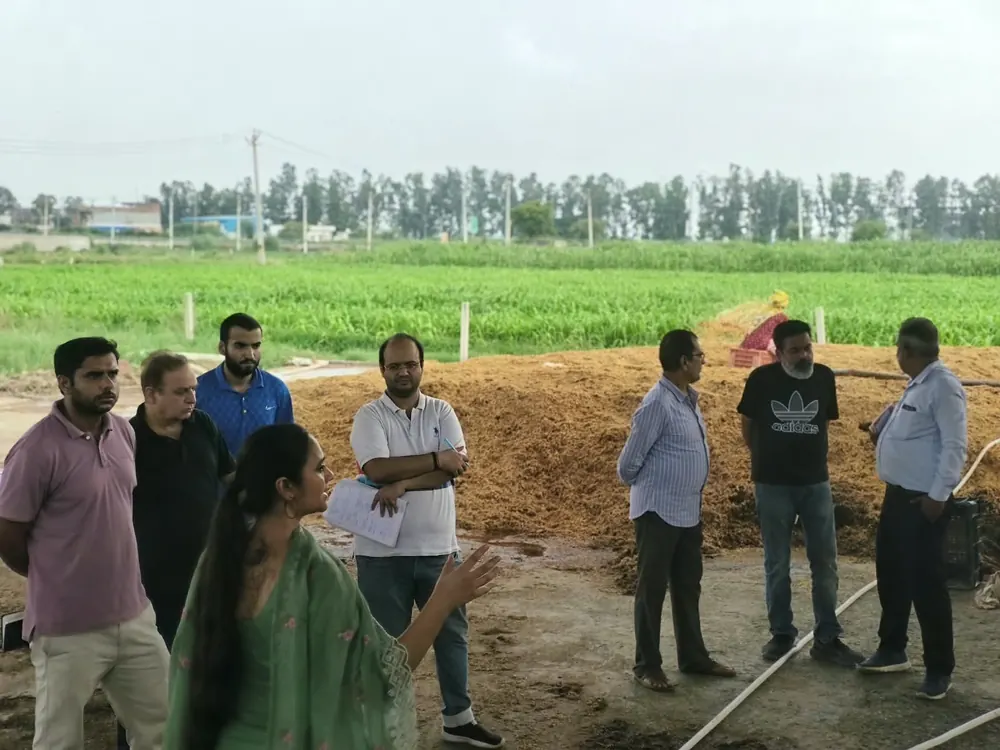
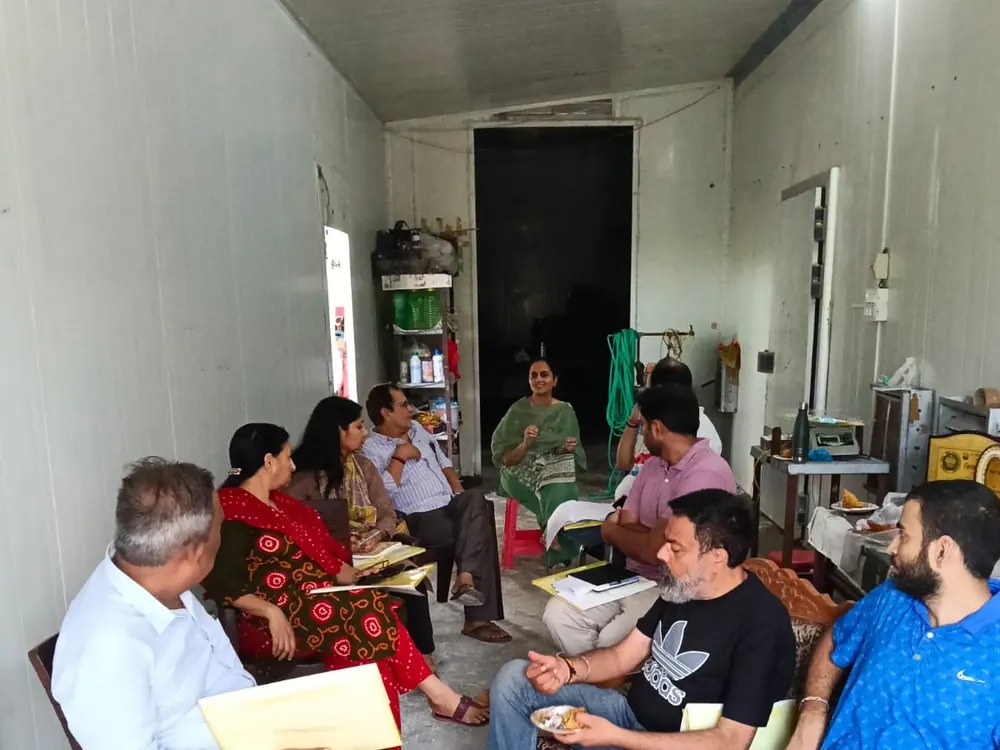
Our most recent farm session ran on Sunday, 25 October 2026. The photos at the top of this page and in the economics section are from that morning, and so is the first one below; the rest are from earlier batches at the farm. Tap any photo to see it larger.
Farm training or online course?
They teach the same syllabus and come with the same certificate. The farm training adds the farm; the online course adds reach, a longer session and an hour one-to-one.
| What you get | At our farm — ₹2,000 | Online — ₹1,499 |
|---|---|---|
| What you learn | The same syllabus: the biology of the crop and the economics of a unit | |
| How it is taught | On a working farm, in front of the crop | Live on screen, with slides and farm footage |
| Length | 2 hours, 11 AM – 1 PM | 3 hours, 10 AM – 1 PM, including an hour one-to-one |
| Next session | 6 December 2026 (Sunday) | 29 November 2026 (Sunday) |
| Where | Barwasni, Sonipat, Haryana | Anywhere in India |
| Certificate | A digital certificate signed by Dr. Sonia Dahiya | |
| Best if | You can reach Sonipat and want to see it first-hand | You cannot travel to Haryana |
Put plainly: if you can get to Sonipat, come to the farm. Watching compost turned and a flush picked fixes things in your memory that no slide can. If you cannot, the online course teaches the same material, and distance should not be the reason anyone does not learn. Many people take the online course first and visit the farm before they build.
See the online course syllabus, module by module →
How to reach the farm
Dr. Dahiya Mushroom Farm, V.P.O Barwasni, opposite Guru Sadan School, District Sonipat, Haryana 131001. Sonipat is about an hour and a half from Delhi by road. The session starts at 11 AM, so plan to arrive a few minutes early.
Common questions
When is it and how long?
6 December 2026 (Sunday), 11 AM to 1 PM: two hours at the farm. Sessions run on one Sunday a month.
Is the syllabus the same as the online course?
Yes. Both teach the biology of the button mushroom crop and the economics of running a unit. The farm training adds the farm itself: you see the compost, the growing rooms, a live crop and the packing table first-hand.
Will I see mushrooms growing?
Usually, yes. What stage the crop is at depends on the farm’s crop calendar that week: you may see bags in spawn run, a fresh casing layer, pinheads or a flush being picked. Any stage that is not on show is taught under the teaching shed with the same figures.
Do I need any experience?
No. Most people who come are deciding whether to start a unit, or are partway through setting one up.
Which mushrooms are covered?
Button mushrooms only: the crop the farm grows commercially. Oyster, milky and other varieties are not part of the training.
Do I get a certificate?
Yes. The farm training comes with a digital certificate signed by Dr. Sonia Dahiya.
What should I bring?
A notebook, your questions, and rough figures for your own plan if you have them: the space you have, your budget and where you would sell. The session is most useful when you can ask about your own situation.
Can I bring someone with me?
Yes. Book the number of seats you need in the booking section, or call us and we will arrange it.
Is there a group option for students?
Yes, separately. See the educational farm visit for schools and colleges.
Book your seat at the farm
₹2,000 · 6 December 2026 (Sunday), 11 AM – 1 PM · at our Sonipat farm.
Cannot travel to Haryana? Take the live online course instead, read the free Button Mushroom Booklet, or browse training guides for your city.