Chapter 6 · Cool down, pinning & crop care
Up to this point the mycelium has been growing: through the compost during spawn run, then up into the casing. Now it has to change its whole behaviour and start producing mushrooms. What tells it to do that is a change of climate, which growers call the cool down or airing: the room is cooled, fresh air is let in, and the carbon dioxide that has been allowed to build up is flushed out. Get this switch right and you get an even carpet of pinheads. Get it wrong and you get too few, too many, or mushrooms in the wrong places.
After the switch comes the longest part of the crop, three to four weeks of cropping in which the room has to be held steady while it carries a changing load of mushrooms. This chapter covers both, ending with the routine we follow every day in a cropping room.
The signalWhy cooling down makes mushrooms form
In nature, the button mushroom fruits when the warm, still air of late summer gives way to cooler, fresher autumn air. The mycelium has spent the warm months spreading through decaying material underground, where carbon dioxide is high; when it reaches the surface and meets cool air low in CO₂, it takes that as the signal that it is in the open, where spores can be released, and it starts to form mushrooms. A growing room recreates that moment on purpose: warm and stuffy during spawn run and case run, then cool and fresh.
That is why both parts of the change matter. Lowering the temperature without letting in fresh air gives a weak, uneven pinning. Letting in fresh air while the room stays warm gives mushrooms that grow too fast, open early and invite disease.
Step oneThe cool down
Cool down begins once the case run is complete and the casing has been ruffled and levelled, roughly a week after casing.
- Lower the temperature gradually
Bring the room down from 22–25°C to around 14–18°C, gradually, over a day or two rather than in one shock. Watch the compost temperature as well as the air; the compost lags behind and is what the mycelium actually feels.
- Increase the fresh air
Open the fresh-air supply so that the stale, CO₂-rich air of the case run is replaced. Fresh air circulation is increased steadily through this period.
- Bring CO₂ down to about 1,000 ppm
Use the CO₂ meter, not guesswork. The level falls as fresh air comes in; aim for around 1,000 ppm during cool down.
- Hold the humidity up
Fresh air is drier than the air in a closed room, and cool, moving air dries the casing quickly. Keep relative humidity at 85–90%, so the casing surface stays moist enough for pins to form at the top.
Case run (before)
- Temperature
- 22–25°C
- Humidity
- 85–90%
- Fresh air
- Low
- CO₂
- Allowed to build
Cool down
- Temperature
- down to 14–18°C
- Humidity
- 85–90%
- Fresh air
- Increased
- CO₂
- About 1,000 ppm
Pinning
- Temperature
- 14–18°C
- Humidity
- 85–90%
- Fresh air
- Good ventilation
- CO₂
- 800–1,000 ppm
Cropping
- Temperature
- 14–18°C
- Humidity
- 85–90%
- Fresh air
- Rising with the crop
- CO₂
- Below about 1,000 ppm
Step twoPinhead formation
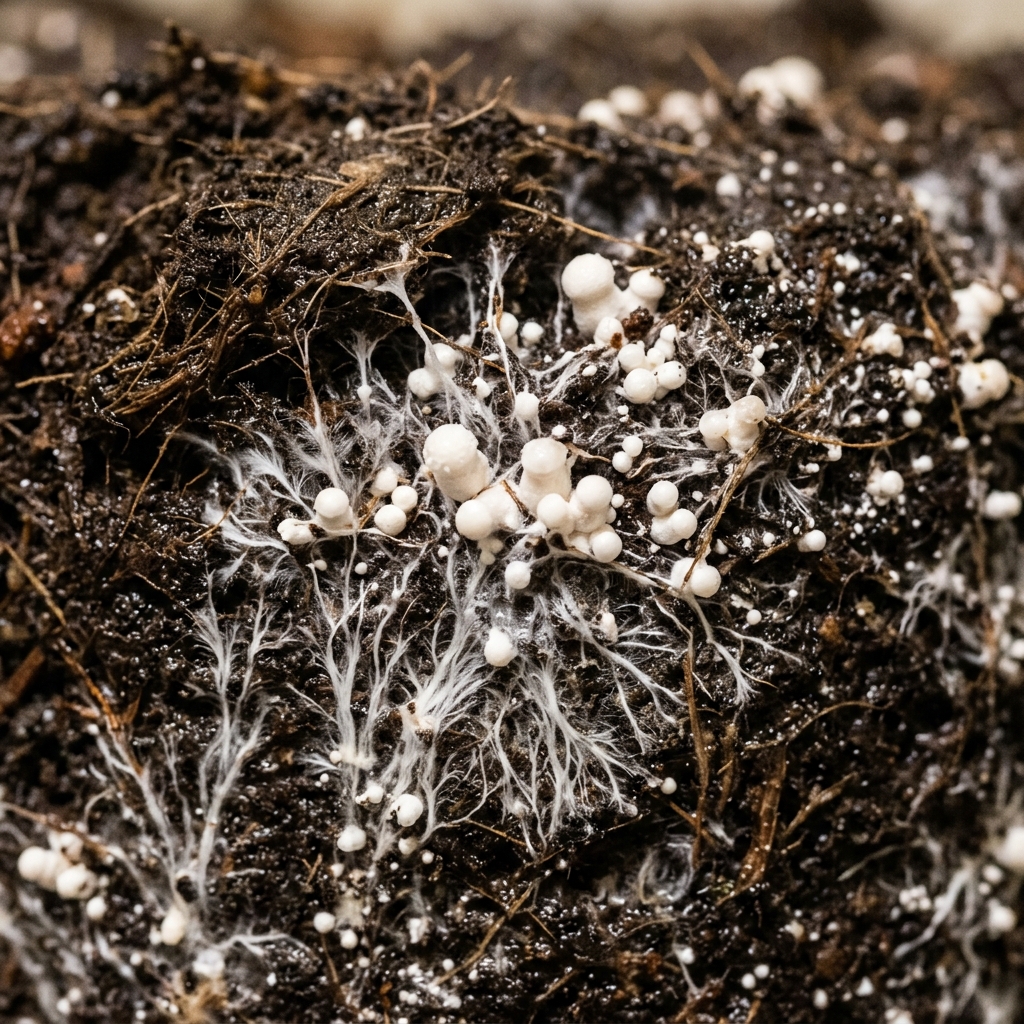
A few days after cool down, small pin-like structures begin to appear in the casing. These are the pinheads, the beginnings of mushrooms. At first they are tiny white dots; within days they swell to the size of a pea, and then into buttons. Conditions during this period are:
- temperature: 14–18°C;
- relative humidity: 85–90%;
- fresh-air ventilation, with CO₂ at 800–1,000 ppm.
Reading the pinning
The pattern of pinheads tells you how well the cool down went, and it is worth learning to read it, because there is still time to correct the climate for the flushes that follow.
| What you see | Likely cause | Correction |
|---|---|---|
| Few pins, late | CO₂ still too high, room too warm, or casing too dry | More fresh air, check temperature and casing moisture |
| Very many pins in crowded clumps | Cool down too sudden, casing too thin, or ruffling missed | Cool more gradually next time; lay casing evenly; ruffle |
| Pins forming deep in the casing | Casing surface too dry, or air too dry | Raise humidity, water the casing lightly |
| Even carpet of separate pins | A good cool down | Hold the climate steady |
The long stretchCrop growth and management
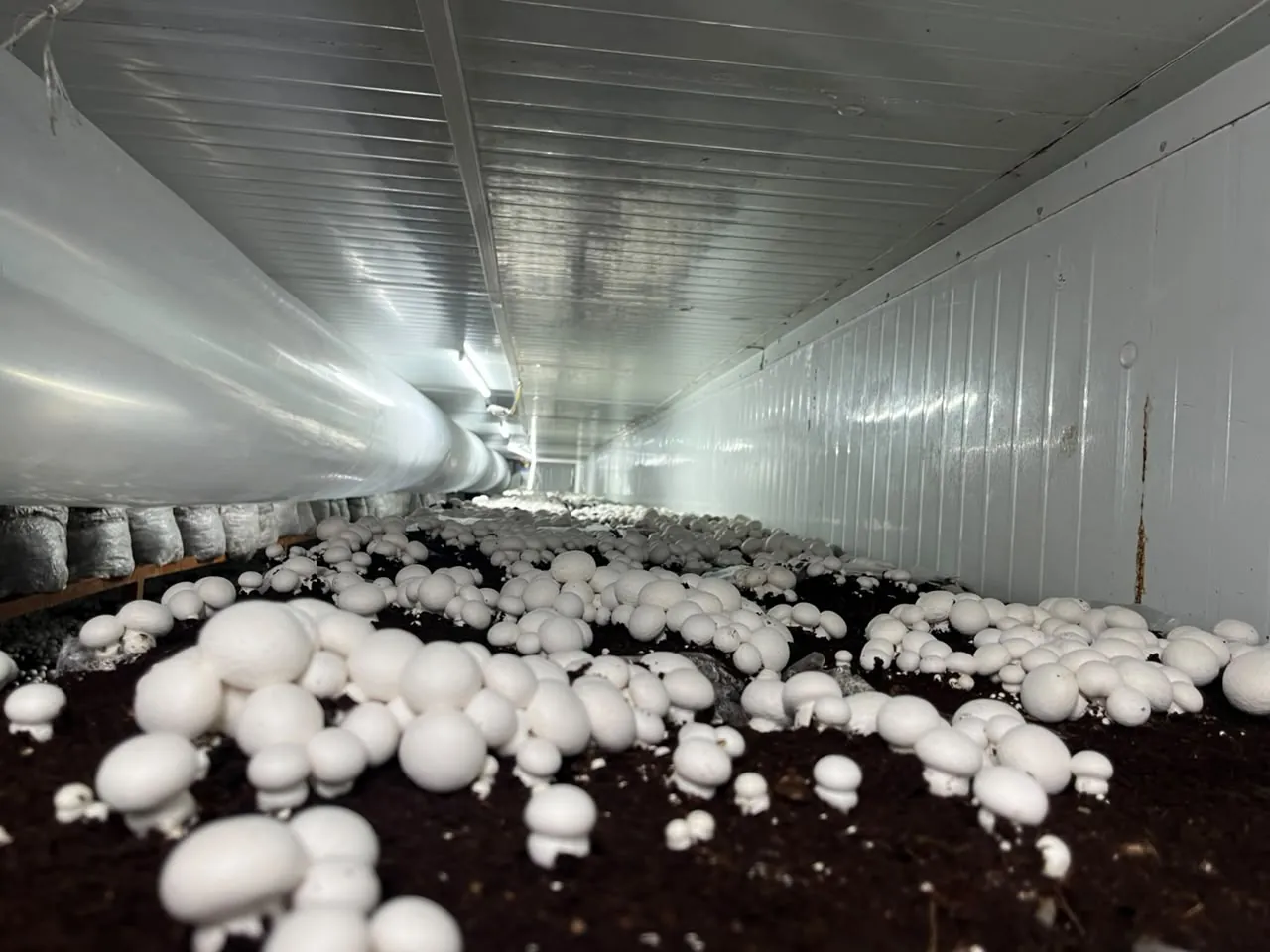
Mushrooms grow rapidly after pinning, and the room's needs change as they do. A bed carrying a full flush of mushrooms gives off far more heat, moisture and carbon dioxide than a bed of pins, so the climate settings that were right yesterday may not be right today. Good crop management comes down to four things: holding temperature and humidity, light and regular watering, ventilation to remove excess carbon dioxide, and constant watching for disease and pests.
Temperature
Hold the room at 14–18°C and keep it even across all the tiers. Warmer than that, mushrooms grow fast but soft, the caps open early and lose their value, and diseases such as dry bubble spread faster. Colder, growth slows and the flush drags on. Uneven temperature between the top and bottom tiers is a sign that air is not circulating well.
Humidity
Keep relative humidity at 85–90%. If it falls too low, the casing dries and the mushroom caps become scaly and cracked. If it is too high for too long, especially if water condenses on the caps, bacterial blotch follows. The aim is a room that is humid but never dripping.
Ventilation and carbon dioxide
Every mushroom in the room is breathing out carbon dioxide. If it builds up, the mushrooms respond by stretching: long stems, small caps and early opening, which are exactly the opposite of what the market pays for. Keep fresh air coming in to hold CO₂ below about 1,000 ppm, and increase it as the flush builds. Move air through the room evenly, but do not blow it directly across the beds, which dries and marks the caps.
A craft to learnWatering the crop
Watering is the part of cropping that takes longest to learn, because the right amount depends on the casing, the stage of the flush and the room's humidity, and it changes from day to day. The principles are simple, though. Water lightly and regularly, and avoid overwatering.
- Little and often. Several light waterings with a fine spray are better than one heavy one. Water should wet the casing, not run through into the compost.
- Go gently on young pins. Heavy watering on tiny pinheads can damage or kill them. Water more as they reach pea size and beyond.
- Water after picking. Each flush draws water from the casing; restore it after the flush is picked, to set up the next one.
- Let the caps dry. After watering, run the air so that the mushroom caps dry within a couple of hours. Water standing on caps is the main cause of bacterial blotch.
- Do not water just before picking. Wet mushrooms bruise, brown and spoil faster.
- Use clean water from a covered tank that is cleaned between crops.
The rhythmFlushes and breaks
Button mushrooms do not appear continuously. They come in waves called flushes, and several flushes are obtained from one crop. A flush grows, is picked over a few days, and then there is a short break of about a week before the next flush appears. A crop usually gives three or four flushes over three to four weeks of picking, and the first two flushes usually give most of the total.
Between flushes, clear away stumps, broken pieces and small dead pins from the casing; anything left on the bed rots and feeds disease. Restore the casing moisture with careful watering, and keep the climate steady. The break is also the best time to look closely for any spots of disease, because there are fewer mushrooms in the way.
Every dayA daily routine for a cropping room
| When | Task |
|---|---|
| First thing | Read and record air temperature, compost temperature, humidity and CO₂. Adjust cooling and fresh air. |
| Morning | Walk the room and look at every tier for disease spots, flies and unusual growth. Then pick the mushrooms that are ready. |
| After picking | Clear stumps and debris. Water where the casing needs it. Run air to dry the caps. |
| Afternoon | Check the climate again at the hottest time of day, when cooling is most likely to fall behind. |
| Evening | Final readings and notes: what was picked, any disease, any change you made. |
The notebook matters more than it seems. When a flush disappoints, the notes are usually where you find why: a hot afternoon three days earlier, a day with too little fresh air, a heavy watering on pinheads.
Visit rooms in order of age each day: the youngest crops first, and the oldest, most disease-prone rooms last. Never go from a room at the end of its crop into one that has just pinned.
Closing the roomEnding the crop
When yields fall away after the last worthwhile flush, the crop is finished. Do not be tempted to keep an old room going for a few more kilos: an ageing crop is where diseases and pests multiply, and from there they reach your younger rooms. Many commercial farms first "cook out" a finished room, heating it with steam to kill pests and disease before anything is moved. Then the spent compost is emptied out through the dirty exit and taken well away from the farm, and the room, racks and floor are washed and disinfected before the next fill.
Spent compost is not waste. It is a valuable organic manure for fields and gardens, and many growers sell it or use it on their own land. Our article on spent mushroom substrate describes its uses.
FAQQuestions about cropping
What temperature do button mushrooms need to fruit?
Button mushrooms fruit at 14 to 18 degrees Celsius with relative humidity of 85 to 90 percent. The room is cooled gradually to that range from the 22 to 25 degrees used during spawn run and case run, which is what triggers pinning.
What is cool down or airing in mushroom farming?
Cool down, also called airing, is the change of climate that makes the mycelium start forming mushrooms. After the case run and ruffling, the room temperature is lowered gradually to about 14 to 18 degrees Celsius, fresh air is increased, and carbon dioxide is brought down to around 1,000 ppm.
What CO2 level is right for button mushroom cropping?
Keep carbon dioxide at about 800 to 1,000 ppm during pinning and below about 1,000 ppm while cropping. Higher levels give long stems, small caps and early opening, so fresh air is increased as each flush builds.
How often should button mushroom beds be watered?
Water lightly and regularly with a fine spray, rather than heavily. Go gently on very small pins, water more as they grow, restore the casing moisture after each flush is picked, and always let the caps dry within a couple of hours to prevent bacterial blotch.
How many flushes does a button mushroom crop give?
A crop usually gives three or four flushes over three to four weeks of picking, with a break of about a week between flushes. The first two flushes usually give most of the total yield.
Why do my button mushrooms have long stems and small caps?
Long stems, small caps and early opening are the classic signs of too much carbon dioxide in the room. Increase the fresh air, check that air is circulating evenly through all the tiers, and keep the temperature within 14 to 18 degrees Celsius.

Written by Dr. Sonia Dahiya
PhD in biotechnology and founder of Dr. Dahiya Mushroom Farm (Shroomy Delights Agro Tech) in Barwasni, Sonipat, known as the “Mushroom Lady of Haryana”. This booklet comes from her years of growing, training and helping farmers set up button mushroom units. About Dr. Sonia →