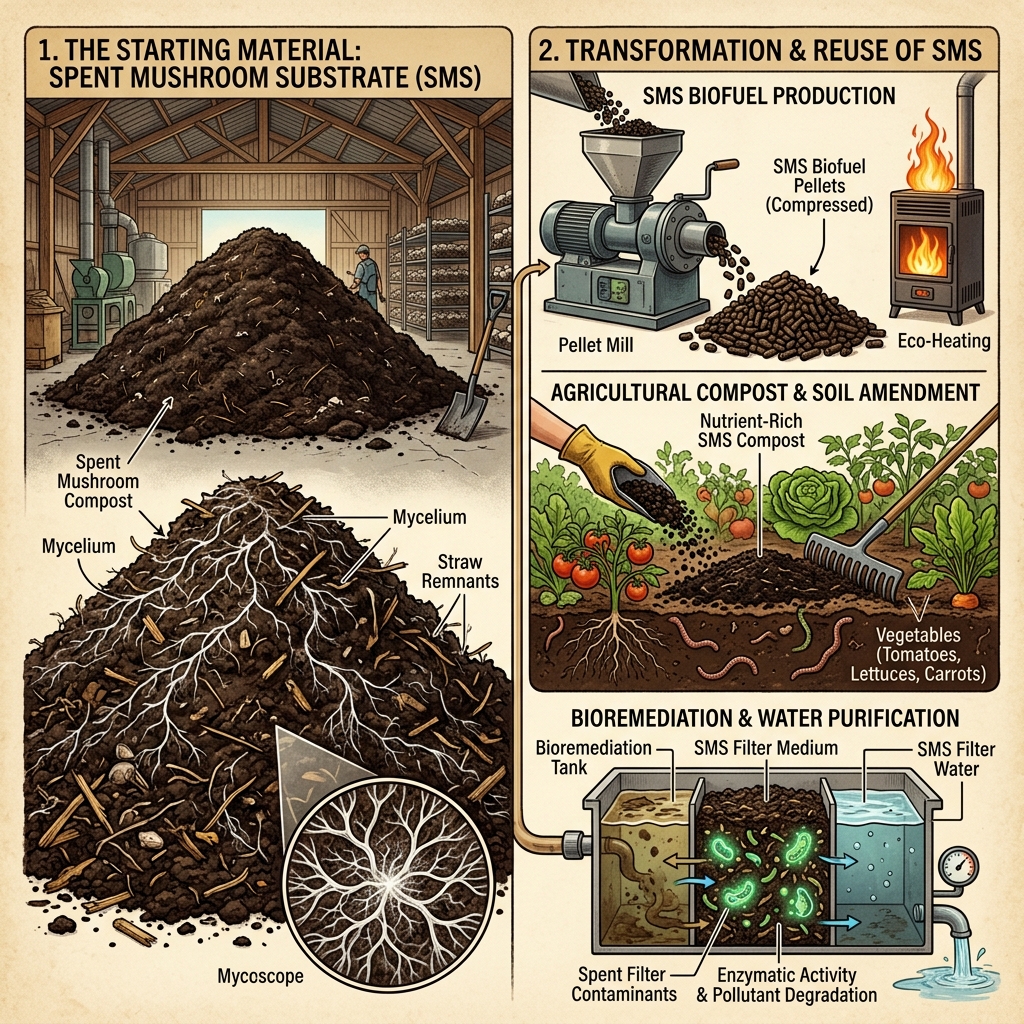
For Every 1 kg of Mushrooms, Farmers Leave Behind 5 kg of Highly Specialised "Waste"
When a crop of button mushrooms is done — after the final flush has been picked and yields have tapered off — the compost isn't completely empty. It's still a dark, dense, biologically active mass permeated with spent mycelium, partially degraded straw, residual peat from the casing layer, and billions of dormant microorganisms. But it is no longer economically viable for the farmer to keep using it for another mushroom cycle.
This leftover material is called Spent Mushroom Substrate (SMS), and for every 1 kilogram of fresh mushrooms harvested, approximately 5 kilograms of SMS are generated. That ratio means a single commercial farm producing 10 tonnes of mushrooms per cycle generates 50 tonnes of SMS as a byproduct.
What Exactly Is Inside SMS?
Spent Mushroom Substrate is not ordinary compost. It has been through a unique biological transformation that no other agricultural waste product undergoes. By the time the mushrooms are done with it, SMS contains:
- Residual mushroom mycelium — a dense network of fungal hyphae packed with enzymes, particularly laccase, manganese peroxidase, and lignin peroxidase
- Partially degraded lignocellulose — the structural polymers of the original wheat straw that were partially broken down during the mushroom growth cycle but not fully consumed
- Humic substances — complex organic molecules formed during composting that improve soil structure and water retention
- Beneficial thermophilic bacteria — survivors from Phase II composting that continue to provide microbial activity
- Peat moss and coco coir — from the casing layer, providing additional organic matter
- Gypsum (calcium sulfate) — a mineral additive from the original composting recipe that provides calcium and sulfur
This combination of active enzymes, partially processed biomass, and stabilized organic matter makes SMS uniquely suited for applications that no other agricultural waste can match.
1. The Super-Sponge for Environmental Pollution (Bioremediation)
The most scientifically exciting application of SMS is in bioremediation — using biological organisms to clean up environmental contamination. The secret weapon is the residual laccase enzyme that remains active in the spent mycelium long after the mushrooms have been harvested.
Laccase (EC 1.10.3.2) is a copper-containing oxidoreductase enzyme that is extraordinarily effective at breaking down complex, toxic chemical bonds. In nature, white-rot fungi (the group that includes Agaricus bisporus) use laccase to decompose lignin — the tough structural polymer in wood. But laccase is remarkably non-specific in what it can attack. Environmental scientists have discovered that when SMS is mixed into polluted soil or water, the laccase enzymes can literally digest:
- Industrial textile dyes — particularly azo dyes and anthraquinone dyes that are major water pollutants near garment factories. Laccase cleaves the chromophoric bonds that give these dyes their color, rendering them colorless and non-toxic
- Agricultural pesticides — organophosphates and carbamates that accumulate in soil after years of intensive farming. SMS-derived laccase breaks these molecules into simpler, non-toxic metabolites
- Polycyclic aromatic hydrocarbons (PAHs) — persistent organic pollutants found at petroleum-contaminated sites, former gas stations, and industrial zones. Research published in Journal of Hazardous Materials showed that SMS can reduce PAH concentrations by 60–80% within 90 days
- Pharmaceutical residues — endocrine disruptors like bisphenol A (BPA) and antibiotics that pass through wastewater treatment plants unchanged. Laccase can oxidize these compounds, preventing them from entering rivers and drinking water
- Hydrocarbon oil spills — SMS has been successfully used in pilot programs to break down crude oil components in contaminated soil
The beauty of SMS-based bioremediation is that it is passive. Unlike chemical remediation (which requires expensive reagents and energy), you simply spread SMS over or mix it into the contaminated material, and the enzymes do the work over weeks to months. The cost is a fraction of conventional cleanup methods.
2. The Biofuel and Bioenergy Revolution
Because SMS consists of dense lignocellulosic biomass — straw and corn cobs that have already been partially broken down by the mushrooms — it is a prime candidate for energy production. The partial degradation is actually an advantage: it means less pre-processing is required compared to raw agricultural waste.
Bio-Pellets for Green Heating
Modern facilities are drying SMS and compressing it into high-efficiency bio-pellets for use in biomass boilers and green energy heating systems. These pellets have a calorific value of approximately 14–17 MJ/kg (comparable to wood pellets at 17–20 MJ/kg), making them a viable solid fuel. Several mushroom farms in Europe are already using SMS pellets to heat their own growing rooms, creating a closed-loop energy system where the waste from one crop provides the heat for the next.
Biogas via Anaerobic Digestion
When SMS is fed into anaerobic digesters — sealed tanks where microorganisms break down organic matter in the absence of oxygen — it produces renewable methane gas (biogas). Research from Wageningen University in the Netherlands showed that co-digesting SMS with other organic waste (like food waste or manure) can yield 200–350 litres of biogas per kilogram of volatile solids. This biogas can be burned directly for electricity generation or upgraded to biomethane for injection into the natural gas grid.
The vision is compelling: the very mushroom farms that produce SMS could use anaerobic digestion to convert their waste into the energy that powers their own operations — composting tunnels, climate-controlled growing rooms, refrigeration, and packaging — achieving near-complete energy self-sufficiency.
3. "Weathered" SMS: The Ultimate Soil Conditioner
Fresh SMS cannot be applied immediately onto sensitive garden plants or agricultural fields. The reason is that its mineral content — particularly soluble salts (electrical conductivity of 5–10 dS/m) and high pH (7.5–8.5) — can shock plant roots and inhibit germination. This is the single biggest mistake home gardeners make with SMS: using it fresh.
The solution is a process called "weathering". Industrial farms and composting facilities now stockpile SMS outdoors for 3–6 months, allowing rain to naturally leach out the excess salts. During this period:
- Electrical conductivity drops from 8–10 dS/m to 2–3 dS/m — safe for all but the most salt-sensitive plants
- pH stabilizes around 6.5–7.0 — ideal for most vegetable crops
- Residual ammonia is fully converted to stable nitrate nitrogen by nitrifying bacteria
- Humic acid content increases as remaining organic matter continues to humify
The resulting weathered mushroom compost is treated as liquid gold in commercial gardening. It is a dark, crumbly, odorless material with exceptional properties:
- Water retention — can hold up to 70% of its weight in water, reducing irrigation needs by 30–40%
- Soil structure — dramatically improves clay-heavy soils by increasing porosity and reducing compaction
- Beneficial microbes — introduces a diverse community of saprophytic fungi and bacteria that suppress soil-borne diseases like Pythium and Fusarium
- Slow-release nutrients — provides NPK at approximately 1.5:0.5:1.0, plus calcium, magnesium, and trace minerals from the original gypsum and compost recipe
- Crop yield increases of 10–18% have been documented in field trials with tomatoes, peppers, and leafy greens when weathered SMS is used as a soil amendment
The Circular Economy Vision
The transformation of SMS from "waste problem" to "valuable resource" represents a perfect example of the circular economy in agriculture. The flow looks like this:
Wheat straw → Composting → Mushroom growth → SMS → Bioremediation / Biofuel / Garden compost → Soil → New crops → Straw → Back to composting
At Dr. Dahiya Mushroom Farm, we manage our SMS through a combination of weathered composting for local agricultural use and partnerships with organic farming cooperatives in Haryana. None of our SMS goes to landfill — every kilogram is returned to the agricultural cycle within 6 months of being generated.
The next time you buy a 200-gram pack of fresh button mushrooms, remember: growing that small package also produced a full kilogram of SMS — a material so biologically active that it can clean polluted water, generate electricity, and grow your garden's next season of vegetables. In mushroom farming, there is truly no such thing as waste.