Your Body Has a Dedicated Transporter for a Molecule Only Fungi Make in Quantity
Your body is not sentimental about what it lets in. Most of what you eat is broken down, sorted, and absorbed by general-purpose machinery. Building a dedicated transport protein for one specific molecule is a serious evolutionary investment — it means that molecule mattered enough to justify custom hardware.
Humans have exactly such a transporter for a compound called ergothioneine. We cannot manufacture it. No animal can. It is made almost exclusively by fungi and certain bacteria.
Which raises a genuinely strange question: why would evolution build a specialised door for something we can only obtain by eating fungi?
The Argument From Design
The transporter is the heart of this story, and it is worth being precise about why it is so suggestive.
A cell membrane is a barrier. Getting a molecule across it deliberately requires a protein built for the job — and building and maintaining that protein costs energy and genome space. Evolution does not preserve that kind of machinery for a molecule that does nothing useful.
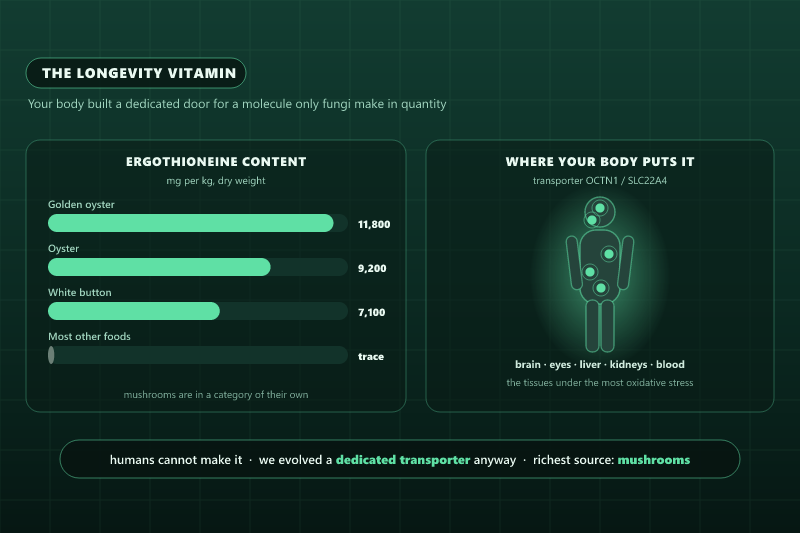
OCTN1 is not a general scavenger. It shows high specificity for ergothioneine, and it does not merely admit it — it accumulates it, holding concentrations inside certain cells well above blood levels. That is the signature of something being deliberately stockpiled.
And look at where it is stockpiled. Not distributed evenly, but concentrated in tissues with a common feature: they are the ones enduring the most oxidative stress.
- The brain — enormous oxygen consumption, high lipid content, easily damaged by oxidation.
- The lens of the eye — lifelong ultraviolet exposure, with proteins that are essentially never replaced.
- The liver and kidneys — the body's detoxification organs, continuously processing reactive compounds.
- Red blood cells — they carry oxygen for a living, which is chemically hazardous work.
A molecule you cannot make, imported by custom machinery, and deposited precisely where oxidative damage is worst. Whatever else is uncertain, that pattern is hard to dismiss as coincidence.
The "Longevity Vitamin" Idea
The biochemist Bruce Ames proposed classifying ergothioneine as a "longevity vitamin" — a category that follows from his triage theory.
The theory runs like this. When a micronutrient is in short supply, the body does not ration it evenly. It triages, allocating the scarce resource to functions needed for immediate survival and reproduction, and starving the functions that only protect you in the long run. The result is that a mild, chronic shortfall produces no detectable deficiency disease at all. You do not get sick. You simply accumulate damage faster, and the consequences arrive decades later as age-related disease.
Under this framing, a "longevity vitamin" is a nutrient with no classical deficiency syndrome, whose absence is invisible in the short term and expensive over a lifetime. Ergothioneine fits the description well: no acute deficiency disease is known, and yet the body clearly treats it as worth capturing.
What the Human Evidence Actually Shows
Here is where care is required, because this topic attracts considerable supplement-industry enthusiasm.
The most striking findings come from blood metabolite studies. In work measuring over a hundred compounds in the bloodstreams of thousands of people and following them for more than twenty years, ergothioneine stood out: among all the compounds measured, it was the one most strongly associated with lower rates of disease and death. Higher blood levels tracked with lower risk of cardiovascular disease and lower all-cause mortality.
That is a genuinely remarkable result. But it must be read correctly, and the limitation is fundamental:
These are observational associations, not proof of cause. People with higher ergothioneine levels eat more mushrooms — and quite likely more vegetables, and quite likely have other habits that independently improve health outcomes. Ergothioneine may be doing the work; or it may be a marker for a dietary pattern that is doing the work. Distinguishing those possibilities requires randomised controlled trials, and the necessary long-term trials in humans have not been completed.
So the accurate statement is this: ergothioneine is a compelling and unusually well-motivated hypothesis — supported by the transporter, by its tissue distribution, and by strong epidemiological associations — but it is not established that supplementing it extends human life. Anyone selling you a capsule on the strength of certainty is ahead of the evidence.
Fortunately, the practical conclusion does not depend on resolving that question. Eating mushrooms is unambiguously good for you regardless, and it is the most reliable way to obtain the compound.
Why Mushrooms Are in a Category of Their Own
Because ergothioneine is made by fungi and certain bacteria, the food supply is lopsided: mushrooms contain a lot, and most other foods contain very little. Figures are usually given on a dry weight basis, which matters — fresh mushrooms are roughly 90% water, so fresh-weight values are far lower.
- Golden oyster mushrooms — around 11,800 mg/kg dry weight in one study of mushrooms cultivated on grape marc
- Oyster mushrooms — around 9,200 mg/kg dry weight
- White button mushrooms — around 7,100 mg/kg dry weight
- Porcini — among the highest of all, though rarely eaten in quantity
- Most other foods — trace amounts at best. Some appears in foods like beans and oats, largely via soil bacteria and fungal associations rather than the plant itself
Two practical points follow. First, content varies substantially with species, strain and growing substrate — the golden oyster figure above comes from mushrooms grown on grape marc, illustrating how much substrate influences the result. Second, ergothioneine is notably heat-stable, so ordinary cooking does not destroy it. Given that cooking also improves the digestibility of chitin-rich mushroom tissue, there is no tension here: cook them properly and you keep the benefit.
Where This Fits With the Rest of the Mushroom
Ergothioneine does not arrive alone, which is part of why whole mushrooms make more sense than isolated capsules. The same food also supplies:
- Vitamin D, which mushrooms generate on exposure to UV light — much as human skin does
- High-quality protein at low calorie density, with all the essential amino acids
- Beta-glucans, the fibres studied for immune and cholesterol effects
- Selenium, copper and B vitamins — with button mushrooms an unusually good non-meat source of several
- Glutamate and guanylate, which is why they multiply the savouriness of everything around them
What It Means for What We Grow
For a mushroom farm, this is the most quietly encouraging fact on this site.
- The everyday mushroom is the point. Ergothioneine is not confined to rare or expensive medicinal species. The ordinary white button mushroom is a rich source. Whatever benefit is on offer here is available from a routine, affordable vegetable — not a boutique supplement.
- Oyster mushrooms are exceptional. They sit at the top of the measured range, which adds to an already strong case for a crop that grows on agricultural waste and suits small farms.
- Substrate may shape nutritional value. That grape-marc result hints at something genuinely interesting for growers: what we feed the mycelium may influence not just yield but the nutritional profile of the harvest. This is an open area, and worth watching rather than overclaiming.
- It reframes the humble mushroom. Mushrooms are often treated as a garnish — texture and flavour, little more. In truth they are the principal dietary source of a compound your body built specialised machinery to capture and hoard.
Somewhere in your evolutionary past, fungi were a reliable enough part of the diet that keeping a dedicated door open for one of their molecules was worth the cost. That door is still there, in every one of your cells, still working.
It seems a shame to leave it unused.