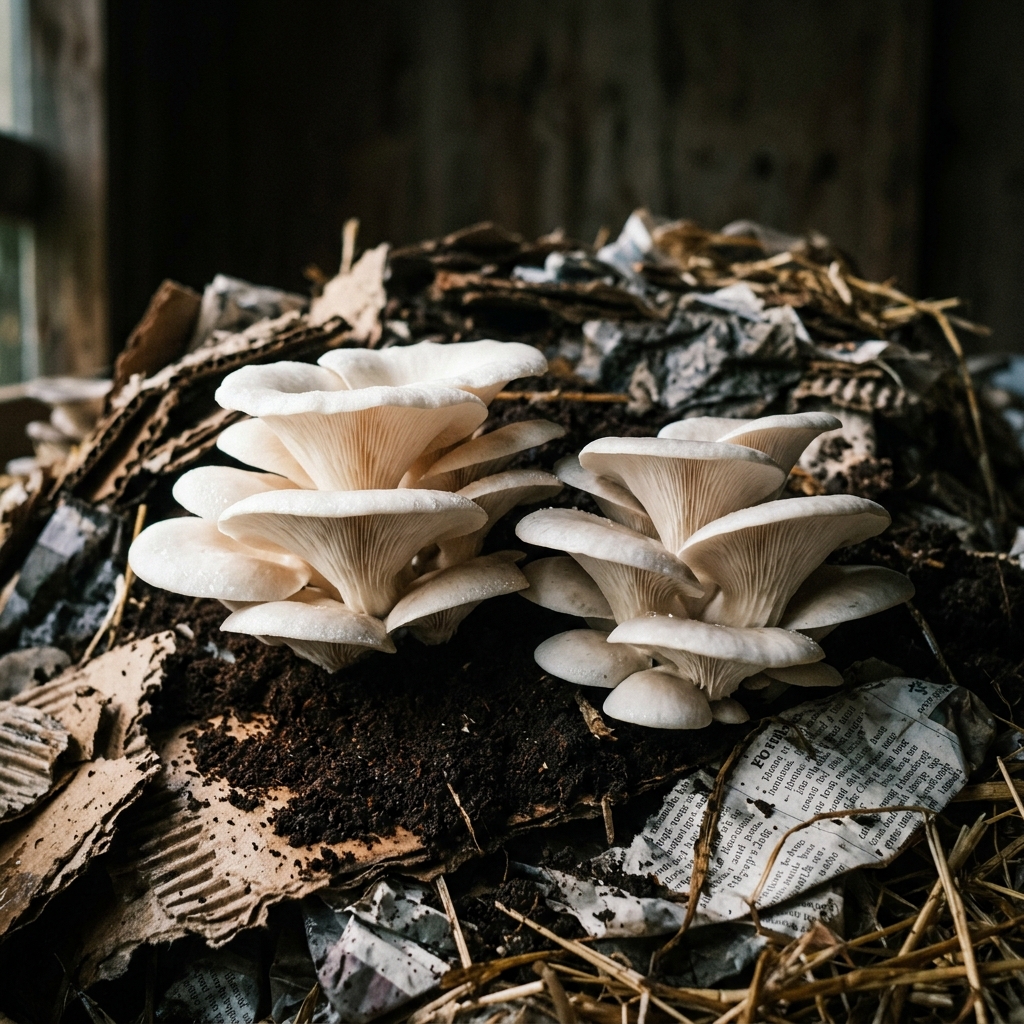
Oyster Mushrooms Can Grow on Your Morning Trash — Their Digestive System Is That Aggressive
Think about everything you threw away this morning. Your used coffee filter and grounds. The cardboard sleeve from your takeaway cup. The newspaper you skimmed. The paper towels you dried your hands with. Maybe a banana peel, some egg carton fragments, or the cardboard packaging from your cereal box. Now consider this: every single one of those items can serve as a perfectly good meal — and growing medium — for the oyster mushroom (Pleurotus ostreatus). It will eat them all, convert them into its own body mass, and produce a flush of beautiful, edible mushrooms in return.
The Enzyme Arsenal: Nature's Most Powerful Chemical Drill
To understand why oyster mushrooms can eat practically anything organic, you need to understand the enzymes they secrete. Unlike animals, fungi don't have stomachs. They practice external digestion — they secrete enzymes outside their bodies, directly onto their food source, and then absorb the broken-down molecules through their cell walls. The oyster mushroom's enzyme toolkit is one of the most powerful external digestive systems ever evolved.
The Three Key Enzymes
- Laccase: A copper-containing oxidase enzyme that catalyses the oxidation of a wide range of phenolic and non-phenolic compounds. Laccase is the oyster mushroom's "Swiss Army knife" — it can attack an extraordinarily broad spectrum of chemical bonds, which is why it works on so many different substrates. It is effective against lignin substructures, synthetic dyes, polycyclic aromatic hydrocarbons (PAHs), and even some pesticides.
- Manganese peroxidase (MnP): An enzyme that uses hydrogen peroxide and manganese ions to generate highly reactive free radicals. These radicals act like molecular "blowtorches," attacking and breaking apart the complex, three-dimensional structure of lignin. MnP is one of the very few enzymes in nature capable of depolymerising lignin — a molecule so resistant to biological attack that it can persist in soil for centuries.
- Versatile peroxidase (VP): A hybrid enzyme unique to certain white-rot fungi, including Pleurotus species. VP combines the catalytic capabilities of both lignin peroxidase and manganese peroxidase into a single molecule, giving it an even broader substrate range. It can oxidise compounds that neither MnP nor standard lignin peroxidase can handle alone.
Together, these three enzyme families give the oyster mushroom the biochemical equivalent of a universal acid — a digestive system that can break apart virtually any complex organic molecule it encounters. This is not an exaggeration: published research has documented Pleurotus ostreatus successfully degrading compounds as diverse as cellulose, hemicellulose, lignin, synthetic dyes, polychlorinated biphenyls (PCBs), polycyclic aromatic hydrocarbons (PAHs), phenols, and various petroleum hydrocarbons.
The Menu: What Can Oyster Mushrooms Actually Eat?
The list of substrates on which Pleurotus ostreatus has been successfully cultivated reads like the contents of a rubbish bin. Here is a documented — and by no means exhaustive — inventory:
Household Waste
- Coffee grounds: Spent coffee grounds are nitrogen-rich (approximately 2% nitrogen by dry weight), pre-sterilised by the brewing process, and have a fine, moist texture that mycelium loves. Oyster mushrooms colonise coffee grounds rapidly — often producing a first flush within 3–4 weeks. Several commercial operations worldwide now collect spent coffee grounds from cafés and restaurants specifically for oyster mushroom cultivation.
- Cardboard and paper: Corrugated cardboard is almost pure cellulose and hemicellulose — essentially pre-processed wood fibre. Oyster mushrooms devour it with enthusiasm. Newspaper, office paper, paper towels, and egg cartons all work. The inks used in modern newspaper printing are soy-based and non-toxic, so they pose no contamination risk.
- Used tea bags: Like coffee grounds, tea leaves are rich in organic compounds and are readily colonised by Pleurotus mycelium. The paper of the tea bag itself is an additional cellulose bonus.
- Cotton clothing and textiles: Cotton is pure cellulose. Old cotton T-shirts, towels, and jeans can all serve as mushroom substrate (after removing synthetic components like polyester blends, zippers, and buttons).
Agricultural Waste
- Wheat straw: The most commonly used commercial substrate for oyster mushroom cultivation worldwide. India alone generates over 140 million tonnes of wheat straw annually, much of which is burned in the open — contributing to the catastrophic air pollution crisis in northern India every winter. Growing oyster mushrooms on this straw is a direct, practical alternative to burning.
- Rice straw and husks: Widely used in South and Southeast Asian oyster mushroom cultivation.
- Corn cobs and stalks: Excellent substrates due to their high cellulose and hemicellulose content.
- Sugarcane bagasse: The fibrous residue left after sugarcane crushing — a massive waste product of the Indian sugar industry that oyster mushrooms readily consume.
- Sawdust and wood chips: From virtually any hardwood species. Oyster mushrooms are among the few cultivated mushrooms that can fruit directly on fresh, uncomposted sawdust.
- Banana pseudostems and leaves: Abundantly available in tropical India and an excellent oyster mushroom substrate.
The Truly Extreme Substrates
This is where the oyster mushroom's digestive powers become genuinely astonishing:
- Cigarette filters: Cigarette butts are the single most littered item on Earth — an estimated 4.5 trillion are discarded annually. The filters are made of cellulose acetate, a synthetic plastic derivative that takes 10–15 years to decompose naturally. Researchers at institutions including the Royal Melbourne Institute of Technology and the University of Maine have demonstrated that oyster mushroom mycelium can be "trained" to colonise and break down cigarette filters, including the trapped tar and nicotine residues, converting them into fungal biomass. The resulting mushrooms are not safe for human consumption (due to accumulated toxins), but the process offers a promising waste-management pathway.
- Used disposable diapers: A single disposable diaper takes an estimated 500 years to decompose in a landfill. Researchers have shown that Pleurotus ostreatus can colonise and significantly reduce the mass and volume of used disposable diapers by breaking down the cellulose, cotton, and superabsorbent polymer components. Again, the resulting mushrooms are not intended for consumption, but the waste-reduction potential is enormous — India alone generates an estimated 9.5 million tonnes of diaper waste annually.
- Petroleum-contaminated soil: In one of the most famous experiments in mycoremediation history, mycologist Paul Stamets collaborated with Battelle Laboratories to test whether oyster mushroom mycelium could clean up soil contaminated with diesel fuel. Four piles of petroleum-soaked soil were treated with different methods: bacteria, bacteria+enzymes, chemical dispersants, and oyster mushroom mycelium. After 8 weeks, the mycelium-treated pile had reduced the total petroleum hydrocarbons by over 95% — outperforming every other method. More remarkably, the mushrooms that fruited on the contaminated soil attracted insects, which laid eggs, which attracted birds — the pile was transforming from a toxic waste site into a functioning ecosystem.
Why Oyster Mushrooms and Not Other Mushrooms?
If you've been reading our earlier facts, you might wonder: don't all mushrooms decompose things? Why are oyster mushrooms specifically singled out for their aggressive digestion?
The answer lies in a critical distinction between different types of fungal decomposers:
Brown-Rot Fungi (e.g., many bracket fungi)
These fungi can break down cellulose and hemicellulose, but they cannot break down lignin. They leave behind the lignin component of wood as a brown, crumbly residue — hence the name "brown rot." Their digestive capability is limited.
White-Rot Fungi (including oyster mushrooms)
These fungi can break down all three major components of plant cell walls: cellulose, hemicellulose, and lignin. They are the only organisms on Earth that can completely decompose wood, leaving behind a white, spongy residue (the remnants of cellulose after the brown lignin has been removed — hence "white rot"). Among white-rot fungi, oyster mushrooms are notable for their speed, aggressiveness, and substrate promiscuity.
Button Mushrooms (Agaricus bisporus)
For comparison, the common button mushroom — the most widely consumed mushroom in the world — is a secondary decomposer. It cannot break down raw lignocellulosic material at all. It requires a pre-composted substrate — typically a mixture of horse manure, straw, and gypsum that has been composted for 2–3 weeks by bacteria and other microorganisms before the mushroom mycelium is introduced. Button mushroom cultivation requires specialised composting facilities, precise environmental controls, and a much narrower range of acceptable substrates.
Oyster mushrooms, by contrast, are primary decomposers — they attack raw, unprocessed material directly, with no composting or pre-treatment required. This makes them dramatically easier, cheaper, and more accessible to cultivate — especially for small-scale farmers in rural India.
What This Means for Indian Farmers
The oyster mushroom's ability to grow on almost any agricultural or household waste has profound implications for farmers in India:
- Zero-cost substrate: While button mushrooms require expensive composted manure, oyster mushrooms can be grown on wheat straw, paddy straw, banana pseudostems, sugarcane bagasse, or sawdust — all of which are available free or nearly free in most Indian agricultural communities.
- Stubble burning alternative: Northern India's annual air quality crisis is driven largely by the burning of crop residue — primarily wheat and rice straw. Oyster mushroom cultivation offers farmers a profitable use for this waste instead of burning it. A farmer who burns ₹0 worth of straw can instead grow ₹15,000–40,000 worth of oyster mushrooms per tonne of straw.
- Year-round income: Oyster mushrooms can be cultivated year-round in most Indian climates (with minimal environmental control), providing a continuous secondary income stream for farming families.
- Women's empowerment: Because oyster mushroom cultivation requires minimal physical labour, low investment, and can be done at home, it is particularly well-suited as an income-generating activity for women in rural communities — which is a core mission of our work at Dr. Dahiya Mushroom Farm.
The Bigger Picture: Fungi as the Planet's Recycling System
The oyster mushroom's voracious digestive system is not just a biological curiosity — it is a window into one of the most important ecological roles on the planet. Without white-rot fungi like oyster mushrooms, the world would drown in dead wood.
Consider: every tree that has ever lived eventually dies. Trees are made primarily of cellulose and lignin — materials so tough that, without specialised decomposers, they would simply accumulate indefinitely. In fact, this is exactly what happened during the Carboniferous period (359–299 million years ago), before white-rot fungi had fully evolved. During that era, dead trees piled up in vast, undecomposed masses because nothing could break down their lignin. Over millions of years, these tree graveyards were buried, compressed, and transformed into coal — the very fossil fuel that powered the Industrial Revolution.
The evolution of white-rot fungi — and their lignin-degrading enzymes — essentially ended the Coal Age. Once these fungi appeared, dead wood no longer accumulated. It was broken down, recycled, and returned to the soil as nutrients. The carbon cycle started working as it does today. Without the oyster mushroom's evolutionary ancestors, we might still be living in a world where forests bury themselves in their own dead.
So the next time you throw away your coffee grounds, your newspaper, or your cardboard packaging — remember that there's a fungus that would be happy to eat all of it, convert it into protein-rich food, and leave behind nothing but clean compost. The oyster mushroom is nature's ultimate recycler. And its digestive system is, quite literally, the engine that keeps the planet's carbon cycle turning.