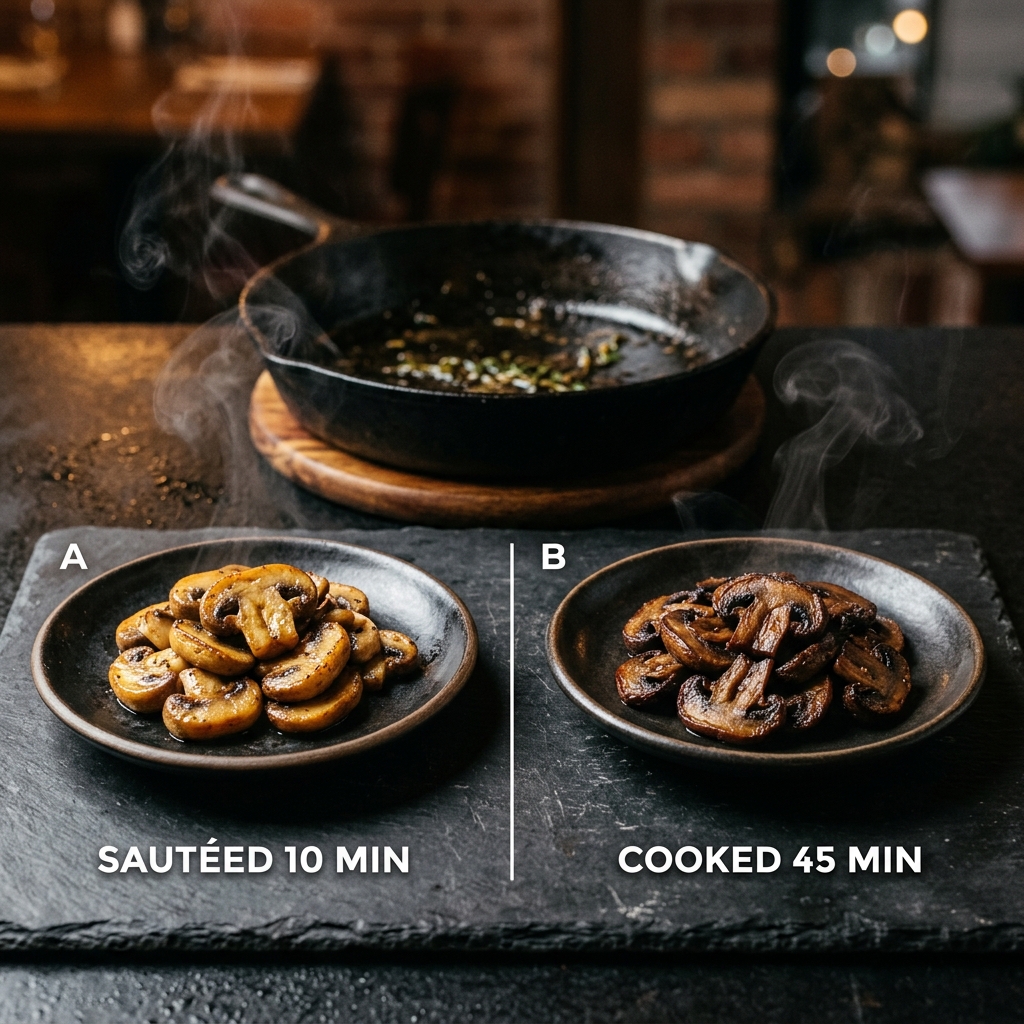
Why It's Practically Impossible to Overcook Button Mushrooms
Here is an amazing culinary and biological fact about button mushrooms that every home cook, chef, and mushroom lover needs to know: it is practically impossible to overcook them. Not difficult. Not unlikely. Practically impossible. You can sauté a button mushroom for 5 minutes or 40 minutes, and while there will be differences in colour and moisture, the mushroom will never turn to mush the way a piece of zucchini does, and it will never become tough and leathery the way a piece of steak does. It just… stays good.
The Experiment That Proved It
The most famous demonstration of this property was conducted by Dan Souza at America's Test Kitchen (the research-driven cooking science programme associated with Cook's Illustrated magazine). Souza designed a rigorous side-by-side comparison to test just how forgiving mushrooms are compared to other foods.
The Setup
He took three ingredients — portobello mushroom caps, beef tenderloin, and zucchini — and cut each into uniform half-inch-thick planks. He then steamed all three at a consistent temperature for 40 minutes straight, measuring the texture of each sample every 5 minutes using a CT3 Texture Analyzer — a laboratory instrument that precisely measures the force required to compress a food item (essentially, how much you'd have to bite down to chew through it).
The Results
- Zucchini: Within the first 5–10 minutes, the zucchini began to collapse. By 15 minutes, it was falling apart. By 40 minutes, it was a structureless, watery mush — the texture analyser barely registered any resistance at all. The cellulose and pectin holding the plant cells together had completely disintegrated.
- Beef tenderloin: The meat went in the opposite direction. As cooking time increased, the collagen contracted and the muscle fibres tightened, squeezing out moisture. By 40 minutes, the tenderloin was tough, dry, and leathery — essentially unwearable. The force required to compress it increased dramatically with every measurement.
- Mushrooms: The portobello caps started slightly softer than the raw beef and firmer than the raw zucchini. Over the next 40 minutes, the texture changed barely at all. The mushrooms became very slightly firmer — but they remained tender, pleasant to chew, and structurally intact. At the 40-minute mark, their texture was still within the range that trained tasters described as "good" to "very good."
The data was striking: after 40 minutes of continuous steaming, the mushrooms had lost only about 12% of their initial weight, while the zucchini had lost over 40% and the beef had lost about 25%. The mushrooms' structural integrity, as measured by compression force, changed by less than 15% over the entire cooking period — compared to a near-total collapse for zucchini and a 300% increase in toughness for beef.
The Science: Why Chitin Is Indestructible (By Cooking Standards)
To understand why mushrooms are so resistant to overcooking, you need to understand the three fundamentally different structural materials that hold plant cells, animal cells, and fungal cells together — and how each responds to heat.
Vegetable Cell Walls: Cellulose + Pectin (Fragile Under Heat)
The cell walls of plants — including every vegetable you cook — are built from two main components:
- Cellulose: Long chains of glucose molecules linked together into tough, rope-like microfibrils. Cellulose itself is reasonably heat-stable.
- Pectin: A gel-like polysaccharide that acts as the "glue" between cellulose fibrils and between adjacent cells. Pectin is the weak link — it dissolves and breaks down rapidly at cooking temperatures (above 85°C/185°F), especially in the presence of water.
When you cook a zucchini, the heat breaks down the pectin. Without pectin holding the cells together, the rigid cellulose scaffolding collapses, the cells separate, water floods out, and the vegetable turns to mush. This is why overcooked vegetables are soft, watery, and structureless.
Meat: Collagen + Muscle Protein (Contracts Under Heat)
Meat has no cell walls at all. Instead, its structure comes from:
- Muscle fibres: Bundles of protein filaments (actin and myosin) that contract when heated, squeezing out moisture and becoming tougher.
- Collagen: A connective tissue protein that surrounds muscle fibre bundles. At low temperatures, collagen is tough and chewy. Above 70°C (158°F), collagen slowly converts to gelatin (which is tender) — but only if given hours of gentle cooking (as in braising). At high temperatures or short cooking times, collagen simply contracts, making the meat even tougher.
This is why overcooking steak makes it tough and dry — the muscle proteins contract, the collagen tightens, and moisture is physically wrung out of the meat like water from a sponge.
Mushroom Cell Walls: Chitin + β-Glucans (Virtually Indestructible)
Mushroom cell walls are made from a completely different set of materials:
- Chitin: A long-chain polymer of N-acetylglucosamine — a modified sugar molecule with a nitrogen-containing acetyl group. Chitin molecules form crystalline microfibrils that are extraordinarily strong, rigid, and heat-resistant. Chitin does not begin to decompose until temperatures exceed 300–380°C (572–716°F) — temperatures that are never reached during boiling (100°C), sautéing (150–200°C), or even deep-frying (175–190°C).
- β-Glucans: A matrix of branched glucose polymers that fill the spaces between chitin fibrils, acting as a flexible "cement." β-glucans are also highly heat-stable and do not dissolve or break down during normal cooking.
Together, chitin and β-glucans form a rigid, heat-proof cage around every single cell in the mushroom. When you cook a mushroom, the heat causes the contents of the cells to change — proteins denature, enzymes deactivate, water evaporates — but the cell walls themselves remain completely intact. The structural scaffolding never collapses. The cells never separate. The mushroom never turns to mush.
Chitin: The World's Second-Most Abundant Biopolymer
Chitin is not some obscure, exotic molecule. It is the second most abundant natural polymer on Earth, after cellulose. It is found across an astonishing range of organisms:
- Arthropod exoskeletons: The hard shells of crabs, lobsters, shrimp, beetles, ants, spiders, and scorpions are all made primarily of chitin.
- Fungal cell walls: Every species of fungus — from microscopic yeasts to giant puffballs — uses chitin as its primary structural material.
- Mollusc structures: The internal shells (gladii) of squid and cuttlefish contain chitin.
- Fish scales: Some fish scales contain a modified form of chitin.
The reason chitin is so widespread in nature is precisely the reason it makes mushrooms impossible to overcook: it is an extraordinarily tough, stable, and resilient material. It evolved hundreds of millions of years ago as a structural polymer for organisms that needed to withstand extreme physical and environmental stresses — crushing ocean pressures, desert heat, freezing polar temperatures, and the mechanical forces of movement and predation.
When you eat a mushroom, you are eating a food whose structural framework is built from the same material as a lobster shell. The only reason the mushroom is soft and chewable (unlike a lobster shell) is that the chitin fibrils are arranged in a loose, hydrated matrix with β-glucans — rather than being densely packed and mineralised as they are in crustacean shells.
The Water Paradox: 90% Water, But Never Waterlogged
Here's another remarkable aspect of mushroom cooking physics: fresh button mushrooms are approximately 90–92% water by weight. That's more water than a watermelon (91%), a cucumber (95%), or a tomato (94%). And yet, mushrooms don't behave like any of those high-water vegetables when cooked.
When you heat a vegetable, its cell walls break down (as described above), and the water inside the cells floods out — creating that familiar pool of liquid at the bottom of the pan. The vegetable deflates, shrinks, and becomes soft and soggy.
When you heat a mushroom, the water inside the cells does want to escape — and it does, gradually, as steam. But because the chitin cell walls don't collapse, the mushroom doesn't deflate catastrophically. Instead, it undergoes a controlled, gradual release of moisture. The chitin-β-glucan matrix acts like a heat-resistant sponge, releasing water slowly and evenly while maintaining structural integrity. This is why mushrooms shrink when cooked (they can lose 50–70% of their volume as water evaporates) but never turn to mush — the scaffolding holds, even as the contents escape.
This property is also why mushrooms are so effective at absorbing flavours. Once the initial water has been cooked off, the intact chitin-matrix structure acts like a network of tiny empty chambers — perfect for soaking up butter, garlic, soy sauce, wine, or any other flavouring liquid you add to the pan.
The Exceptions: When Mushrooms Can Lose Their Texture
While mushrooms are famously resilient, they are not completely indestructible. There are a few scenarios where even chitin's armour can be compromised:
1. Prolonged Acid Exposure
Chitin can be slowly hydrolysed (broken down) by strong acids. If you cook mushrooms for a very long time in a highly acidic liquid — such as a tomato-based sauce, a vinegar reduction, or a heavy wine sauce — the acid can gradually weaken the chitin-β-glucan matrix, eventually causing the mushrooms to soften more than usual. This is why mushrooms in a long-simmered bolognese sauce may eventually become slightly mushier than mushrooms sautéed in butter.
2. Freeze-Thaw Damage
Freezing mushrooms causes the water inside their cells to form ice crystals, which can physically puncture and rupture the chitin cell walls. When the mushrooms are thawed, the damaged cell walls release their water all at once, resulting in a soggy, waterlogged texture. This is why previously frozen mushrooms often cook up softer and wetter than fresh ones.
3. Drying Out Completely
While mushrooms won't turn to mush, they can become leathery, rubbery, or charred if cooked at high heat for so long that all their water evaporates. At that point, the chitin-protein matrix remains intact, but without any moisture, the texture becomes unpleasantly tough and chewy — like a piece of mushroom jerky. This is technically "overcooked" in the sense that the eating quality has deteriorated, even though the structural integrity is still perfect.
Why This Matters for Nutrition
Chitin's heat resistance has an important nutritional implication that is often overlooked: because mushroom cell walls don't break down during cooking, some of the nutrients inside those cells may be less bioavailable from raw mushrooms than from cooked ones.
When you eat a raw mushroom, your digestive system must work to break through the chitin cell walls to access the nutrients inside — and human stomachs don't produce chitinase (the enzyme that breaks down chitin) in significant quantities. This means that some nutrients remain trapped behind intact chitin walls and pass through your digestive system unabsorbed.
Cooking helps in two ways:
- Heat denatures proteins inside the cells, making them easier to digest once the cell contents are released.
- Mechanical disruption during cooking (chopping, slicing, chewing the softened mushroom) can rupture some cell walls, releasing their contents.
- Longer cooking = more nutrient access: Extended cooking time allows more water to escape through the intact cell walls, concentrating the remaining nutrients and making them more accessible.
This is one reason why many nutritionists recommend eating mushrooms cooked rather than raw — not because raw mushrooms are dangerous (they're not), but because cooking significantly improves the bioavailability of their nutrients, including B vitamins, potassium, selenium, and ergothioneine (a powerful antioxidant found almost exclusively in mushrooms).
The Culinary Bottom Line
The next time you're cooking button mushrooms and you worry you've left them in the pan too long — relax. Your mushrooms are wearing armour made of the same material as a lobster shell. They are the most forgiving ingredient in your kitchen. They are, for all practical purposes, impossible to overcook.
And now you know why: a billion years of fungal evolution produced a cell wall material so tough, so heat-stable, and so resilient that your kitchen stove doesn't stand a chance against it. The mushroom wins. Every single time.