A Mushroom Doesn't Just Taste Savoury — It Multiplies the Savouriness of Everything Around It
Cooks have known for centuries that mushrooms make food taste bigger. Add a handful to a stew and the whole pot deepens — meatier, rounder, more satisfying — in a way that is oddly hard to attribute to the mushrooms themselves. The dish doesn't taste more of mushroom. It just tastes more.
This is not a figure of speech, and it is not the cook's imagination. It is a measurable molecular event happening on the surface of your tongue. Mushrooms carry a molecule that does not merely taste savoury on its own account — it physically jams your umami receptor shut, so that every other savoury molecule on the plate registers far more loudly than it otherwise would.
The mushroom is not a flavour. It is an amplifier.
A Taste the West Refused to Believe In
In 1908, a chemist at Tokyo Imperial University named Kikunae Ikeda asked a deceptively simple question: what, exactly, is the taste of dashi — the kombu seaweed broth at the foundation of Japanese cooking? It was plainly not sweet, salty, sour or bitter. Those four were supposed to be the complete set.
Ikeda boiled down enormous quantities of kombu and isolated the culprit: glutamate. He named the taste umami — roughly, "deliciousness" — and argued it was a fifth basic taste in its own right.
Then he waited. And waited. For most of a century, Western sensory science was largely unconvinced, treating umami as a mere combination of the other four, or dismissing it as a cultural quirk. Ikeda was fully vindicated only around the turn of the millennium, when researchers identified the actual umami taste receptor on the tongue. You cannot easily argue with a receptor.
Ikeda's students, meanwhile, kept pulling the thread — and it led straight to fungi.
- 1908 — Kikunae Ikeda isolates glutamate from kombu seaweed.
- 1913 — Shintaro Kodama, Ikeda's student, finds a different umami substance in dried bonito flakes: the nucleotide inosinate (IMP).
- 1957 — Akira Kuninaka identifies guanylate (GMP) as the principal umami compound of dried shiitake mushrooms — and discovers the far more important thing.
Kuninaka's Discovery: The Multiplication
Kuninaka noticed that glutamate and the nucleotides — IMP from fish, GMP from mushrooms — did something strange when combined. The taste did not simply add up. It leapt. A quantity of glutamate that was barely detectable alone became powerfully savoury the instant a trace of nucleotide joined it.
This is umami synergy, and it is the reason the discovery mattered far beyond mushrooms. Figures for the size of the effect vary considerably between studies and depend heavily on concentration and method — you will see multipliers quoted anywhere from roughly sevenfold to fifteenfold or more. The precise number is genuinely contested. What is not contested is the shape of the effect: the combination is dramatically, disproportionately more savoury than the sum of its parts.
And it retrospectively explained a great deal of the world's cooking. Kuninaka had found the chemistry underneath something cooks worked out by trial and error centuries earlier: Japanese dashi pairs kombu (glutamate) with bonito flakes (inosinate) — the two halves of the synergy in one pot. It is not a tradition. It is a formula.
The Molecular Door-Wedge
Here is what is physically happening, and it is genuinely elegant.
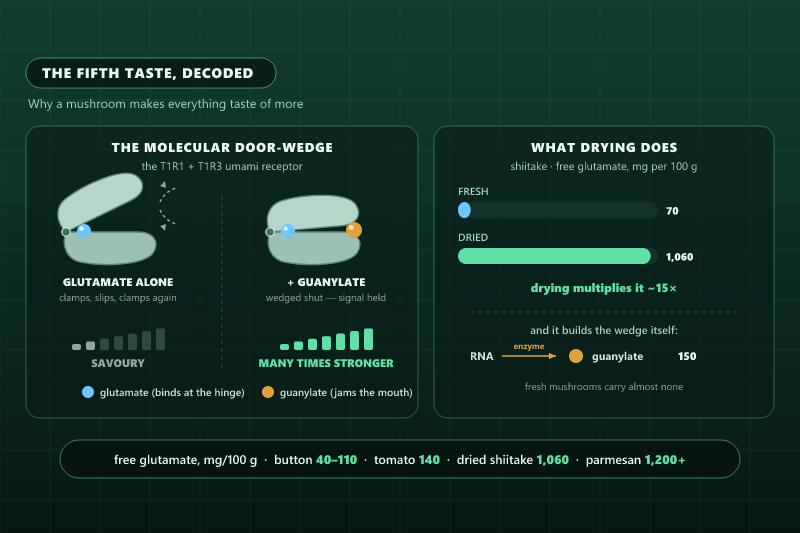
The umami receptor is a pairing of two proteins, T1R1 and T1R3. The business end has a structure biologists call a "Venus flytrap" domain — two lobes joined by a flexible hinge, which can gape open or clamp shut. Closed means signal: the nerve fires and your brain registers "savoury."
Now the two molecules, and note carefully that they do not compete for the same spot:
- Glutamate binds deep inside, close to the hinge. This encourages the flytrap to close. But the closure is unstable — it clamps, slips open, clamps again. The signal is real but weak and intermittent.
- Guanylate binds at a separate, adjacent site, right by the opening of the flytrap. It cannot switch the receptor on by itself. What it does is stabilise the closed shape — it sits in the gap like a wedge jammed under a door, so once the trap shuts, it stays shut.
The glutamate throws the switch. The guanylate holds it down. The receptor stops flickering and starts transmitting continuously — and your brain reads that steady, sustained signal as a savouriness far greater than the glutamate concentration alone could ever justify.
This is why the mushroom seems to add flavour that isn't its own. It isn't contributing much taste. It is making your receptor better at hearing everything else.
The Numbers on the Plate
Free glutamate content, in milligrams per 100 grams, sets the scene:
- Button mushroom (Agaricus bisporus): 40–110
- Fresh shiitake: 70
- Enoki: 90 | Truffle: 60–80
- Ripe tomato: 140
- Parmigiano Reggiano: 1,200–1,600 — one of the richest natural sources known
On glutamate alone, a mushroom looks modest — comfortably beaten by a tomato, annihilated by parmesan. But glutamate is only half the story, because mushrooms bring the other half: guanylate, which most foods simply do not have. Dried shiitake carries roughly 150 mg/100 g of it.
That is the whole trick. The mushroom is not competing with the parmesan. It is completing it.
What Drying Actually Does
Now the part that surprises people: a fresh mushroom is not where the guanylate lives. Fresh mushrooms carry very little. The guanylate has to be manufactured — and drying is what manufactures it.
The numbers are startling. Fresh shiitake holds about 70 mg/100 g of free glutamate. Dried shiitake holds about 1,060 — roughly a fifteenfold increase. Some of that is simple concentration, since removing water concentrates whatever remains. But the guanylate is a different matter entirely, and it is genuinely created:
Every mushroom cell is packed with RNA. As the mushroom is slowly dried and its cells break down, enzymes called ribonucleases are released and set to work chopping that RNA into fragments — and one of those fragments is 5′-guanylate. The mushroom is, in effect, digesting its own genetic machinery into flavour.
This is why a dried shiitake is not merely a fresh shiitake with the water taken out. It is a chemically different ingredient, and a far more powerful one.
How to actually exploit this at home
Because the guanylate is enzyme-made, the enzymes' working conditions matter — and here the practical advice is worth following even though the published temperature optima vary between sources:
- Rehydrate dried mushrooms slowly in cold water — ideally in the refrigerator, for several hours or overnight. Patience here is not fussiness; it is chemistry.
- Do not dump them straight into fiercely boiling water. A violent temperature jump wastes the enzymes' window before they have done their work.
- Heat the soaking liquid gently and gradually, then bring it to the boil at the end. The final boil deactivates the enzymes and locks the guanylate in place.
- Never throw away the soaking water. Much of the flavour you spent all night building is dissolved in it. That liquid is the stock.
Why Your Grandmother Was Right
Once you know about synergy, a great deal of world cooking stops looking like tradition and starts looking like applied chemistry. Cooks everywhere, with no access to a laboratory, converged on the same solution: put a glutamate food next to a nucleotide food.
- Mushroom and tomato — guanylate meets 140 mg of glutamate. The basis of countless pasta sauces.
- Mushroom and parmesan — guanylate meets the richest glutamate source in the kitchen. Risotto exists for a reason.
- Kombu and bonito — glutamate meets inosinate. Dashi, and therefore most of Japanese cuisine.
- Mushrooms in a meat stew — mushroom guanylate meets the inosinate and glutamate of the meat, stacking all three.
And it explains why mushrooms are the backbone of good vegetarian cooking. The problem with removing meat is not protein — it is the loss of that deep savoury base. A mushroom restores it, not by imitating meat, but by supplying the exact molecule that makes the vegetables already present taste profoundly more of themselves.
What This Means for Our Farm
This is the science behind advice we give constantly:
- Buy fresh for texture; dry for power. They are not substitutes. A fresh button mushroom brings body, bite and moisture. A dried mushroom brings concentrated umami. Serious cooks keep both, and use them for different jobs.
- Drying is value addition, not waste disposal. For growers on our training courses this is a genuinely important lesson: drying is not what you do with mushrooms you failed to sell. Drying creates a chemically superior product with a shelf life measured in months instead of days — one that commands a higher price per kilogram precisely because the flavour has been multiplied. A solar dryer is one of the highest-return additions a small farm can make.
- A little goes a very long way. Because the effect is multiplicative, you do not need many mushrooms to transform a dish. That is a strong selling point, not a weak one.
So the next time a handful of mushrooms turns a flat, ordinary pot into something people go quiet over, you will know it was never really about the mushrooms. Somewhere on your tongue, a microscopic trap snapped shut — and a molecule the fungus built by dismantling its own RNA slid into the gap and refused to let it open again.
The mushroom didn't add the flavour. It just made sure you couldn't miss it.