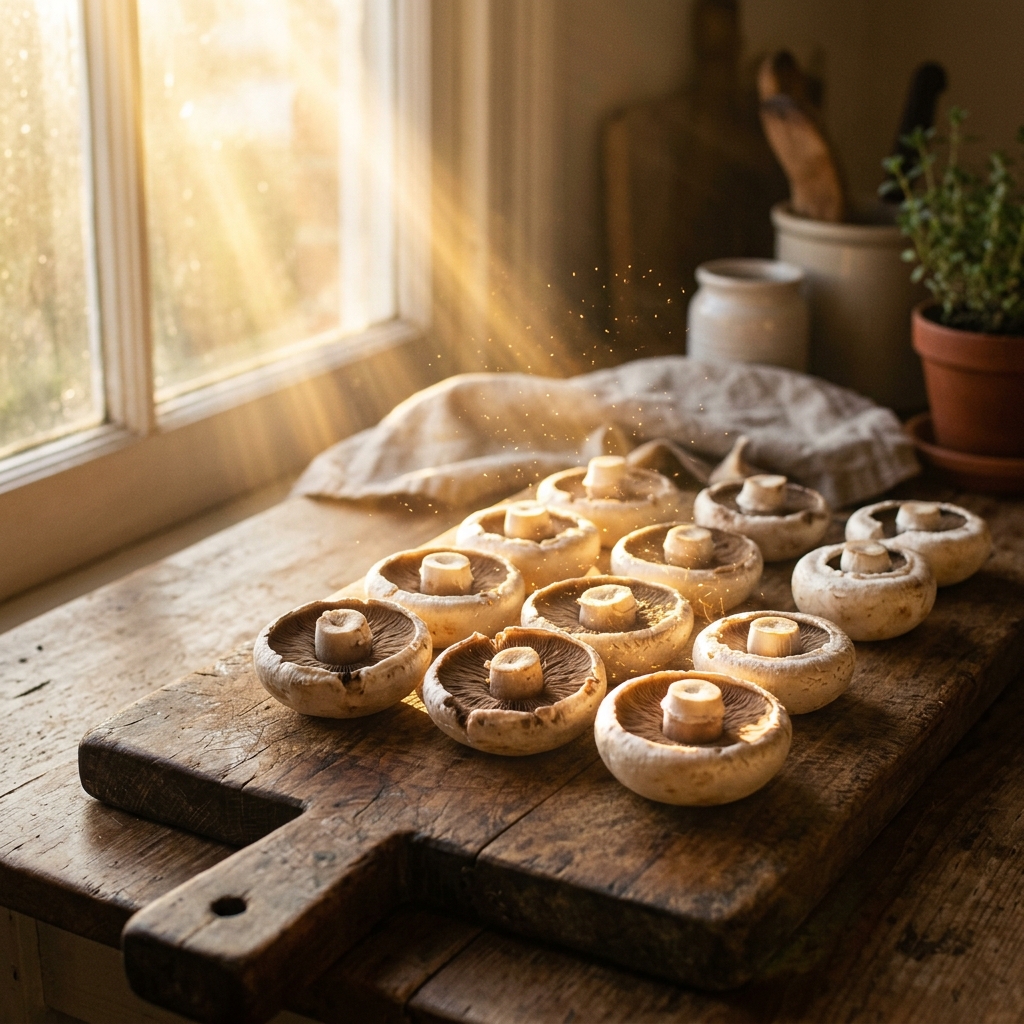
Button Mushrooms Act Just Like Human Skin When Exposed to Sunlight
Here is a fascinating biological fact about button mushrooms that sounds impossible until you learn the science behind it: when you place a common white button mushroom in sunlight, it does something that no other food in your kitchen can do. It starts producing vitamin D — using the exact same type of photochemical reaction that happens in your own skin when you step outside on a sunny day. The mushroom is, in a very real biochemical sense, sunbathing.
The Chemistry: Two Kingdoms, One Reaction
The parallels between mushroom and human vitamin D synthesis are not vague analogies — they are precise, step-by-step biochemical mirrors of each other. Understanding the chemistry reveals just how deeply connected the fungal and animal kingdoms are at the molecular level.
In Human Skin
Your skin contains a sterol compound called 7-dehydrocholesterol (7-DHC), which sits in the cell membranes of your epidermal cells — the outermost layer of your skin. When UV-B photons (wavelength 290–315 nanometres) strike a molecule of 7-DHC, they cause a specific chemical bond in the molecule's B-ring to break — a reaction called photolytic ring opening. This converts 7-DHC into previtamin D3. Over the next 24–48 hours, previtamin D3 undergoes a slow, heat-driven rearrangement (thermal isomerisation) to become vitamin D3 (cholecalciferol) — the biologically active form that enters your bloodstream and regulates calcium absorption, bone health, immune function, and dozens of other critical processes.
In Mushroom Tissue
Mushroom cell membranes contain ergosterol — a sterol that serves the same structural role in fungal cells that cholesterol serves in animal cells. Ergosterol and 7-DHC are structurally almost identical; they differ by only two chemical bonds in their side chains. When UV-B photons strike ergosterol, the exact same photolytic ring-opening reaction occurs: the B-ring of the sterol molecule breaks open, converting ergosterol into previtamin D2. This then thermally isomerises into vitamin D2 (ergocalciferol).
The reaction is so chemically similar that if you placed the molecular diagrams of the two pathways side by side, you would struggle to tell them apart without looking at the subtle differences in the side chain. The same wavelength of light. The same type of bond breakage. The same thermal rearrangement. Two entirely different kingdoms of life — Animalia and Fungi — running the same photochemical program.
The Dark Secret: Why Store-Bought Mushrooms Have Almost No Vitamin D
If mushrooms can produce vitamin D from sunlight, you might assume that the button mushrooms in your grocery store are already loaded with it. They are not. In fact, commercially grown white button mushrooms typically contain less than 0.1 micrograms (4 IU) of vitamin D per 100 grams — an almost negligible amount. The recommended daily intake for adults is 15–20 micrograms (600–800 IU), meaning you would need to eat roughly 150–200 kilograms of store-bought mushrooms per day to meet your vitamin D needs from them alone.
Why so little? The answer lies in how mushrooms are commercially cultivated:
- Total darkness: Commercial button mushrooms (Agaricus bisporus) are grown in climate-controlled indoor facilities — typically in windowless rooms, tunnels, or converted warehouses — in complete darkness or very low artificial light. The mushrooms never see a single photon of UV light during their entire growing cycle.
- No UV exposure post-harvest: After harvesting, the mushrooms are immediately packaged, refrigerated, and transported in cold-chain logistics systems — again, in conditions with zero UV exposure.
- Packaging blocks UV: Even if mushrooms were briefly exposed to daylight during transport or retail display, the plastic packaging and cardboard containers they're sold in block virtually all UV-B radiation from reaching the mushroom tissue.
The ergosterol is there, sitting patiently in every cell membrane, ready to convert — but it never gets the UV-B trigger it needs. The mushroom has the loaded gun; it just never pulls the trigger.
The 30-Minute Sunlight Trick: How to "Charge" Your Mushrooms
Here is where this fact becomes genuinely useful in your daily life. Because mushroom ergosterol converts to vitamin D2 even after the mushroom has been harvested, you can dramatically boost the vitamin D content of store-bought mushrooms with an astonishingly simple technique:
The Method
- Take your mushrooms out of the packaging. Plastic film and cardboard block UV light.
- Place them gill-side up on a plate, tray, or cutting board. The gills (the dark, ridged underside of the cap) have a much larger surface area than the smooth cap, maximising UV exposure.
- Set them in direct sunlight — outdoors or on a window sill that receives unfiltered sunlight (not through glass, which blocks most UV-B). The ideal time is between 10:00 AM and 3:00 PM, when UV-B intensity is highest.
- Leave them for 15–60 minutes. Even 15 minutes of strong midday sun can produce a significant vitamin D boost. Thirty to sixty minutes is optimal.
- Use them as normal. Cook, refrigerate, or freeze them. The vitamin D2 produced is heat-stable — it survives cooking, sautéing, boiling, and baking with minimal loss.
The Results Are Staggering
Published research has demonstrated the following vitamin D2 levels in button mushrooms after controlled UV-B exposure:
- Before UV exposure: 0.1 µg (4 IU) per 100g — essentially nothing.
- After 15 minutes of direct midday sunlight: approximately 10 µg (400 IU) per 100g.
- After 30–60 minutes: up to 25–40 µg (1,000–1,600 IU) per 100g — more than enough to meet the full daily requirement in a single 100-gram serving.
- After commercial UV-B lamp treatment: levels as high as 100 µg (4,000 IU) per 100g have been achieved.
That's an increase of up to 40,000% — from virtually zero to one of the richest natural food sources of vitamin D on the planet — with nothing more than placing a mushroom in the sun for half an hour.
Why This Matters Enormously for India
This fact has profound implications for public health in India, where vitamin D deficiency has reached epidemic proportions:
The Indian Vitamin D Crisis
- An estimated 70–90% of the Indian population is vitamin D deficient or insufficient, according to multiple published studies — one of the highest rates in the world.
- This is paradoxical for a tropical country with abundant sunshine. The causes include increasing urbanisation, indoor lifestyles, air pollution (which blocks UV-B), dark skin (which requires more UV exposure to produce the same amount of vitamin D), and cultural practices of covering the skin.
- Vitamin D deficiency is linked to weak bones (osteoporosis and rickets), impaired immunity, increased susceptibility to respiratory infections, depression, and an elevated risk of several chronic diseases.
- The primary dietary sources of vitamin D — oily fish (salmon, mackerel, sardines), cod liver oil, and egg yolks — are not accessible to India's large vegetarian and vegan population, which constitutes an estimated 30–40% of the country.
Mushrooms: The Only Vegetarian "Vitamin D Factory"
Sun-exposed mushrooms are the only non-animal, non-fortified food source of significant vitamin D in the world. This makes them uniquely important for India's vegetarian population. Unlike vitamin D supplements (which are often derived from lanolin — sheep's wool grease — or fish oil), sun-exposed mushrooms provide a completely plant-kingdom-compatible, natural, affordable, and readily available source of vitamin D2.
And the economics are compelling: a 100-gram serving of button mushrooms costs approximately ₹15–25 in most Indian markets. Thirty minutes of sunlight is free. The resulting vitamin D content is equivalent to a vitamin D supplement tablet that costs ₹5–10 per dose. For families in rural India, where supplements may not be available or affordable, sun-exposed mushrooms could be a transformative dietary intervention.
D2 vs. D3: Are They Equally Effective?
A common question — and an important one — is whether vitamin D2 (from mushrooms) is as effective as vitamin D3 (from animal sources and human skin synthesis) at raising blood levels of active vitamin D.
The science is nuanced:
- Both D2 and D3 are biologically active and effective at raising serum 25-hydroxyvitamin D levels — the standard clinical marker of vitamin D status.
- D3 may be slightly more potent per microgram than D2 in some studies, primarily because D3 has a longer half-life in the bloodstream (it stays active for longer before being metabolised).
- However, at typical dietary doses (10–25 µg per day), multiple randomised controlled trials have shown that D2 and D3 are equally effective at maintaining adequate vitamin D status when consumed regularly.
- The key is consistency: because D2 is metabolised slightly faster, regular daily or every-other-day intake is more important than with D3.
The practical takeaway: if you eat sun-exposed mushrooms regularly — even a few times per week — the vitamin D2 they provide is a clinically meaningful and effective contribution to your vitamin D status, particularly if you are vegetarian, vegan, or have limited sun exposure.
The Evolutionary Story: A Billion-Year-Old Sunscreen
Why do mushrooms have this ability at all? The answer reaches back into deep evolutionary time.
Ergosterol serves multiple functions in fungal cell membranes beyond being a vitamin D precursor. It helps maintain membrane fluidity, permeability, and structural integrity — much like cholesterol does in animal cell membranes. But ergosterol also acts as a natural UV-absorbing shield. When the ergosterol molecule absorbs a UV-B photon and converts to previtamin D2, it is effectively neutralising that photon — preventing it from damaging the cell's DNA, proteins, or other sensitive molecules.
In other words, the vitamin D synthesis pathway may have originally evolved not as a way to produce a nutrient, but as a UV-protection mechanism — a molecular sunscreen. The production of vitamin D was initially a byproduct of this protective function. Over evolutionary time, organisms that could use vitamin D for calcium regulation and immune modulation gained a survival advantage, and the pathway became essential rather than incidental.
This means that when you place a mushroom in sunlight and it produces vitamin D, you are witnessing the modern expression of a billion-year-old survival strategy — one that was already ancient before the first animals, the first plants, and the first true fungi had even diverged into separate kingdoms of life.
Practical Tips: How to Maximise Vitamin D in Your Mushrooms
- Slicing increases surface area: Sliced mushrooms produce more vitamin D2 per gram than whole mushrooms because more ergosterol molecules are exposed to UV light.
- Gill-side up is critical: The gills have a vastly larger surface area than the smooth cap surface. Always place mushrooms upside down.
- Direct sunlight, not through glass: Window glass blocks most UV-B radiation. Place mushrooms outside or on an open balcony/terrace.
- Midday sun is best: UV-B intensity peaks between 10 AM and 2 PM. Morning and evening sun contains mostly UV-A, which is less effective at converting ergosterol.
- Works with all mushroom varieties: Button, cremini, portobello, oyster, shiitake — all contain ergosterol and all produce vitamin D2 when UV-exposed. The specific amount varies by species, but the mechanism is universal across edible fungi.
- Dried mushrooms work too: Sun-dried mushrooms (common in Asian cuisine) can contain exceptionally high levels of vitamin D2 — often higher than fresh sun-exposed mushrooms because the drying process concentrates the vitamin on a per-gram basis.
- Vitamin D survives cooking: Sautéing, boiling, baking, and microwaving cause minimal loss of vitamin D2 content. You do not need to eat mushrooms raw to benefit.