The World's Most Expensive Food Is a Fungus That Refuses to Be Farmed
Gram for gram, one of the most expensive foods on the planet is a lumpy, dark, unglamorous fungus that grows in the dirt. A prized white truffle can sell for thousands of dollars per kilogram — occasionally rivalling or exceeding the price of gold. People pay it gladly, shaving wafer-thin slices over a plate of pasta for an aroma that is genuinely like nothing else.
The obvious question is: if truffles are worth that much, why doesn't everyone just grow them? We grow button mushrooms by the tonne in climate-controlled rooms. Why not truffles?
The answer is one of the most elegant stories in all of mycology. Truffles are not expensive because someone is keeping them scarce. They are expensive because of what they are — a fungus so deeply entangled with a living tree, and so committed to a hidden underground life, that it fights every attempt to farm it on demand.
A Fungus That Married a Tree
To understand the truffle, you first have to understand that fungi make their living in two very different ways.
The mushrooms we grow on our farm are mostly saprotrophs — decomposers. They feed on dead material: straw, sawdust, compost, logs. You can hand a saprotroph a bag of the right dead matter and it will happily grow, which is precisely why button and oyster mushrooms are farmable in a shed.
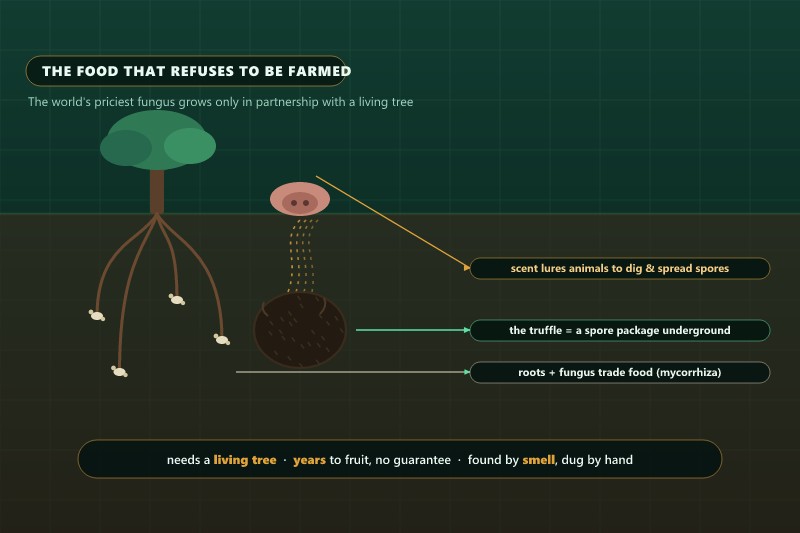
Truffles are the other kind: mycorrhizal fungi. Instead of eating dead matter, they form a living partnership with a plant. The truffle fungus sheathes the fine root tips of an oak or hazel in a dense fungal glove — the ectomycorrhiza — and the two organisms trade:
- The fungus gives the tree water and minerals, gathered from a vast area of soil its threads can reach but the roots cannot.
- The tree gives the fungus sugars, made by photosynthesis — energy the fungus cannot produce on its own.
This is a genuine, obligate symbiosis. The truffle fungus cannot be fed a bag of compost, because dead matter is not what it eats — it eats sunlight, second-hand, through the roots of a partner tree. And you cannot grow it without also growing a healthy, mature tree for it to marry. Immediately, "just grow it in a room" is off the table.
Why Underground — and Why the Smell?
Here is the second twist, and it is beautiful. An ordinary mushroom is a fungus's way of getting its spores into the air — it pushes a fruiting body up above the ground and releases spores to the wind, as we described in our fact on airborne spores.
A truffle does the opposite. It fruits entirely underground, never breaking the surface. This is safer in some ways — protected from drying out and from frost — but it creates an obvious problem: how do you spread your spores if you're buried in the dirt? The wind can't reach you.
The truffle's solution is to advertise to the nose instead of the wind. As it ripens, it produces an intense, complex aroma that soaks through the surrounding soil and rises to the surface. That smell is a signal aimed squarely at animals: wild boar, deer, squirrels, mice. They smell the ripe truffle, dig it up, and eat it — and in doing so they carry the spores away in their guts, depositing them far from the parent tree. The truffle is, in effect, paying animals in flavour to be its delivery service.
This is why humans hunt truffles with trained pigs and dogs: we are simply hijacking the exact recruitment system the truffle evolved. The truffle "wants" to be sniffed out and dug up — that is its whole reproductive strategy. We just get to the meal first.
A myth worth correcting
You will often read that pigs are drawn to truffles because the aroma contains androstenol, a compound also found in boar saliva as a sex pheromone — the charming story being that the sow thinks she has found a mate. It is a great story, and there is a grain of truth in it, but the science is more nuanced. When researchers actually tested what the animals were detecting, the compound that reliably led pigs and dogs to black truffles was dimethyl sulfide, a simple sulphurous molecule — not the pheromone. The romantic version is largely a myth; the real lure is a much plainer-smelling chemical. (It is also why pigs are risky truffle-hunters — they genuinely want to eat the prize — and why most modern hunters prefer dogs.)
So Why Can't We Just Farm Them?
Now the pieces come together. Growing truffles reliably means solving several hard problems at once:
- You must grow a tree, not just a fungus. Truffle cultivation ("trufficulture") starts by inoculating oak or hazel seedlings with the fungus and planting an orchard. You are not farming a mushroom; you are establishing a forest partnership and waiting.
- It takes years. An inoculated orchard typically produces nothing for the better part of a decade, if it produces at all. This is farming on a timescale of tree growth, not crop cycles.
- The soil has to be exactly right. The prized species demand specific, often alkaline, well-drained soils (roughly pH 7.5–8.3) and a particular Mediterranean-style climate. Get the chemistry wrong and nothing fruits.
- Success is never guaranteed. Even a perfectly inoculated orchard in ideal soil may simply fail. The trigger that tells the fungus to actually form a truffle — rather than just live quietly on the roots — is still not fully understood. You cannot command it.
- And you still can't see the harvest. Because the crop is underground, it can't be spotted or machine-harvested. Every single truffle must be found by a trained animal's nose and dug up by hand.
So the honest picture is not that truffles are impossible to cultivate — inoculated orchards do exist and do produce, and a large share of today's black truffles come from them. It is that cultivation is slow, expensive, unpredictable, and only partly within human control. You cannot dial up a truffle harvest the way you can a mushroom harvest. You plant, you tend, you wait years, and you hope. That uncertainty, baked into the biology, is what keeps the price sky-high.
What the Truffle Teaches a Mushroom Farmer
This fact is, in a way, the perfect mirror of what we do — and understanding it makes you appreciate cultivated mushrooms all the more.
- It explains why some mushrooms are cheap and some are priceless. The single biggest factor is not taste or rarity of demand — it is farmability. Button, oyster and lion's mane mushrooms are saprotrophs we can feed and control, so they are affordable and abundant. Truffles are mycorrhizal partners we can only coax, so they stay rare and dear. The biology sets the price.
- It shows how much control cultivation really gives us. On our farm we decide when to spawn, when to trigger fruiting, when to harvest. A truffle grower has almost none of that certainty. The predictability of mushroom farming — often taken for granted — is a genuine achievement, and the truffle is what farming looks like without it.
- It is a lesson in fungal partnership. The mycorrhizal relationship the truffle depends on is the same kind of partnership that sustains most of the world's forests underground. It is a reminder that fungi are not only decomposers and food — they are the hidden trading network beneath the living world.
So the next time you see truffle shavings on a menu at an eye-watering price, you will know you are not paying for a rare mushroom. You are paying for a fungus that insisted on marrying a tree, burying its children, and hiring wild animals to raise them — a creature so committed to doing things its own way that, thousands of years into agriculture, it still largely refuses to be farmed on our terms.