Mushrooms May Help Make Their Own Rain
A raindrop cannot form out of nothing. This is one of the more counter-intuitive facts in atmospheric science: no matter how much water vapour a cloud holds, it will not spontaneously become rain. Water needs a surface to condense onto — a speck of something solid for the first molecules to gather around.
These specks are called cloud condensation nuclei, and the atmosphere is full of them: dust from deserts, sea salt from breaking waves, soot, pollen, volcanic ash. Every raindrop that has ever fallen on your farm formed around one.
And some meaningful fraction of them, it turns out, are mushroom spores.
The Same Trick, Used Twice
Here is the detail that makes this genuinely elegant, and it connects directly to something we've covered before.
In our fact on the surface-tension catapult, we described how a mushroom fires its spores. The spore's surface is coated in mannitol and other hygroscopic sugars, which lower the water potential at the surface so that water vapour spontaneously condenses onto it from humid air. That condensed droplet — Buller's drop — then merges with a film on the spore and flings it off its stalk.
Now notice what the spore carries with it into the sky: that same sugar coating.
The chemistry that pulled water out of the air to build a launch mechanism does not switch off after launch. Once airborne and lifted into a cloud, the spore keeps doing exactly what it did on the gill — attracting water onto itself. Researchers observed droplets reforming on spores in humid air at relative humidities matching cloud conditions (around 100–102%).
One adaptation, two completely different consequences: a catapult on the ground, and a raindrop seed at altitude. The second was almost certainly never "designed" for — it is a free side effect of the first.
Why Size Matters So Much
Not all condensation nuclei are equal, and the spore's dimensions are unusually favourable.
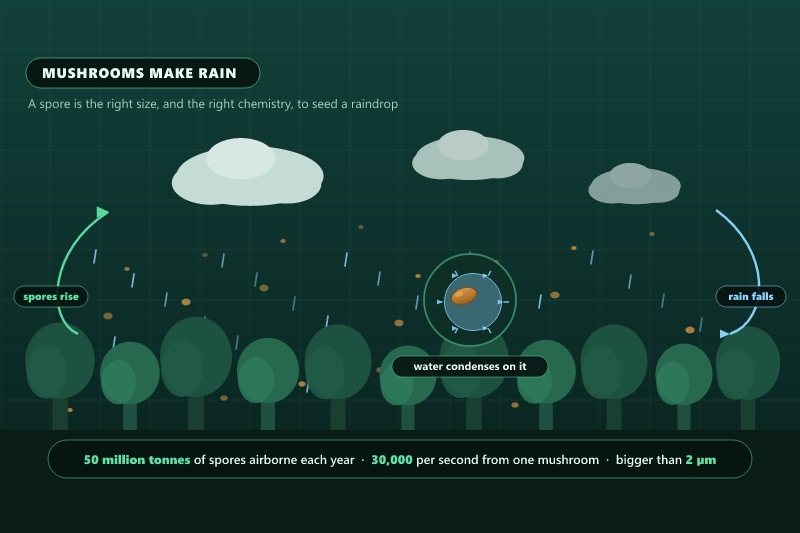
Particles larger than about 2 micrometres are classed as giant cloud condensation nuclei (GCCN). They matter disproportionately because of how rain actually forms. A cloud full of tiny, uniform droplets is stable — the droplets are too small to fall, and they simply drift. To get rain, you need some droplets to grow large enough to start falling and colliding with smaller ones, sweeping them up and accelerating into raindrops.
Giant nuclei jump-start that process. They form large droplets immediately, which begin falling sooner and collect more efficiently. A relatively small number of them can trigger precipitation in a cloud that would otherwise have stayed a cloud.
Mushroom spores are, in effect, well suited to this role: big enough to matter, water-attracting by default, and released in staggering numbers.
The Loop — Stated Carefully
This suggests a rather beautiful cycle:
Rain falls on a forest → fungi fruit and release spores → spores rise into the atmosphere → spores seed droplets in clouds → rain falls on the forest.
Fungi fruit after rain. Fruiting releases spores. Spores may help make rain. The fungus appears to be participating in the weather system that triggers its own reproduction — most plausibly over tropical forests, where the biomass of ectomycorrhizal and saprotrophic basidiomycetes is enormous.
Now the necessary caution, because this is exactly the kind of story that gets overstated:
- The authors explicitly reject an adaptive reading. They state there is no adaptive significance to the effect. The fungus is not "trying" to make rain, and this did not evolve as a rain-making strategy. It is a by-product of spore chemistry that happens to have atmospheric consequences.
- The key observations are laboratory work. The droplet-reformation results come from controlled conditions, and the researchers acknowledge uncertainty about how this scales in the real atmosphere.
- The magnitude is unresolved. That spores can act as condensation nuclei is well supported. How much of the world's rainfall they meaningfully influence, relative to dust, sea salt and everything else, is not settled.
So the honest framing is the one in this article's title: mushrooms may help make rain. The mechanism is real and measured; the global significance is an open question.
Fungi in the Air You Are Breathing
Set the rainfall question aside and one fact remains, and it is worth pausing on: 50 million tonnes of spores a year.
Fungal spores are one of the most abundant biological particles in Earth's atmosphere. There are spores above the oceans, over the poles, and in the air of every room you have ever been in. Right now, with every breath, you are inhaling fungal spores — ordinarily in small enough numbers to be entirely harmless.
Some spores have also been shown to act as ice nuclei, seeding the freezing of supercooled water in colder clouds — a separate pathway to precipitation, and one that also brings the spores back down. Rain, in that sense, is partly how fungi land.
We tend to picture the fungal kingdom as something underfoot: soil, logs, compost, the dark. In reality it is also continuously airborne, in quantities measured in tens of millions of tonnes, drifting through the weather.
What This Means Inside a Growing Room
This is not only planetary-scale trivia. The same physics has consequences we manage every single day on the farm.
- Spore load is an air-quality problem. A mature crop with open gills releases spores at an extraordinary rate into an enclosed room. This is the practical basis for ventilation, filtration and masks — the risk of mushroom worker's lung is a direct consequence of how effective mushrooms are at putting particles into the air.
- It reinforces why we harvest with the veil closed. Picking button mushrooms before the veil opens means picking them before the catapults fire. Better product, and dramatically lower spore load in the room.
- Spores are how contamination travels. Every grower who has lost a batch to a competitor mould has watched atmospheric spore dispersal work perfectly. Sterile technique exists precisely because the air carries fungal propagules everywhere — this is the whole reason substrate must be pasteurised.
- Humidity governs everything. The hygroscopic chemistry above only works in moist air. It is the same reason growing rooms are kept humid: spore release, droplet formation and mushroom development all depend on water in the air.
So the next time rain moves across your fields, consider the possibility — carefully hedged, not yet proven at scale — that some of those drops formed around a spore. Fired from a gill by a droplet of water. Carried up on a warm current. Coated in a sugar that could not stop attracting moisture even at the top of a cloud.
And falling back down to make more mushrooms.