Why Mushrooms Refuse to Grow Without a "Sterile" Trick
There is a common myth that mushrooms are simple organisms that grow passively out of decomposing dirt or damp compost. In reality, commercial mushroom cultivation is one of the most scientifically complex disciplines in modern agriculture. If you simply plant button mushroom mycelium into rich, nutritious compost, it will happily spread its white thread-like root system (hyphae) forever. But it will never produce a single mushroom.
Left to its own devices, the mycelium will remain in a permanent vegetative state, content with its food supply. To force the fungus to transition from vegetative growth to reproductive growth (fruiting), farmers must deploy a clever biological trick: applying a specialized, nutrient-poor top blanket known as the casing layer.
What Is a Casing Layer?
The casing layer is a highly engineered, clean, but not completely sterilized blanket spread directly over the fully colonised compost. Its primary characteristic is that it is virtually devoid of nutrients. If the casing had nutrients, the mycelium would simply continue feeding and growing vegetatively, rather than feeling the biological urge to reproduce.
A standard, high-yield casing layer mixture consists of:
- Sphagnum Peat Moss: The gold standard for water retention. It can hold up to 20 times its dry weight in water, acting as a moisture reservoir for the developing mushrooms.
- Coco Coir: Often blended with peat to improve aeration and structure, ensuring the mycelium can breathe.
- Vermicompost: Added in trace, pasteurized amounts to introduce structural diversity and support beneficial microbial life.
- Calcium Carbonate (Chalk or Limestone): This is crucial for pH control. Mushroom compost is highly acidic, but the casing layer must maintain a slightly alkaline pH of 7.5 to 8.0. This alkaline environment inhibits competitor molds (like green mold, *Trichoderma*) while favoring button mushroom growth.
The Science of "The Pin": Biological Triggers
Once the casing layer is applied, the mycelium grows upward through it. When it reaches the top, the farmer triggers "pinning" (primordia formation). This transition requires three simultaneous biological and physical cues:
1. The $CO_2$ Crash
Deep inside the compost, the actively respiring mycelium produces massive amounts of carbon dioxide, keeping $CO_2$ levels extremely high (often 5,000 to 10,000 ppm). The casing layer acts as a barrier. When the mycelium finally pushes through the top of the casing, it suddenly encounters the open air, where $CO_2$ levels are significantly lower (around 800 to 1,000 ppm). This steep drop in $CO_2$ concentration is a primary signal that the mycelium has reached the surface and can safely release spores.
2. The Temperature Drop
In addition to the $CO_2$ drop, the farmer lowers the ambient air temperature in the growing room from 24°C (75°F) down to 16°C–18°C (60°F–64°F). In nature, this temperature drop simulates the transition from late summer to autumn—the natural season for fungal reproduction. The cold shock tells the fungus that winter is coming and it must reproduce immediately to survive.
3. The *Pseudomonas* Symbiosis (The Bacterial Trick)
The most fascinating aspect of the casing layer is that it is **not sterile**. While it is pasteurized to kill pathogens, it must contain a thriving population of beneficial bacteria, specifically **Pseudomonas putida** and related species.
Research shows that these bacteria feed on the iron compounds and volatile organic chemicals (such as 1-octen-3-ol) produced by the mycelium. By consuming these compounds, the bacteria remove the chemical "brakes" that keep the mycelium in its vegetative state. Without these specific bacteria, *Agaricus bisporus* mycelium will grow to the surface of the casing and simply stall—it will **never form pins**. This is why completely sterilizing the casing layer with autoclaves or chemicals is a critical mistake; it kills the very bacteria the mushroom needs to fruit.
Step-by-Step Farming Application: The Air Shock
In a commercial setting, like **Dr. Dahiya Mushroom Farm**, managing the casing run is an exact science:
- Casing Application: The 2-to-3 cm casing mixture is spread uniformly over the compost. The bed is watered gently but heavily to saturate the peat moss without flooding the compost below.
- Casing Run: For 7 to 9 days, the room is kept warm (24°C) and closed. The mycelium grows through the casing. The farmer monitors the surface daily.
- The Air Shock: Once the mycelium begins to peek through the top of the casing (about 70% coverage), the farmer executes the **"air shock."** They open fresh air dampers to flush out $CO_2$ and activate chilling coils to drop the temperature to 16°C.
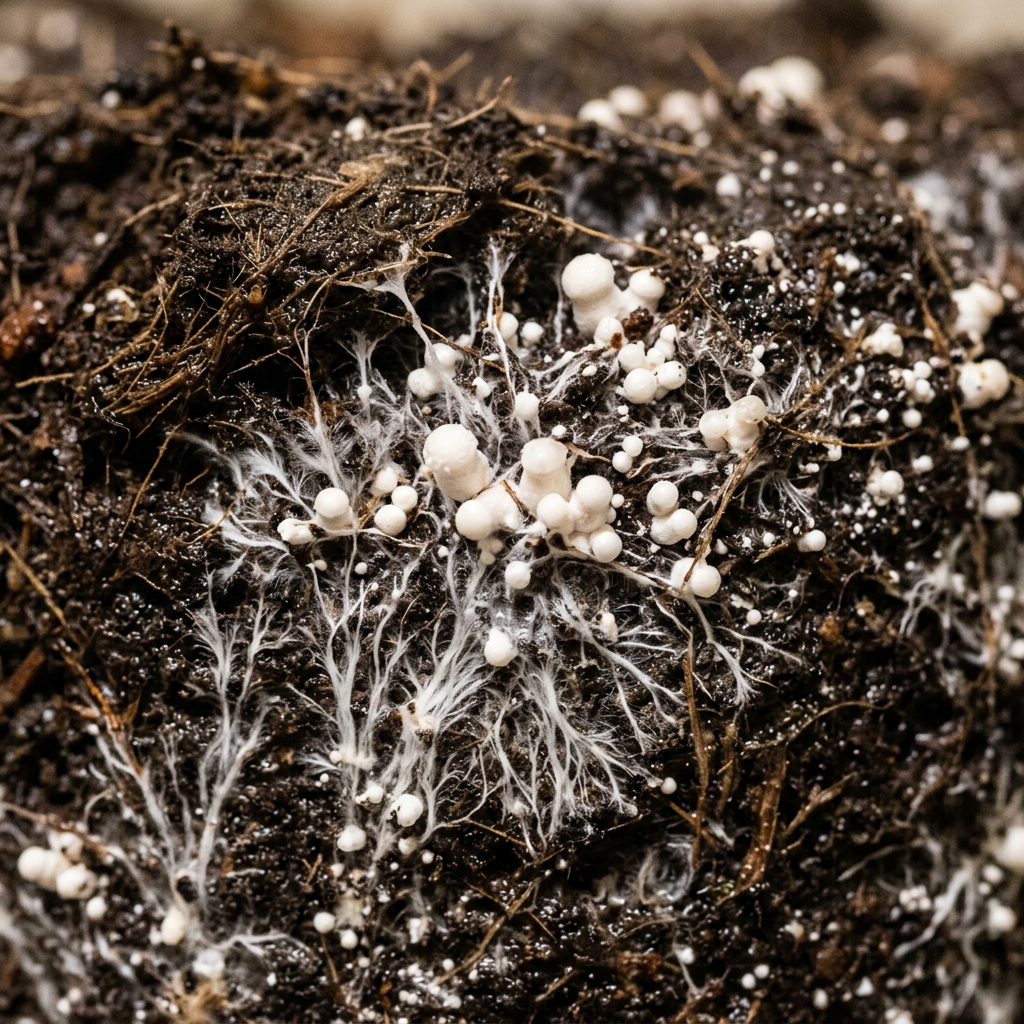
- Pin Head Development: Within 4 to 6 days of the shock, millions of tiny white bumps, called "pins," appear. They are highly fragile and demand 95% relative humidity to prevent drying out.
- The Flush: The pins rapidly swell, doubling in size every 24 hours. Within a week, they develop into mature button mushrooms, ready for the first "flush" (harvest wave).
Common Pitfalls: The Danger of "Overlay"
Mushroom farming requires constant vigilance. If the farmer makes a mistake during the casing run, the entire crop can be lost to a condition known as **overlay**.
Overlay occurs when the environmental shock is delayed, the humidity is too high, or the casing layer is allowed to dry out. Instead of forming pins, the mycelium continues its aggressive vegetative growth. It grows over the top of the casing, forming a thick, dense, felt-like white crust. Once overlay forms, it becomes completely hydrophobic—it repels water like plastic. The crust blocks oxygen exchange and seals the surface, **permanently preventing any mushrooms from breaking through**.
To fix overlay, farmers must physically rake or scratch the surface to break the crust, add a light "patching" layer of fresh casing, and immediately execute the air shock to force pinning before the crust can reform. It is a labor-intensive rescue operation that always reduces final yields.
Conclusion: The Art of Agricultural Deception
The casing layer is a testament to the sophistication of mycology. It is a biological interface where physics, chemistry, and microbiology meet. By using Sphagnum peat, coco coir, limestone, and *Pseudomonas* bacteria, and combining them with a sharp climate shock, farmers pull off a brilliant trick. They convince a subterranean organism that it is under threat on the surface, harvesting the delicious result of its panic.