Every Mushroom Is a Water-Powered Catapult That Fires Spores at Over 10,000 G
A mushroom is, to all appearances, the most passive object in nature. It has no muscles, no nerves, no tendons, no moving parts. It sits in the dark and does nothing. Watch one for an hour and you will see absolutely nothing happen.
This is an illusion. In that same hour, underneath the cap, a single mushroom has performed millions of individual launches — each one a violent, microsecond-long acceleration that ranks among the most extreme in the living world. Every spore a mushroom has ever released was fired from a catapult. And that catapult is built, used once, and destroyed — out of a single droplet of water condensed from the air.
The Man Who Stared at Mushrooms for Thirty Years
We owe this discovery to Arthur Henry Reginald Buller (1874–1944), a British-Canadian mycologist at the University of Manitoba whose patience is the stuff of legend. Between 1909 and 1934 he published Researches on Fungi — seven volumes devoted almost entirely to watching fungi do things too small and too fast for anyone else to bother with.
Peering at gills under a microscope, Buller noticed something nobody had explained: just before a spore vanished from its stalk, a tiny bead of liquid would appear at the spore's base and swell. Then, in an instant too quick to follow, both the bead and the spore were gone. He correctly deduced that the droplet was not a by-product — it was the mechanism. That bead is now called Buller's drop in his honour, and the process is understood as a "surface tension catapult."
It took another seventy years, and cameras shooting at up to 100,000 frames per second, to actually see him proved right.
How the Catapult Is Built
The launch happens on a club-shaped cell called a basidium, which sits in the fertile layer lining every gill. Each basidium grows a few slender stalks called sterigmata, and each sterigma holds one spore. Here is the sequence.
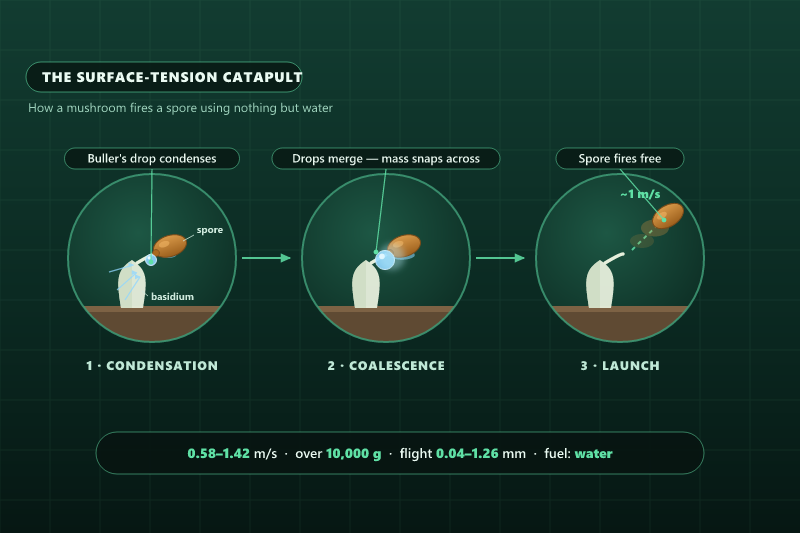
Step 1 — The spore pulls water out of thin air
The spore's surface is coated in hygroscopic sugars — chiefly mannitol and glycerol. These lower the water potential right at the spore's surface, which means water vapour in the surrounding humid air spontaneously condenses onto it. The mushroom is not spending energy pumping fluid; it is letting chemistry harvest water from the atmosphere. A droplet begins to swell at a small knob at the spore's base called the hilar appendix. This is Buller's drop.
Step 2 — Two drops, held apart
At the same time, a second, flatter, lens-shaped film of water — the adaxial drop — spreads across the adjacent face of the spore itself. Now the system is armed: two bodies of water on the same spore, kept from touching by the geometry of the hilar appendix, which acts as a temporary barrier. The catapult is cocked. It stays this way until Buller's drop grows just large enough to bridge the gap.
Step 3 — Coalescence, and the snap
The moment the two drops touch, surface tension does what surface tension always does: it collapses them into one drop, minimising surface area. Buller's drop snaps from the hilar appendix onto the spore's surface. That is a sudden, violent redistribution of mass across the spore — and by conservation of momentum, the spore lurches in the opposite direction, tearing free of its sterigma.
The energy books are revealing. The surface tension released at coalescence amounts to about 0.4 × 10⁻¹² joules — roughly ten times the kinetic energy the spore actually ends up with. The rest is squandered as heat and internal wobbling of the droplet. It is, in engineering terms, a wildly inefficient catapult. It also doesn't matter in the slightest: the fuel is free, condensed out of the air, and the mushroom builds a fresh one for every single spore.
The Numbers That Shouldn't Work
Measured across seven species, launch velocities land between 0.58 and 1.42 m/s. The accelerations are the headline: from about 32,400 m/s² in the wood ear (Auricularia auricula) to roughly 140,000 m/s² — about 14,000 g — in the wheat bunt fungus (Tilletia caries).
For scale: a fighter pilot loses consciousness at about 9 g. A spore shrugs off more than a thousand times that and lands intact and viable.
In the interest of honesty, ballistospory is not the fastest launch in the fungal kingdom. Fungi that use turgor pressure — building up hydraulic pressure and bursting, as the dung fungus Pilobolus does — accelerate their spores roughly ten times harder still. What makes Buller's drop remarkable is not raw speed but elegance: comparable performance from nothing but a water droplet and the physics of a curved surface.
So Why Does It Only Throw the Spore a Hair's Breadth?
Here is where the story turns genuinely beautiful. That 10,000-g launch propels the spore a distance of… 0.04 to 1.26 millimetres. A rounding error. Why build a catapult and then aim it almost nowhere?
Two reasons, and both are exquisite design.
First, the physics. At the scale of a spore, air is not the thin stuff we move through — it behaves more like honey. Viscous drag dominates completely. Drag scales with the spore's radius squared, while its mass and inertia scale with radius cubed. So bigger spores coast further and smaller spores stop almost instantly. No matter how hard you fire it, a microscopic projectile stops dead within a fraction of a millimetre. Firing harder would be wasted effort.
Second, the architecture. A mushroom's gills are packed as tightly as possible — that is the entire point of gills, to cram the maximum spore-producing surface under one cap. But tight packing creates a trap: fire a spore too hard and it slams into the opposing gill and is wasted. So the discharge distance is tuned to roughly half the gap between gills — just far enough to clear the surface it grew on and reach the still air in the middle of the channel, and no further. Armillaria tabescens, for instance, throws its spores a measured 0.06 to 0.10 mm. Fungi that fruit on open, exposed surfaces instead of inside gills — rusts and jelly fungi — fire 0.5 mm or more, because they need to punch out of the layer of sluggish, motionless air clinging to their surface.
In other words, spore size and droplet size are not arbitrary. They are evolutionary dials, tuned species by species to match the geometry of the fungus's own gills. The catapult is calibrated to its own architecture.
And once the spore has cleared the gill and stopped? Gravity takes over. It falls down the channel between the gills and out from under the cap — into the moving air below, where the mushroom's own convection currents carry it away. (That air movement is a trick worth its own story — see how button mushrooms create their own wind.)
Why This Matters Inside a Mushroom Farm
This is not merely a curiosity — it has direct, daily consequences for how we grow mushrooms at Dr. Dahiya Mushroom Farm.
- Humidity is not comfort, it is mechanism. Buller's drop only forms if there is water vapour to condense. This is part of why growing rooms are held at high relative humidity: in air that is too dry, the catapult never arms and spores are simply never released. The fungus's reproduction is hostage to the hygrometer.
- Spores are an occupational hazard. A mature, open-gilled crop fills the air with an astonishing spore load. Chronic inhalation can cause hypersensitivity pneumonitis — known in the trade as "mushroom worker's lung." This is a real reason for ventilation, filtration, and air management in commercial houses.
- It shapes when we harvest. Button mushrooms are picked while the veil is still closed and the gills are sealed underneath. That timing is chosen for quality and shelf life — and it happens to be before the catapults ever start firing. The mushrooms you buy from us are harvested at the stage where their billions of catapults are still cocked, unused.
- It explains sporeless strains. Breeders have developed low-spore and sporeless varieties of oyster mushrooms specifically to protect growers' lungs — strains in which this ancient mechanism is deliberately switched off.
The Scale of the Thing
Buller himself estimated that a single field mushroom (Agaricus campestris) sheds on the order of 16 billion spores over its short life. Every one of those is not simply shed. Each is individually manufactured, individually armed with its own droplet, and individually fired — millions of times an hour, silently, for days.
So the next time you look at a mushroom sitting motionless in the dark, understand what you are actually looking at: not a passive lump of fungus, but a vast battery of microscopic catapults, each one condensing its own ammunition out of the air, each one firing a projectile at 10,000 g, each one aimed with millimetre precision at a gap it cannot see. Doing nothing, very loudly.