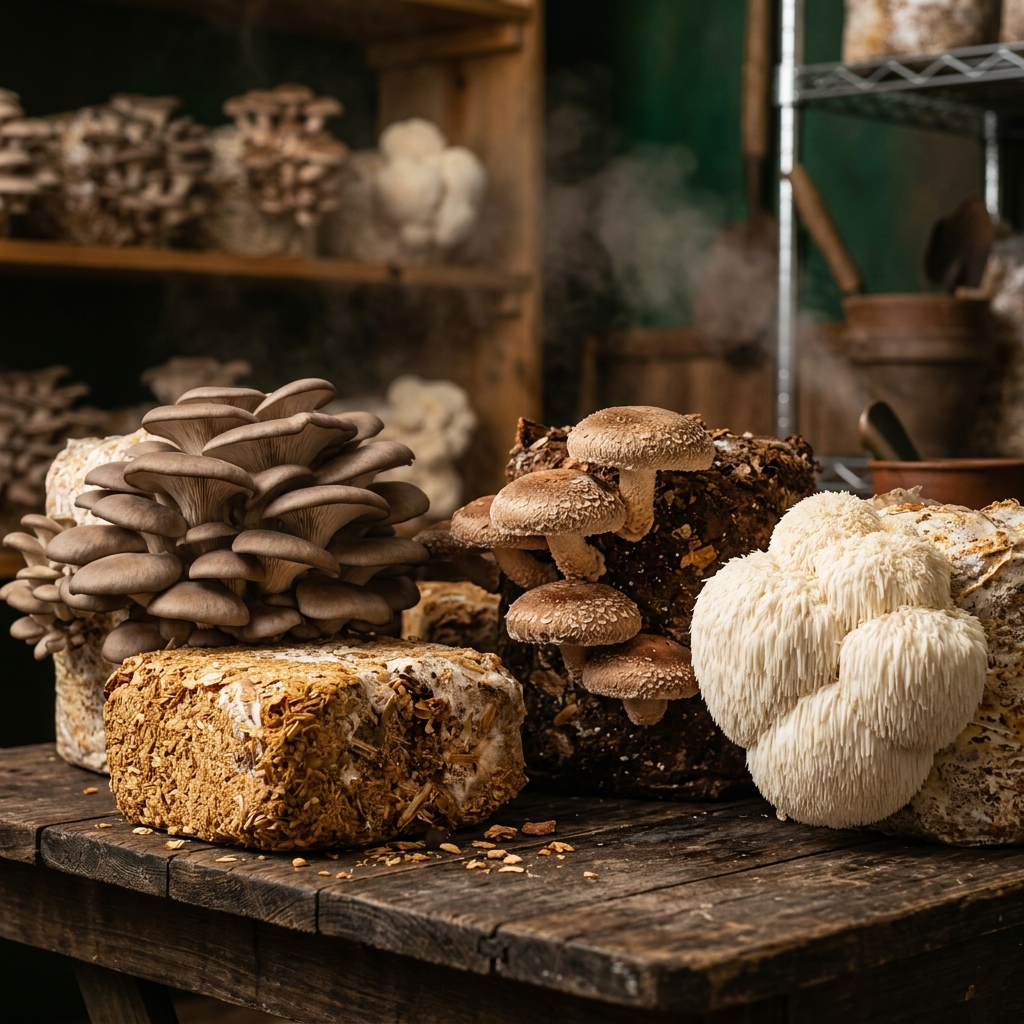
The Secret of the "Fake Wood" Substrate — How Mushroom Farmers Turn Sawmill Waste Into Premium Protein
Most people know mushrooms grow on organic material. They picture them sprouting from fallen logs on a damp forest floor, or poking up from rich, dark compost. But here's what almost nobody realises: the gourmet mushrooms you find at upscale restaurants and farmers' markets — varieties like Shiitake, Oyster, and Lion's Mane — are not grown on logs or soil at all. They're grown on something far more surprising: compressed blocks of sawdust. Waste sawdust. The stuff that lumber mills sweep off their factory floors and pay to have hauled away.
Why Sawdust? The "Fake Wood" Insight
To understand why sawdust is the ideal substrate for gourmet mushrooms, you need to understand where these mushrooms come from in nature. In the wild, Shiitake grows on dead hardwood trees. Oyster mushrooms colonise dying or dead deciduous trees. Lion's Mane fruits from wounds in living hardwoods like oak and beech. They are all wood-decay fungi — organisms that have evolved over hundreds of millions of years to eat wood.
But here's the practical problem with using actual logs: they're slow. A Shiitake log can take 6–18 months to produce its first flush of mushrooms, and the yields are modest and unpredictable. You can't control the moisture content, the nutrient density, or the internal structure of a natural log. You certainly can't sterilise one effectively.
The revolutionary insight — developed primarily by Chinese and Japanese mushroom scientists in the 1970s–80s — was this: what if you could create "fake wood"? What if you could take the raw material of wood (cellulose and lignin), grind it into small particles (sawdust), mix in extra nutrients, pack it into a uniform shape, sterilise it completely, and present it to the mushroom mycelium as an ideal, optimised food source?
That is exactly what the modern "supplemented sawdust block" is. It is, in essence, artificial wood — engineered to be the perfect meal for a wood-decay fungus. And it works spectacularly well. Where a natural log might produce its first Shiitake harvest in a year, a properly formulated sawdust block produces its first flush in 8–12 weeks, with yields that are 3–5 times higher per kilogram of substrate.
The Anatomy of a Sawdust Block: What Goes In
A modern gourmet mushroom substrate block is a carefully engineered recipe. While formulations vary by mushroom species and regional ingredient availability, the basic components are remarkably consistent worldwide:
1. Hardwood Sawdust (70–80% of the mix)
The base material is always hardwood sawdust — typically from species like oak, beech, maple, poplar, mango, or neem (in India). Softwood sawdust (from pine, cedar, spruce) is generally avoided because it contains terpenes and phenolic resins — natural antimicrobial compounds that the tree produces to resist fungal attack. Hardwoods produce far fewer of these inhibitory chemicals, making their sawdust much more hospitable to mushroom mycelium.
The sawdust serves as the primary carbon source — the energetic backbone of the mushroom's diet. The cellulose and hemicellulose in the sawdust are complex carbohydrates that the fungus breaks down into simple sugars for energy. The lignin, while harder to digest, is also slowly degraded by the mushroom's specialised enzyme systems.
2. Nutrient Supplement (15–25% of the mix)
Raw sawdust alone is nutritionally incomplete. It's carbon-rich but nitrogen-poor — like trying to build muscle on a diet of pure sugar. Mushroom mycelium needs nitrogen to synthesise proteins, enzymes, and cellular structures. This is where the agricultural waste supplements come in:
- Soybean hulls: The outer casing of the soybean, removed during processing. They are rich in nitrogen (approximately 12% crude protein), cellulose, and hemicellulose — making them simultaneously a nitrogen supplement and an additional carbon source. Soybean hulls are the single most popular sawdust supplement in commercial Shiitake and Lion's Mane production worldwide.
- Wheat bran: The outer layer of the wheat kernel, separated during flour milling. Contains approximately 15–17% protein and is rich in B vitamins and minerals. Widely used in India and other Asian countries where wheat milling generates enormous quantities of bran as a by-product.
- Oat bran: Similar nutritional profile to wheat bran, with slightly higher beta-glucan content. Popular in North American and European substrate formulations.
- Rice bran: Abundantly available in India and Southeast Asia. Contains 12–15% protein and is an excellent, low-cost nitrogen supplement for mushroom substrates.
- Cottonseed meal: A high-nitrogen supplement (approximately 41% crude protein) used in small quantities. It dramatically accelerates mycelium growth but must be used carefully — excess nitrogen can invite contamination.
3. Water (60–65% moisture content)
The dry ingredients are mixed with water to achieve a final moisture content of approximately 60–65%. This is critical — too dry, and the mycelium can't grow; too wet, and anaerobic bacteria outcompete the fungus. The ideal moisture level allows the mycelium to transport nutrients through its hyphal network while maintaining sufficient oxygen diffusion through the substrate's pore spaces.
4. Gypsum (1–2% of the mix)
A small amount of calcium sulphate (gypsum) is typically added to buffer the pH, improve substrate structure, and provide calcium and sulphur as micronutrients. Gypsum also prevents the wet sawdust from clumping into an impenetrable mass, maintaining the loose, granular structure that allows oxygen to reach the interior of the block.
The Enzyme Arsenal: How Fungi Eat "Fake Wood"
The reason mushrooms can grow on sawdust blocks — while virtually no other food-producing organism can — lies in their extraordinary enzyme systems. Wood-decay fungi have evolved a suite of enzymes that are, collectively, among the most powerful biochemical tools in nature:
- Cellulases: A family of enzymes that break down cellulose — the most abundant organic polymer on Earth — into glucose. Cellulose is the structural backbone of every plant cell wall, and it forms approximately 40–50% of the dry weight of hardwood sawdust. The cellulase system works in three stages: endoglucanases cut the cellulose chains internally, exoglucanases snip off cellobiose units from the chain ends, and beta-glucosidases convert cellobiose into glucose — the simple sugar that the fungus can actually absorb and metabolise.
- Hemicellulases (xylanases): Enzymes that break down hemicellulose — a heterogeneous group of branched polysaccharides that form 20–30% of wood's dry weight. Hemicellulose is easier to digest than cellulose because it is amorphous (non-crystalline) and branched, giving the enzymes more points of attack.
- Laccases and peroxidases: The truly special enzymes — the ones that set white-rot fungi apart from every other organism on the planet. These oxidative enzymes attack lignin, the incredibly tough, irregular, three-dimensional phenolic polymer that cements cellulose fibres together and gives wood its rigidity. Lignin makes up 18–35% of hardwood by dry weight, and it is so chemically complex that only white-rot fungi can fully degrade it. No bacterium, no animal, no plant can do what these fungal enzymes do.
When you inoculate a sawdust block with mushroom spawn, the mycelium secretes this full enzyme cocktail directly into the substrate, digesting it from within. Over the course of several weeks, the block transforms: the pale, loose sawdust becomes thoroughly colonised by white mycelium, then darkens as the lignin is oxidised and the cellulose is consumed. Eventually, when the mycelium has accumulated enough energy reserves, it shifts from vegetative growth to reproductive mode and produces mushroom fruit bodies — the part we eat.
The Numbers: Waste to Protein Efficiency
The efficiency of this waste-to-food conversion is genuinely remarkable. Consider these figures:
- A 2.5 kg supplemented sawdust block typically costs ₹20–40 in raw materials (sawdust + bran + bag).
- It produces approximately 500–750 grams of fresh mushrooms over 2–3 flushes.
- Those mushrooms have a market value of ₹150–500 depending on species and market (Shiitake and Lion's Mane command premium prices).
- The biological efficiency (fresh mushroom weight ÷ dry substrate weight) ranges from 75–125% for oyster mushrooms — meaning the mushroom can actually produce more fresh weight than the dry weight of the substrate it consumed.
- After fruiting, the spent substrate is not waste — it is nutrient-rich compost that can be used directly as a soil amendment, fed to earthworm vermicomposting operations, or used as livestock feed supplement.
Why This Matters for Indian Farmers
India is the world's second-largest producer of agricultural waste, generating over 500 million tonnes annually. Much of this — rice husks, wheat straw, sugarcane bagasse, sawdust from carpentry and furniture workshops — is either burned in the open (contributing to catastrophic air pollution) or dumped in landfills. Simultaneously, India has a massive protein deficiency crisis, with over 70% of the population consuming inadequate protein according to the Indian Market Research Bureau.
Mushroom farming on sawdust and agricultural waste substrates addresses both problems simultaneously:
- Waste elimination: Every tonne of sawdust or wheat straw that goes into mushroom substrate blocks is a tonne that doesn't get burned or landfilled.
- Protein production: Dried mushrooms contain 20–35% protein by weight — comparable to many legumes and significantly higher than most vegetables. And this protein is produced from zero arable land, using only indoor vertical growing space.
- Income generation: A small mushroom growing unit occupying just 100 sq ft of indoor space, using locally available sawdust and wheat bran, can generate ₹15,000–30,000 per month in net income — a transformative amount for rural Indian families.
- Women's empowerment: Substrate preparation, inoculation, and harvesting require minimal physical strength and can be done from home — making mushroom farming an ideal income-generating activity for women in rural and semi-urban communities.
The Bigger Picture: Nature's Original Recyclers
The "fake wood" substrate is not really a human invention — it's a human imitation of what fungi have been doing for over 300 million years. In every forest on Earth, wood-decay fungi are quietly and relentlessly recycling dead trees back into soil nutrients. They are the planet's primary decomposers of woody material — the only organisms that can fully break down lignin and return the locked-up carbon and nutrients to the ecosystem.
Without these fungi, dead wood would simply accumulate forever. Forests would drown in their own dead timber. The carbon cycle would grind to a halt. In fact, this is precisely what happened during the Carboniferous period (359–299 million years ago), before efficient lignin-degrading fungi had evolved. Dead trees piled up in unimaginable quantities, were buried and compressed over geological time, and became coal — the fossil fuel that powered the Industrial Revolution and is now driving climate change.
When a mushroom farmer packs sawdust into a bag, sterilises it, and introduces mushroom mycelium, they are tapping into this ancient, 300-million-year-old recycling system. They are harnessing the same enzymes that ended the Coal Age and unlocked the planet's carbon cycle. The difference is that instead of just returning nutrients to the forest floor, the farmer is intercepting the process and redirecting it to produce human food.
So the next time you see a block of compressed sawdust in a mushroom farm, remember: you're looking at a piece of industrial waste that a fungus — using biochemical tools refined over geological time — will transform into one of the most nutritious, sustainable, and delicious foods on the planet. No soil. No sunlight. No pesticides. Just waste, water, and the extraordinary chemistry of fungi.