A Shaggy White Mushroom May Coax Your Brain Into Growing New Nerve Connections
It does not look like a mushroom at all. There is no cap, no stem, no gills. Instead, lion's mane (Hericium erinaceus) grows as a single white mass covered in long, soft, cascading spines — like a frozen waterfall, or the shaggy coat of the animal it is named after. It grows on hardwood trees, it is entirely edible, and cooked it famously tastes of crab or lobster.
But lion's mane is one of the most intensely researched mushrooms in the world for a reason that has nothing to do with the kitchen. It appears to do something no other food does: it may encourage your own nervous system to repair and grow itself.
This is a topic wrapped in enormous hype, and it deserves better than either breathless overselling or dismissive eye-rolling. The real science is genuinely fascinating — and genuinely unfinished. Let us take it seriously, and honestly.
What Nerve Growth Factor Actually Does
To understand why this matters, you have to understand NGF — a discovery so important it won a Nobel Prize.
Nerve growth factor is one of a family of proteins called neurotrophins. Think of them as the maintenance crew for your nervous system. They keep neurons alive, encourage them to grow and branch, help form and strengthen the connections (synapses) between them, and support repair after damage. As we age, or after injury, neurotrophin activity declines — and with it, some of the brain's capacity to maintain and rebuild itself.
The obvious idea would be to simply give people more NGF. This does not work, and the reason is a beautiful piece of biology. The brain is protected by the blood–brain barrier, a highly selective boundary that keeps most of what is in your bloodstream out of your brain tissue. NGF is a large protein, and like most large proteins it cannot cross. Swallowing NGF, or injecting it into the blood, gets it nowhere near the neurons that need it.
The Clever Part: Don't Deliver NGF — Trigger It
This is where lion's mane does something genuinely elegant, and it is the single most important thing to understand about it.
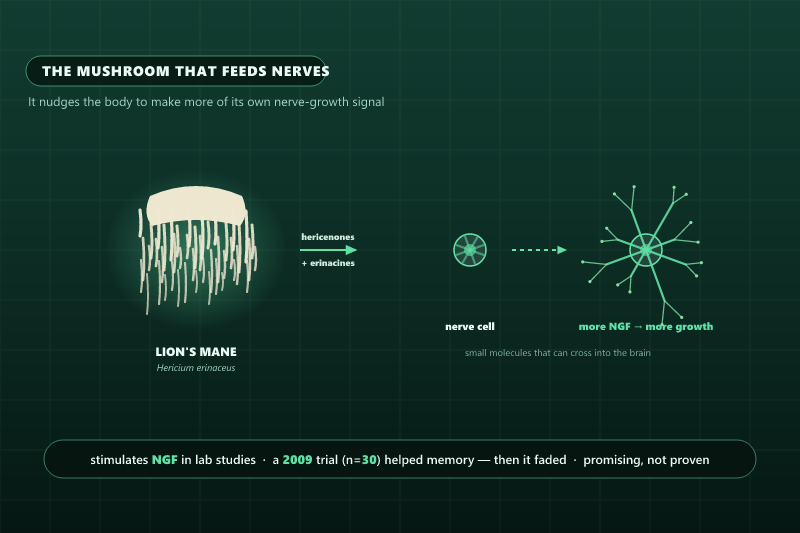
Lion's mane does not contain NGF. It cannot give you a protein it does not have. What its hericenones and erinacines appear to do instead is act as signals: they prompt the body's own cells — particularly a support cell in the nervous system called an astrocyte — to manufacture more NGF themselves, right where it is needed.
And because these compounds are small, fat-soluble molecules rather than bulky proteins, they are candidates to slip across the blood–brain barrier that NGF itself cannot pass. So the proposed mechanism is:
- You eat lion's mane.
- The small hericenone/erinacine molecules are absorbed and may reach the brain.
- There, they signal your own support cells to make more NGF.
- That locally produced NGF does what NGF does — supports and grows neurons.
In other words, lion's mane is not proposed to be a nerve-repair drug you take. It is proposed to be a key that unlocks your own nerve-repair machinery. That is a much more plausible and interesting idea than "eating brain protein," and it is why the mushroom has earned serious scientific attention rather than being written off.
What the Human Evidence Actually Shows
Here is where honesty is essential, because this is exactly the point where marketing outruns the science.
The laboratory and animal evidence is real and repeatable: in cell cultures and in rodents, lion's mane compounds stimulate NGF, promote the growth of nerve projections, and improve outcomes in models of nerve injury and cognitive decline. This is not fringe — it is a substantial, published body of work.
The human evidence is promising but thin. The most-cited human study is a 2009 Japanese trial by Mori and colleagues. It is worth describing precisely, because its shape tells you both what is encouraging and what is unresolved:
- It was a proper double-blind, placebo-controlled trial — the right design.
- But it was small: just 30 older Japanese adults (aged 50–80) with mild cognitive impairment, split into two groups of 15.
- The lion's mane group took about 3 grams per day of dried powder for 16 weeks, and scored significantly better on a cognitive scale than the placebo group at weeks 8, 12 and 16.
- The catch: when the participants stopped taking it, the benefit faded — their scores declined again within about four weeks.
That last point cuts both ways. On one hand, it strengthens the case that the mushroom was actually doing something — the effect tracked with taking it. On the other hand, it shows the effect was not a permanent cure; it was a maintained-while-taken improvement in a very small group. More recent studies, including work on healthy adults and on an erinacine-enriched extract, are broadly encouraging but similarly small and short.
So the honest, defensible summary is this: lion's mane is one of the most scientifically plausible "brain" mushrooms, with a real mechanism and genuine early evidence — but it is not a proven treatment for dementia, memory loss, or any medical condition. It is a promising, actively researched food, not a medicine. Anyone claiming certainty is ahead of the data, and no one should replace medical treatment with a mushroom.
Why This One Is Special Even Setting the Brain Aside
It is worth stepping back, because even the sober version of this story is remarkable. Most of a mushroom's value to us is nutritional or culinary — protein, fibre, flavour, antioxidants like ergothioneine. Lion's mane is being studied for something categorically different: the possibility of influencing the growth of the human nervous system through diet.
And the compounds responsible — hericenones and erinacines — are, as far as we know, essentially unique to the Hericium genus. This is not a generic "mushrooms are healthy" claim. It is specific chemistry, found in specific mushrooms, doing a specific and unusual thing. That specificity is what separates lion's mane from the wall of vague wellness marketing around it.
What It Means for Growing and Eating It
For a mushroom farm, lion's mane is one of the most exciting crops to grow — and this fact shapes how we talk about it, carefully.
- It is a genuine gourmet-and-functional crop. It grows well on supplemented sawdust substrate, commands a premium price, tastes superb, and carries a legitimate — if still-emerging — health story. Few crops combine all three.
- Fruiting body and mycelium differ. Hericenones are concentrated in the fruiting body (the part you eat); erinacines are found in the mycelium (used in some extracts). This matters when comparing a fresh culinary mushroom with a supplement — they are not chemically identical.
- Eat the whole mushroom, and keep expectations honest. The best approach is the least hyped one: enjoy lion's mane as the excellent food it certainly is, benefit from its nutrition, and treat any cognitive upside as a promising bonus under investigation — not a guarantee, and never a substitute for medical care.
- It is a superb teaching example. On our courses, lion's mane is the perfect case study in reading health claims critically: a real mechanism, real early evidence, real limits — and the discipline to hold all three at once.
So: a shaggy white mushroom that tastes of seafood, grows on dead wood, and contains molecules found almost nowhere else on Earth — molecules that may whisper to your own cells to rebuild the connections in your brain. That is astonishing enough to be worth getting excited about, and important enough to describe truthfully.
The wonder is real. So are the caveats. Both deserve to be told.