 Today's Fact
A Mould Growing in a Dirty Dish Became the Most Important Medicine in History
Before the 1940s, a scratch could kill you. A thorn in the garden, a scrape on the knee, an infected tooth, a routine childbirth — any of these could let bacteria into the body, and once an infection took hold, doctors had almost nothing to offer. People died, in enormous numbers, from things we now treat with a few days of pills.
What changed all of that — what quietly became the single most important medical discovery in human history — was a fungus. Specifically, a common green mould, of the kind you have seen growing on old bread or forgotten fruit. Its name is Penicillium, and the drug we make from it, penicillin, is estimated to have saved around 200 million lives.
Almost everyone knows the headline: Alexander Fleming discovered it by accident. Far fewer know the real story, which is stranger, more human, and more instructive than the myth — and which turns on the fact that finding the mould was the easy part.
The Accident
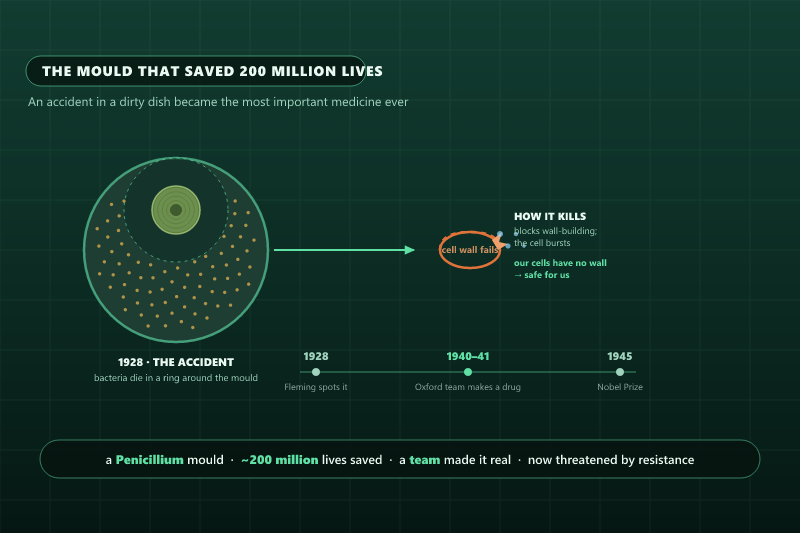
The famous version is essentially true. In September 1928, Fleming came back to his notoriously untidy London laboratory after a summer break to find a stack of petri dishes he had left growing Staphylococcus bacteria. One dish had been contaminated — a mould spore, probably drifting up from a laboratory below, had landed and grown into a fuzzy colony.
Most scientists would have thrown out a spoiled plate without a second thought. What made Fleming's moment matter was what he noticed: in a clear halo surrounding the mould colony, the bacteria had died. Something the mould was producing had diffused out into the jelly and dissolved the bacteria around it. He identified the mould as a species of Penicillium, and named the mysterious antibacterial substance "penicillin."
It is a genuine story of scientific luck meeting a prepared mind — Fleming was alert enough to see significance in a "ruined" experiment. But here the heroic version usually stops, and that is exactly where the truth gets more interesting.
The Part the Legend Leaves Out
Fleming had found something remarkable. He then largely failed to develop it — not through carelessness, but because the problem was genuinely hard. Penicillin proved extremely difficult to extract and purify: it was unstable, present in tiny quantities, and Fleming was a bacteriologist, not a chemist. He published his findings in 1929, could not turn the substance into a usable drug, and by the mid-1930s the discovery had gone quiet. For roughly a decade, penicillin was a curiosity in the scientific literature, saving no one.
The people who actually gave the world penicillin were a team at the University of Oxford, working around 1939–1941:
- Howard Florey, an Australian pathologist, who led the project and drove it forward.
- Ernst Chain, a biochemist and refugee from Nazi Germany, who worked out how to isolate and stabilise the active compound.
- Norman Heatley, whose ingenuity in growing the mould and extracting the penicillin — improvising equipment, even using hospital bedpans as culture vessels — made it possible to produce enough to test at all.
In 1940 the Oxford team showed that purified penicillin could cure mice of otherwise fatal bacterial infections. In 1941 they treated their first human patient. The results were miraculous — and immediately revealed the next enormous problem: they could barely make any of it. Producing enough penicillin to treat a single patient took a heroic laboratory effort. To save millions, someone would have to manufacture it by the tonne.
The War That Made a Medicine
The final act is one of industrial science under wartime pressure. Britain, under bombardment and stretched to its limit, could not build the vast production the drug needed. So in 1941 Florey and Heatley carried their precious mould to the United States, where government laboratories and pharmaceutical companies took up the challenge.
The breakthroughs that followed were as important as the original discovery:
- Scientists developed deep-tank fermentation — growing the mould in enormous vats rather than on the surface of countless small flasks.
- A worldwide hunt for a more productive strain famously ended with a mould found on a rotting cantaloupe in an Illinois market, which yielded far more penicillin than Fleming's original.
- Production was scaled so fast that, by the time of the D-Day landings in 1944, there was enough penicillin to treat the wounded of the Allied armies — saving countless soldiers who would otherwise have died of infected wounds.
In 1945, Fleming, Florey and Chain shared the Nobel Prize in Physiology or Medicine. It is worth noting who is remembered and who is not: Fleming, the discoverer, became a household name; Heatley, whose hands-on genius made the drug producible, received no Nobel and far less fame. The real story of penicillin is not a lone genius — it is a chain of people, over more than a decade, each solving a piece of the puzzle. Discovery is not the same as delivery.
How a Fungus Kills Bacteria (and Spares Us)
Why does the mould make penicillin at all? In the wild, Penicillium competes with bacteria for food. Producing a chemical that kills nearby bacteria is simply chemical warfare — a way for the fungus to clear its rivals from a patch of rotting fruit. We did not invent penicillin; we discovered a weapon fungi had already been using against bacteria for hundreds of millions of years.
The mechanism is beautifully precise, and it explains why the drug is so safe for us:
- Bacteria are wrapped in a rigid cell wall that holds them together against their own internal pressure.
- Penicillin blocks the enzyme that stitches this wall together (it jams the "cross-linking" step of wall construction).
- A growing bacterium therefore cannot build a sound wall. Under its own internal pressure, it effectively bursts and dies.
- Crucially, human cells have no cell wall at all. Penicillin's target simply does not exist in our bodies — so it destroys the bacteria while leaving our own cells untouched. That selective toxicity is what makes it a near-perfect drug.
The Shadow: Resistance
No honest account of penicillin can end on pure triumph, because the story has a serious final chapter — and Fleming himself gave the warning.
In his 1945 Nobel lecture, Fleming cautioned that bacteria could become resistant to penicillin if it were used carelessly. He was right. Because bacteria reproduce and evolve so quickly, exposing them to an antibiotic relentlessly selects for the rare individuals that can survive it — and those pass on their resistance. Decades of overuse, in both medicine and agriculture, have produced bacteria that our original wonder-drug can no longer touch. Antibiotic resistance is now one of the most serious threats in global health, and it is, in a sense, the predictable price of using the fungus's weapon so heavily.
This does not diminish penicillin — it deepens it. The drug remains one of humanity's greatest gifts, and it came, unasked, from a mould. Preserving its power is now our responsibility.
Why We End the Month on This
We grow mushrooms, not moulds — but penicillin is, in a sense, the most important fact in this entire collection, and it belongs at the heart of how we teach people to see fungi.
- Fungi are not a curiosity — they are a pillar of human survival. People think of fungi as food, or as something that spoils the bread. But the fungal kingdom handed us the medicine that ended the age when a scratch could kill. No group of organisms has done more, quietly, for human life.
- It is the same chemistry we celebrate all month, aimed at a different target. The enzyme arsenal that lets fungi dismantle wood, the antibiotics leafcutter ants farm on their bodies, the compounds in lion's mane — penicillin is one more expression of fungi's astonishing chemical creativity. They are the planet's great chemists.
- It reframes what a mushroom farm is part of. When we cultivate fungi, we are working with the same kingdom that gave the world antibiotics, bread, and half its cuisine. That is a lineage worth taking seriously — and sharing, especially with the students who visit us.
So the next time you see a fuzzy green patch of mould and reach to throw it away, pause for just a second. A patch exactly like that, spotted in a dirty dish by a scientist who bothered to look closely, went on to save more human lives than almost anything else we have ever found.
The fungi were making medicine long before we knew to ask. We were simply lucky enough, once, to notice.