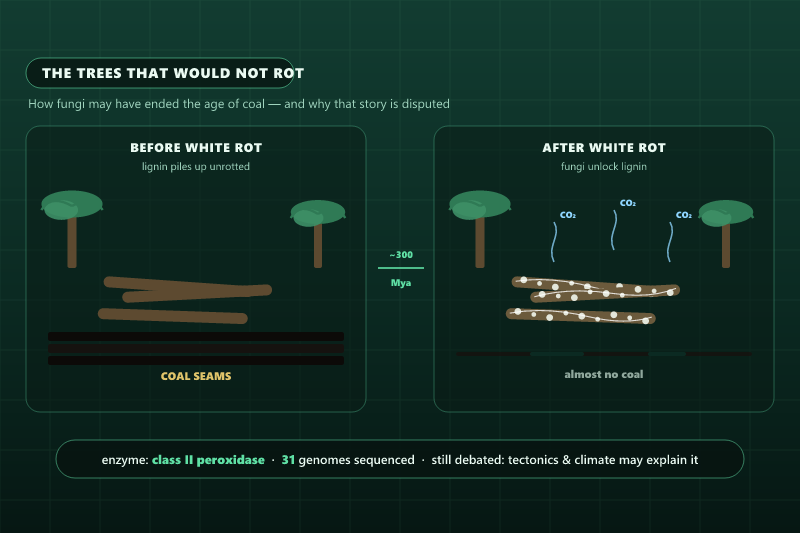
Almost All the World's Coal Formed in One Window — and Fungi May Have Closed It
Every lump of coal ever burned — every tonne that powered the Industrial Revolution, every seam still being mined — is the compressed remains of plants that died hundreds of millions of years ago and, crucially, failed to rot.
That failure is the whole story. Rotting is the normal fate of a dead tree: fungi and bacteria dismantle it, and its carbon returns to the atmosphere as CO₂. Coal only exists because, for a long stretch of Earth's history, that dismantling did not happen properly. Dead trees fell, and simply stayed.
The period is so defined by this that we named it after the result: the Carboniferous — the carbon-bearing age, roughly 359 to 299 million years ago. And there is a famous, elegant explanation for why it ended, in which the villains — or heroes — are the ancestors of the mushrooms we grow today.
Why Lignin Was Such a Problem
To appreciate the scale of the challenge, consider what lignin actually is.
Cellulose — the other main component of wood — is a long chain of sugar units linked in a regular, repeating pattern. Regularity is a weakness: a predictable bond can be attacked by an enzyme shaped to fit it, and plenty of organisms digest cellulose.
Lignin is the opposite. It is a three-dimensional, irregular, randomly cross-linked aromatic polymer. There is no repeating unit to target, because no two lignin molecules are built quite the same way. It is less like a chain and more like set concrete poured through the plant's cell walls.
This was a triumph for plants. Lignin let them stand upright and grow tall enough to form the first great forests, and it made their tissue nearly indigestible. But it created a problem for the rest of the biosphere: it produced enormous quantities of organic carbon that the normal recycling machinery could not process. The carbon went into the ground and stayed out of circulation.
The Enzymes That Cracked It
What eventually solved lignin was not a better lock-and-key enzyme, because a molecule with no consistent structure cannot be attacked that way. The solution was chemical brute force.
White rot fungi deploy class II peroxidases — lignin peroxidase and manganese peroxidase — which generate highly reactive, non-specific oxidising agents. Rather than recognising a particular bond, these enzymes produce free radicals that attack lignin more or less indiscriminately, tearing the network apart wherever they meet it.
This is why white rot fungi are such spectacular decomposers, and why their enzymes are so useful outside the forest. It is exactly the same chemistry we described in spent mushroom substrate: laccases and peroxidases so unfussy about their targets that they will also degrade industrial dyes, pesticides and petroleum residues. An enzyme evolved to dismantle the most irregular polymer in nature turns out to be excellent at dismantling molecules evolution never anticipated.
It is also, incidentally, why oyster mushrooms can grow on coffee grounds and cardboard. That capability is a direct inheritance from this ancient arms race.
The Story — and Why It May Be Wrong
The narrative writes itself, and you will find it repeated confidently across the internet: plants invented lignin, nothing could eat it, coal piled up for 60 million years, then fungi learned the trick and the age of coal ended forever.
It is a wonderful story. It may also be substantially wrong, and it would be dishonest to present it as settled.
In 2016, a team led by Matthew Nelsen, with William DiMichele, Shanan Peters and C. Kevin Boyce, published a direct challenge in PNAS, under the pointed title "Delayed fungal evolution did not cause the Paleozoic peak in coal production." Their objections are substantive:
- The timing is not precise enough to carry the argument. Molecular clock estimates for the origin of lignin-degrading peroxidases have wide error bars. Claiming a causal link requires sharper dating than the method currently supports.
- Lignin was not always the main component. In many of the plants that formed these coals — particularly the giant lycopsids — lignin-rich wood was of secondary importance. Much of the biomass was bark-like tissue. If shifts in lignin abundance had no obvious effect on coal formation, lignin cannot be the master variable.
- Evidence of decay is everywhere. Fossil evidence of lignin degradation — including by fungi — is widespread in the relevant deposits. The picture of an undecayed world is too simple. Indeed, a total absence of lignin decay would have disrupted the global carbon cycle far more dramatically than the record shows.
- There is a better-supported explanation. The rise and fall of coal deposits tracks a specific and unrepeatable combination of climate and tectonics during the assembly of Pangaea: mountain-building created persistently subsiding basins, and those basins sat in the everwet tropics. You need a place where dead plants are continuously buried below water and protected from oxygen. Pangaea produced those conditions on an enormous scale, and then stopped producing them.
So the honest position today is genuinely split. The 2012 genomic work stands — the Agaricomycete ancestor really did evolve lignin-degrading peroxidases, and this really was a major event in the history of life. What is contested is the causal claim that this evolutionary step is why coal formation declined. A reasonable reading is that fungal decay was a contributing factor among several, with geology doing much of the heavy lifting.
This is worth sitting with, because it is how science actually behaves. A beautiful hypothesis appeared, spread widely because it was satisfying, and then met a rigorous challenge. The uncertainty is not a flaw in the story — it is the story.
What It Means That Fungi Can Do This At All
Set the coal question aside and one fact remains undisputed: at some point, fungi acquired the ability to fully decompose wood, and nothing else on Earth does it as well.
Consider the alternative. Roughly every tree that has died since has been dismantled and returned to the atmosphere and soil largely by fungi. Without that, forests would bury themselves in their own undecayed remains, and the carbon and nutrients locked in wood would never return to circulation. The reason a fallen log in a forest disappears over years instead of persisting for geological ages is that fungi digest it.
Fungi are not merely participants in the carbon cycle. On land, they are substantially responsible for closing it.
The Same Chemistry, in a Bag of Straw
Here is what makes this fact more than a geology lesson for a mushroom farm.
When we prepare substrate, we are running a small, deliberate version of the process described above. Wheat straw is lignocellulose — the same cellulose-and-lignin composite that made Carboniferous wood so indigestible. Growing mushrooms on it means putting an organism to work on the exact chemical problem that shaped the ancient carbon cycle.
- It explains why substrate preparation matters so much. Composting and pasteurisation exist to make that lignocellulose accessible. We are helping the fungus with a genuinely hard chemical task.
- It explains the species split. Aggressive white rot fungi like oyster mushrooms attack raw lignocellulose directly. Agaricus bisporus is fussier and needs its food pre-digested by thermophilic bacteria first. Different strategies against the same ancient polymer.
- It explains why farming straw into food works at all. Straw is agricultural waste precisely because livestock and humans cannot extract much from lignified tissue. A mushroom farm converts an indigestible waste stream into protein — using enzymes that took hundreds of millions of years to evolve.
So when you next look at a colonised bag of straw, place it properly in time. That white mycelium is running the same biochemical toolkit whose arrival may have helped close the greatest carbon-burial episode in Earth's history — and which has been quietly recycling the world's dead wood ever since.
We just point it at straw and harvest the mushrooms.