Button Mushrooms Eat "Pre-Digested" Food Prepared by Extremophiles
Here is a fact that surprises even experienced farmers: button mushrooms (Agaricus bisporus) are actually quite delicate eaters. Despite being heterotrophs that digest organic matter, they cannot easily grow on raw straw, fresh manure, or untreated wood. If you simply pile up wheat straw and sprinkle mushroom spawn on it, the result is not a mushroom crop — it is a thriving colony of aggressive wild molds, bacteria, and competitor fungi that outcompete Agaricus and steal every available nutrient.
To solve this problem, commercial mushroom farming relies on one of the most sophisticated biological engineering processes in all of agriculture: a two-part composting system where the real work is done not by the farmer, but by billions of heat-loving microorganisms called thermophiles.
Phase I: The Violent Fermentation
Before the extremophiles can do their work, the raw materials must be prepared. Phase I composting begins outdoors on large concrete yards called composting wharves. The base ingredients — typically wheat straw, horse manure or poultry litter, gypsum (calcium sulfate), and water — are mixed into long windrows (piles) that can stretch 30 meters long and stand 2 meters high.
Over the next 7 to 14 days, these windrows undergo a violent, uncontrolled aerobic fermentation. Indigenous mesophilic bacteria (those thriving at moderate temperatures of 25–40°C) begin breaking down the simple sugars and soluble carbohydrates in the straw. This microbial activity generates enormous heat — internal temperatures routinely climb to 70–80°C — and releases clouds of ammonia gas as the nitrogen-rich manure decomposes.
The windrows are mechanically turned every 2–3 days using specialized turning machines. Each turn redistributes moisture, exposes fresh material to oxygen, and prevents anaerobic (oxygen-starved) pockets from forming. The ammonia concentration in Phase I compost is extremely high — typically 1,000–2,000 ppm — which is toxic to virtually every organism except the hardiest thermophilic bacteria.
By the end of Phase I, the compost has been physically broken down, is uniformly dark brown, and is saturated with ammonia and partially degraded organic compounds. It is a hostile chemical environment that no mushroom could survive in. This is where Phase II takes over.
Phase II: The Extremophile Takeover
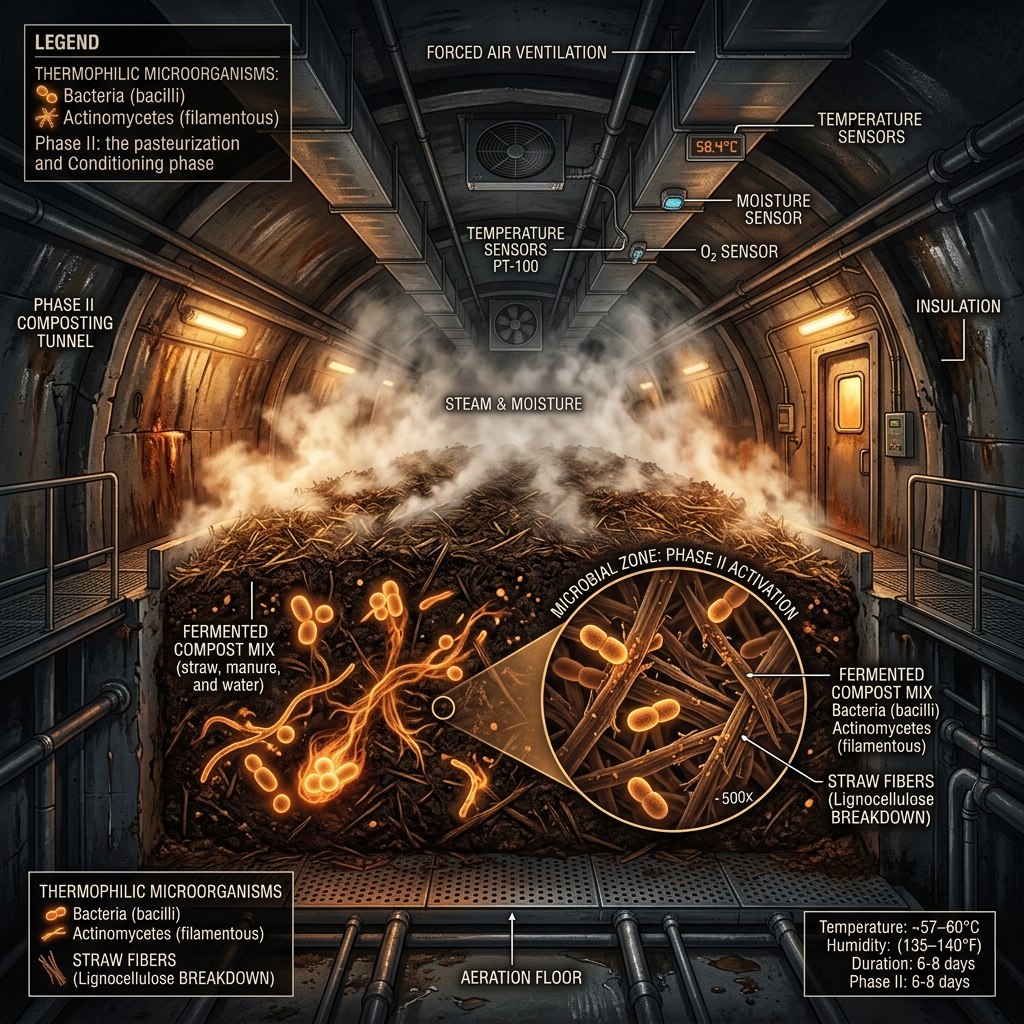
Phase II composting is where the true science happens. The raw Phase I compost is loaded into sealed, insulated tunnels — typically concrete or steel chambers equipped with computer-controlled air handling systems, temperature probes, and recirculation fans. These tunnels are the bioreactors of the mushroom industry.
The process unfolds in two precisely controlled stages:
Stage 1: Pasteurization (Peak Heat)
Steam or heated air is injected into the tunnel to raise the compost temperature to 58–62°C and held there for a minimum of 6–8 hours. This pasteurization step is critical — it kills the wild molds, weed seeds, nematodes, and insect larvae that would otherwise devastate a mushroom crop. Unlike food pasteurization (which kills everything), compost pasteurization is carefully calibrated to eliminate pests while preserving the beneficial thermophilic microorganisms that are the true stars of Phase II.
Stage 2: Conditioning (The Extremophile Window)
After pasteurization, the temperature is carefully lowered to 48–52°C and held in this narrow range for 4–7 days. This is the sweet spot where thermophilic microorganisms — organisms that thrive at temperatures that would kill most life on Earth — explode in population and perform their transformative work.
The two most important groups of extremophiles in Phase II compost are:
1. Thermophilic actinomycetes (particularly Thermoactinomyces, Streptomyces thermovulgaris, and Humicola insolens): These filamentous bacteria form a distinctive white, chalky coating on compost particles that experienced mushroom farmers call "fire-fang." They produce powerful extracellular enzymes — including cellulases, hemicellulases, and proteases — that break down the complex plant cell wall polymers (cellulose and hemicellulose) in straw into simpler sugars and organic acids that Agaricus bisporus can absorb.
2. Thermophilic bacteria (including Bacillus species and Thermus species): These organisms perform the critical task of ammonia assimilation. They absorb the toxic free ammonia from the compost and incorporate it into their own cellular protein. When these bacteria eventually die, their protein-rich biomass becomes a slow-release nitrogen source that the mushroom mycelium can digest over weeks — essentially converting a toxic gas into a gourmet nitrogen fertilizer.
Why This Matters: The Selectivity Principle
The genius of Phase II composting is that it creates a substrate with a very specific chemical profile:
- Ammonia level drops below 10 ppm (from 1,000+ ppm in Phase I) — making the compost non-toxic to mushroom mycelium
- Simple sugars are exhausted — the thermophiles have consumed all the easy-to-digest carbohydrates, which means competitor molds (like Trichoderma, the green mold) have nothing left to eat
- Complex lignocellulose remains intact — the structural polymers that Agaricus bisporus specializes in breaking down are still available as a long-term food source
- Microbial protein is abundant — the dead bodies of thermophilic bacteria provide a rich, slow-release nitrogen source
- pH is stabilized at 7.0–7.5 — the ideal range for Agaricus mycelium growth
This chemical profile is called selective compost because it selectively favors Agaricus bisporus over every other organism. The thermophiles have eaten everything that competitors could use, while leaving behind exactly the nutrients that button mushrooms need. It is a biological lock-and-key system where Phase II compost is the lock, and Agaricus is the only key that fits.
The Numbers Behind the Process
The scale of Phase II composting in commercial mushroom farming is staggering:
- A single composting tunnel typically holds 80–120 tonnes of Phase I compost
- The pasteurization phase consumes approximately 200–400 kg of steam per tonne of compost
- Air recirculation rates during conditioning reach 150–200 m³ per tonne per hour
- The thermophilic microbial population during conditioning can exceed 10⁹ colony-forming units per gram of compost — that's a billion organisms in a single gram
- Total Phase II duration: 5–8 days from loading to spawning-ready compost
What Happens If You Skip Phase II?
If a farmer attempts to grow button mushrooms on Phase I compost (or worse, raw straw), the results are catastrophic:
- Residual ammonia at 200+ ppm kills mushroom mycelium on contact
- Competitor molds — especially Trichoderma harzianum (green mold) — colonize the substrate within 48 hours, producing antifungal metabolites that prevent Agaricus growth entirely
- Bacterial blotch (Pseudomonas tolaasii) thrives in the unstable microbial environment, causing brown lesions on any mushrooms that do manage to form
- Sciarid flies and nematodes, which were not killed by pasteurization, breed explosively in the warm, nutrient-rich substrate
In short, without Phase II, you don't get a mushroom farm — you get an expensive pile of contaminated, ammonia-soaked compost crawling with pests.
The Dr. Dahiya Farm Approach
At Dr. Dahiya Mushroom Farm in Sonipat, Haryana, we operate computerized Phase II tunnels with real-time temperature monitoring at multiple depths within the compost bed. Our conditioning protocol maintains the thermophilic window at precisely 50 ± 1°C for 5 days, achieving consistent ammonia levels below 5 ppm at spawn-run. This precision is what allows us to achieve first-flush yields of 25–30 kg per square meter — well above the Indian industry average.
The next time you eat a button mushroom, remember: before it ever grew, billions of invisible extremophiles spent a week in a 60°C sauna, eating everything in sight, just to prepare the perfect meal for that mushroom. Every button mushroom is, quite literally, dining on food that was pre-digested by organisms that live in conditions approaching those of volcanic hot springs.