Ants Were Farming Mushrooms 50 Million Years Before Humans Existed
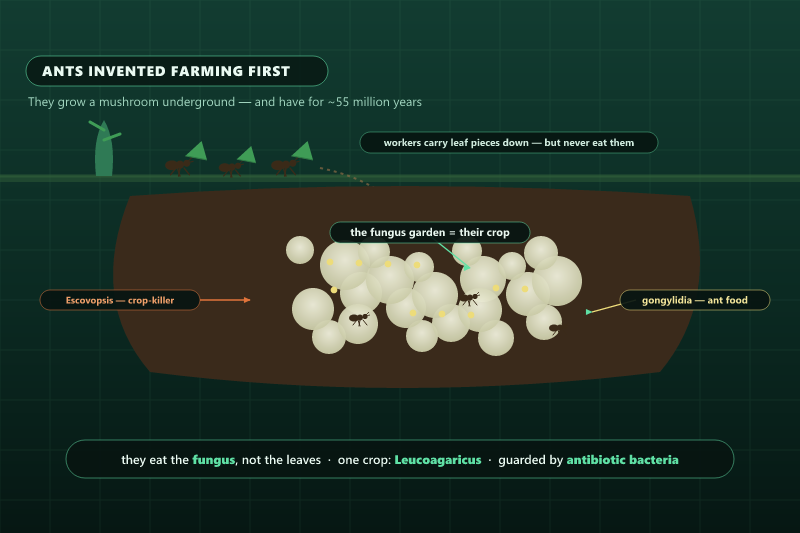
If you walk through a Central or South American forest, you may see one of nature's most famous sights: a moving green river across the forest floor, made of thousands of ants, each holding aloft a neatly cut fragment of leaf many times its own size. These are leafcutter ants, and the columns can strip a tree bare overnight.
The obvious assumption is that they are carrying the leaves back to eat. They are not. Leafcutter ants cannot digest leaves at all. Every one of those hard-won fragments is destined for something else entirely — and understanding what reveals one of the most sophisticated relationships in the living world.
The ants are not gathering food. They are gathering compost. They are farmers, carrying feedstock home to a crop — and the crop is a fungus.
A Crop That Cannot Leave, and Farmers That Cannot Eat Anything Else
What makes this true agriculture — and not just "ants that happen to live near a fungus" — is how total the dependence has become. Over tens of millions of years, ant and fungus have grown so entwined that neither is a complete organism without the other. Biologists call this an obligate mutualism.
- The ants cannot digest leaves. They lack the enzymes to break down tough plant material. The leaves they gather are useless to them as food — they are raw material for the crop, nothing more.
- The fungus cannot survive on its own. This particular cultivar is found essentially only in ant nests. It has been farmed for so long that it depends entirely on the ants to feed it, weed it, and spread it. It has, in effect, been domesticated into a crop that can no longer live in the wild — much as many human crops can no longer survive without us.
- New queens carry the crop with them. When a young queen leaves to found a new colony, she takes a small pellet of the fungus in a special pouch in her mouth. She flies off carrying, quite literally, the seed of next year's harvest. The farm is inherited, mother to daughter, across millions of years.
This is the same principle we see in our own crops: a plant so changed by cultivation it needs a farmer, and a farmer whose survival depends entirely on the crop. The leafcutters simply arrived at it 50 million years before the first human planted a seed.
The Division of Labour
A leafcutter colony — which can contain millions of individuals — runs the operation as a genuine production line, with different castes of ant doing different jobs, exactly like workers with different roles on a farm:
- Foragers climb the trees and cut the leaf fragments.
- Carriers transport them home along the trails.
- Smaller workers chew the leaves into a pulp and press it into the fungus garden as fresh mulch.
- Gardeners tend the crop — planting tufts of fungus onto new mulch, weeding out contaminants, and harvesting the gongylidia to feed the colony, including the larvae and the queen.
The gongylidia deserve special attention, because they are the clearest sign that this is a true partnership and not exploitation. They are swollen tips of the fungal threads, rich in lipids and sugars — and the fungus grows them specifically as ant food. It is, in effect, the crop offering fruit to its farmer: the fungus produces an easy, nutritious package precisely because well-fed ants are its route to survival and spread. Crop and farmer feeding each other, each shaped by the other over millions of years.
The Part That Sounds Like Science Fiction: Antibiotic Farming
A monoculture is fragile. Any farmer knows that a single crop, grown densely in one place, is a feast waiting for the right pest — and the leafcutters' fungus garden is exactly that. It has a dedicated enemy: a parasitic fungus called Escovopsis, which appears to eat nothing else and, left unchecked, can destroy a colony's entire food supply within weeks.
Here is where the story becomes genuinely astonishing. The ants defend their crop with antibiotics — and they have been doing so for millions of years.
On their own bodies, many fungus-growing ants cultivate colonies of bacteria in the genus Pseudonocardia, living on their exoskeletons. These bacteria produce antifungal and antibiotic compounds that specifically suppress Escovopsis while sparing the crop. The ant is, in effect, wearing a living pharmacy — a bodyguard microbe that manufactures pesticide on demand. When gardeners detect infection, the antibiotics help beat it back.
Step back and count the players in this single system:
- The ant — the farmer.
- The Leucoagaricus fungus — the crop.
- The Escovopsis fungus — the crop-specific pest.
- The Pseudonocardia bacteria — the antibiotic-producing bodyguard.
That is a four-way coevolutionary arms race, running continuously for tens of millions of years — an ecosystem of agriculture, pest and pesticide packed into a nest under the forest floor. And it is not one-sided: research suggests the parasite fights back with its own chemical weapons, including compounds that can sabotage the ants' defensive behaviour. The war is still going on.
Humbling for a Human Farmer
It is worth pausing on how thoroughly the ants got there first. Every technique we think of as advanced, sustainable agriculture, the leafcutters were already practising before primates existed:
- Growing a crop on composted plant waste — exactly the composting principle behind commercial mushroom growing.
- Cultivating a single, domesticated cultivar — a clonal crop line maintained and propagated by the farmer, just as button mushroom farming relies on clonal strains.
- Biological pest control — using one organism (antibiotic bacteria) to defend the crop against another, rather than blanket chemical spraying.
- Waste recycling — spent, exhausted garden material is carried out to refuse chambers, closing the loop.
The parallels to our own farm are not a coincidence — they are convergence. When you set out to cultivate a fungus for food, the same problems arise (feed it, keep it pure, defend it, propagate it), and both ants and humans arrived at the same broad solutions. The difference is that the ants have been refining theirs for 55 million years, and we have had roughly ten thousand.
The Real Lesson
We opened by saying the ants were carrying leaves. They were, but that was never the point — the leaves are just the means. The actual centre of a leafcutter colony, the thing everything else serves, is the fungus: a pale, humble garden of mycelium that the entire vast society exists to feed, tend and protect.
It is a striking mirror of our own work. Strip away the machinery and a mushroom farm is the same thing: a human society organised around feeding and protecting a fungus, because that fungus feeds us back. The leafcutters remind us that this bargain — we care for the fungus, the fungus cares for us — is not a modern invention or even a human one.
It is one of the oldest and most successful partnerships on Earth, and we are only its most recent participants.