One Fungus Has 23,328 Sexes — Your Button Mushroom Has Almost No Sex Life at All
Humans have two sexes. So do most animals, and most plants keep to a similar arrangement. It feels like a law of nature — a binary that biology simply obeys.
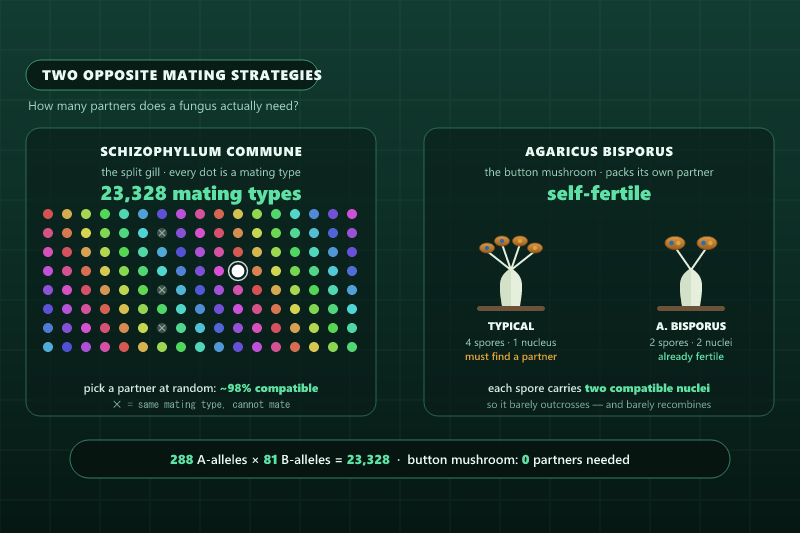
Fungi did not get the memo. There is a small, tough, fan-shaped fungus called the split gill (Schizophyllum commune) growing on dead wood on every continent except Antarctica. It has, by the standard count, 23,328 mating types.
And the mushroom in your kitchen? It went in exactly the opposite direction. Agaricus bisporus — the white button mushroom — solved the problem of finding a partner by packing one inside every spore it makes. It doesn't need anybody. That single quirk of fungal sex is the reason nearly every white button mushroom on Earth is, genetically speaking, almost the same mushroom.
First: "Sexes" Is the Wrong Word
Calling them sexes is a useful headline but a poor description. Fungi have no males and no females. There is no egg, no sperm, no large gamete and small gamete. When two fungal mycelia meet, they simply fuse their hyphae and swap nuclei. Both partners contribute equally, and both carry on growing. Nobody is fertilised; nobody does the fertilising.
What geneticists actually call these categories is mating types, and their job is not to define a role in reproduction. Their job is self-recognition — a molecular ID check. Two mycelia are only allowed to form a fertile partnership if their mating-type genes differ. That is it. The system exists for one overriding reason: to stop the fungus from mating with itself or its siblings.
Once you see mating types as an anti-inbreeding device rather than a sex, the number 23,328 stops sounding absurd and starts sounding like good engineering.
How the Split Gill Reaches 23,328
Schizophyllum commune uses what is called a tetrapolar system: two separate, unlinked mating-type loci that must both be different for a partnership to work.
- The A locus encodes homeodomain transcription factors — proteins that pair up across the two partners and switch on the developmental programme for a fertile joint mycelium.
- The B locus encodes pheromones and pheromone receptors — a chemical lock-and-key that governs whether nuclei are allowed to migrate through the other partner's hyphae.
Each locus is multiallelic: rather than the two options a biallelic gene offers, natural populations hold up to 288 different A alleles and 81 different B alleles. Because compatibility requires a mismatch at both, every combination is a distinct mating type: 288 × 81 = 23,328.
Why this is such a good trick
Run the arithmetic on what that buys the fungus. For a random partner to be incompatible, it must match at A (a 1-in-288 chance) or at B (1-in-81). Work it through and roughly 98% of all other individuals in the species are viable partners.
Compare that to our own binary. With two sexes, half the population is off-limits to you before anything else is considered. The split gill has engineered a system where almost nobody is off-limits — except its own close relatives, who are the ones most likely to share its alleles. It is a mechanism that maximises outbreeding and minimises inbreeding at the same time.
It is worth noting that Schizophyllum commune is one of the most widely distributed fungi on the planet. The strategy appears to work.
The Button Mushroom Took the Opposite Road
Now look at Agaricus bisporus, and prepare for a genuine oddity.
In a typical mushroom, a basidium performs meiosis to produce four nuclei, then grows four spores and pushes one nucleus into each. Every spore lands as a single-mating-type individual — a homokaryon — which must find a compatible stranger before it can ever produce a mushroom of its own.
Agaricus bisporus cheats. Its name is the clue: bi-sporus, two spores. Most of its basidia grow only two spores — and then push two of the four post-meiotic nuclei into each one. Crucially, the two nuclei packed together are usually of compatible mating types.
The consequence is remarkable. Each spore is not a lonely half-organism looking for a partner. It is a complete, self-fertile, ready-to-go heterokaryon — a fungus that has already mated, in the womb, with its own sibling nucleus. It germinates and marches straight on to making mushrooms. This arrangement is called secondary homothallism.
On top of that, A. bisporus is bipolar rather than tetrapolar — it has just a single working mating-type locus (the homeodomain locus). The pheromone/receptor locus, the split gill's busy B locus, has lost its mating-type role altogether.
So where the split gill built 23,328 doors, the button mushroom quietly bricked up nearly all of them and stopped going outside.
Why Breeders Find This Maddening
Self-fertility sounds like a triumph. For the fungus, in the short term, it is: colonise a patch of compost, never waste a spore failing to find a mate. But over evolutionary time — and over a breeding programme — it has a heavy cost.
If a fungus almost always mates with itself, then it almost never outcrosses. If it almost never outcrosses, it almost never recombines — the shuffling of genetic material that mixes traits into new combinations. And recombination is the raw material every plant and animal breeder in history has depended on.
This creates two very practical problems:
- You cannot easily get the parents. To make a controlled cross you need homokaryons — spores carrying a single mating type. But A. bisporus mostly produces self-fertile two-nucleus spores. Breeders have to hunt for the minority of spores from the rarer three- and four-spored basidia, which is slow, fiddly work.
- The genome barely shuffles. Recombination in this species is limited and unevenly distributed, so large blocks of chromosome tend to travel together rather than mixing freely. You cannot easily separate a desirable trait from an undesirable one sitting next to it.
Which Is Why Your Mushroom Is a Monoculture
In 1980, the Mushroom Experimental Station at Horst in the Netherlands released the first commercial white hybrid, made by crossing two homokaryons designated H39 and H97. The strain was called Horst U1, and it was very, very good.
It was so good that the industry adopted it wholesale — and because the species resists recombination, breeders have never really been able to move far from it. Genetic studies of modern commercial strains reach a blunt conclusion: all the white strains in the Horst U1 lineage share a single basic genotype with the original U1. The published assessment is that modern white Agaricus cultivation is "effectively a monoculture."
Pause on that. The white button mushrooms sold across the world are, to a first approximation, one mushroom, copied — a 45-year-old hybrid endlessly cloned. It is the fungal equivalent of the Cavendish banana, and it carries the same well-known risk: a genetically uniform crop faces any new disease with a single, shared immune response. If a pathogen defeats it once, it defeats it everywhere.
This is exactly why breeders prize Agaricus bisporus var. burnettii, a wild variety from the Sonoran Desert of California. Unlike the cultivated form, it is four-spored and genuinely heterothallic — it still outcrosses properly. It is, in effect, a reservoir of the sex life the domesticated mushroom gave up, and it is used to force recombination back into breeding programmes.
What This Means on Our Farm
This is not abstract genetics — it shapes how mushroom farming physically works, and it answers a question students on our training courses ask almost every batch: "Can I just take spores from a really good mushroom and grow more of it?"
The honest answer is no, not usefully. Here is why:
- Spores will not breed true. Even with secondary homothallism, spores carry a reshuffled and unpredictable genetic package. Sow them and you get a lottery of mediocre, uneven mushrooms — not the strain you admired.
- Commercial growing is clonal, not seed-based. This is the deepest difference between mushroom farming and crop farming. A wheat farmer can save seed. We cannot. Spawn is made by cloning mycelium — vegetative tissue multiplied onto sterile grain — so that every bag of spawn is a genetic copy of a proven strain.
- Which is why strain choice matters so much. Since you are buying a clone, you are buying a fixed set of traits: yield, flush timing, cap density, shelf life, disease tolerance. You cannot breed your way out of a bad strain mid-crop. You choose it at the start, and you live with it.
- And why we buy spawn from specialist labs. Maintaining a clean, true-to-type clonal line demands laboratory sterility that no growing room can match.
So the next time you look at a tray of identical white buttons, know that their uniformity is not a coincidence of farming. It is the end point of an evolutionary decision the fungus made long before we started growing it — to stop looking for partners, and to carry one along instead.
The split gill on a dead log outside has 23,328 ways to find someone. The mushroom on your plate needed none — and handed its entire future to us.