A 40-Foot Tower Was Grown From Mushroom Roots — Then Composted
In the summer of 2014, a tower rose in the courtyard of MoMA PS1 in New York. It stood 40 feet tall, built from 10,000 pale bricks stacked into three merging cylinders. Structurally it was sound enough to satisfy the engineers at Arup and stand through a New York summer.
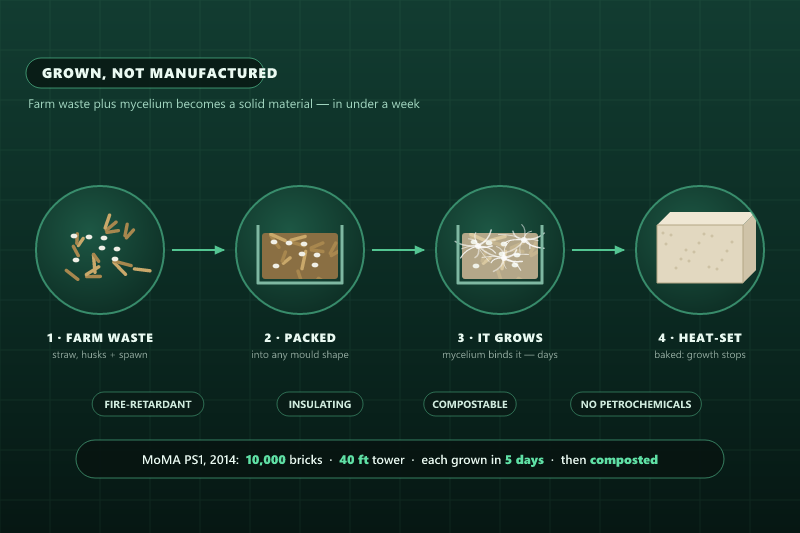
Not one of those bricks was fired, moulded from clay, or manufactured in any conventional sense. Every single one had been grown — from chopped corn stalks and mushroom mycelium — in about five days each.
At the end of the exhibition the tower was taken down, and the bricks were composted into fertiliser. The building became soil.
The Farmer's View: You Already Know This Material
Here is what makes this fact different from most "future material" stories. If you have ever grown mushrooms, you have already made this substance — probably without noticing.
Anyone who has handled a fully colonised bag of substrate knows the sensation. You fill a bag with loose, crumbly straw or sawdust. Two weeks later you pick it up and it is no longer loose at all: it is a single firm white block that holds its shape when you cut the bag away. You can knock on it. It has structure.
Every mushroom grower on Earth has produced that block and then thought of it purely as a step toward mushrooms. The biomaterials industry looked at the same block and asked a different question: what if the block itself is the product, and the mushroom is beside the point?
That is the entire insight. There is no exotic new organism here. It is the ordinary colonisation every grower relies on — redirected.
How It Is Actually Made
The process is almost provocatively simple, and it will look familiar to anyone who has run a substrate room:
- Substrate. Cheap agricultural waste — corn stalks, husks, straw, hemp hurd, sawdust — is pasteurised. The feedstock is genuinely low-value; that is the point.
- Inoculation. Mycelium is mixed through the loose substrate, exactly as spawning is done for a mushroom crop.
- Moulding. The mix is packed into a mould of whatever shape is required — a brick, a packaging insert shaped to cradle a specific laptop, a lampshade, a panel.
- Growth. Over roughly five to nine days, hyphae thread through every gap, wrapping around each particle and knitting the mass into one continuous solid. The fungus performs the assembly. Nobody presses, extrudes or bonds anything.
- Heat-setting. The part is dried and heated. This kills the mycelium, so the material is inert and stable — it will not sprout mushrooms on a warehouse shelf or keep growing in a customer's hands.
The energy budget is the striking part. Compare it with expanded polystyrene, which demands petrochemical feedstock and industrial heat. This is a material that assembles itself at room temperature, in the dark, out of waste.
What It Is Genuinely Good At
Mycelium composites are not a miracle substance, but their property profile is real and unusually well matched to certain jobs:
- Fire retardance. This surprises people. The resistance comes largely from chitin — the same tough polymer that makes mushrooms almost impossible to overcook — which resists combustion and slows flame spread. Critically, it does not release toxic gases as it degrades.
- Insulation. The material is low-density and full of trapped air, which makes it a natural thermal barrier — competitive with conventional insulation values.
- Structural strength. NASA's assessment of mycelial materials reports compressive strength superior to dimensional lumber and flexural strength superior to reinforced concrete. That is a startling claim about a fungus, and it comes with the obvious caveat that these are specific laboratory metrics for specific formulations, not a licence to build a bridge.
- End of life. A polystyrene insert outlives everyone reading this. A mycelium insert goes in the garden and is gone in weeks.
Where It Has Actually Been Used
This is not confined to design school exhibitions.
Packaging
Ecovative, founded in 2007 by two engineering graduates, pioneered growing protective packaging as a direct replacement for polystyrene foam. Dell has shipped laptops cushioned in mycelium foam inserts, and IKEA has pursued mushroom-based packaging to displace plastic foam from its furniture boxes. The fit is excellent: packaging is bulky, single-use, low-value, and almost impossible to recycle — precisely the profile of a product that ought to be grown and composted rather than refined from oil.
Architecture
The Hy-Fi tower described above, designed by The Living under architect David Benjamin, was the first large structure built from the material and remains its most famous demonstration.
Leather
Grown differently — as a dense, pure mycelial mat rather than a bound composite — the same organism yields a supple sheet material with a startling resemblance to leather. MycoWorks produces Reishi, which has been used by Hermès, and has appeared in a Ligne Roset sofa and the interior of a General Motors concept vehicle.
Space
NASA's myco-architecture project, led by Lynn Rothschild at Ames Research Center, has prototyped growing habitats rather than shipping them. The proposed design is layered: an outer mycelium shell for insulation and radiation shielding, a cyanobacteria layer generating oxygen, and living quarters within. And it connects directly to yesterday's fact — the concept specifically invokes melanised fungi for radiation protection. The logic is the same as the ISS shielding experiment: never launch the mass, launch the organism and let it build the structure on arrival.
The Part the Hype Articles Skip
It would be easy to end there, with mushroom skyscrapers on Mars. The commercial record is more sobering, and worth stating plainly.
Bolt Threads made Mylo, the best-known mycelium leather. It had everything a material could want: partnerships with Stella McCartney and Adidas, enormous press attention, and over $300 million raised since 2009. In 2023 the company paused production, citing costs. The material worked. The economics did not.
That failure is the most useful thing in this entire story. Grown materials are competing against petrochemical incumbents that have had a century of scale, infrastructure and optimisation to drive costs down. Being biodegradable and elegant is not sufficient; the part must also be cheaper, or good enough that someone will pay more.
The sector is not dead — MycoWorks has opened a large commercial plant and continues to scale, and analysts project substantial growth from a small base. But the honest summary is that mycelium materials are a real technology in an unfinished commercial fight, not a solved replacement for plastic.
What This Means for a Mushroom Farm
For growers, the interesting implication is not that anyone should abandon food production. It is what this reveals about the economics of a mushroom farm.
- Your core skill is more general than you think. A mushroom farmer's actual expertise is not "growing mushrooms" — it is sterile technique and controlled colonisation: preparing substrate, excluding contaminants, and managing an organism through a growth cycle. That skill set is the foundation of an entire materials industry.
- The feedstock is the same waste you already handle. Straw and agricultural residue — the input for every crop cycle — is exactly the feedstock these materials use.
- It reframes the whole substrate question. We have already written about the 5 kg of spent substrate left behind for every 1 kg of mushrooms harvested. Grown materials suggest a further thought: colonised substrate has value as a solid object, not only as compost or fuel.
- Keep expectations honest. This is a genuinely capital-intensive, R&D-heavy field where a company with $300 million in funding stopped. It is a fascinating adjacent possibility for a farm to understand, not a side business to start next season.
So the next time you cut open a bag and lift out a firm white block of colonised substrate, look at it properly. You are holding the same substance that was stacked forty feet into the air in a New York courtyard, that cushions laptops in transit, that Hermès has stitched into handbags, and that NASA has proposed growing into shelter on Mars.
You were only ever waiting for it to sprout.