Fungi Are Growing Inside the Chernobyl Reactor — and They Grow Toward the Radiation
On 26 April 1986, Reactor 4 at the Chernobyl Nuclear Power Plant exploded, and the building around it became the most radioactive structure on Earth. Human beings could not enter. The robots sent inside had their electronics scrambled and died. Every assumption said the interior was sterile — a place where the fundamental machinery of life would simply be shredded faster than it could repair itself.
Then, in the late 1990s, samples taken from inside the ruins revealed something nobody expected. The walls were not bare. They were covered in a thick, black growth.
Life had not merely survived in there. It had moved in.
Growing Toward the Thing That Should Kill You
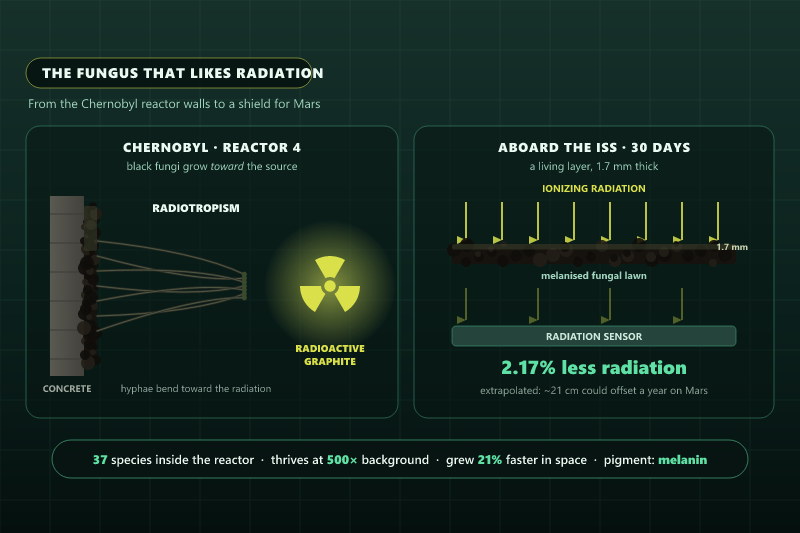
Fungi steer their growth all the time. Hyphae will grow toward food, toward moisture, along chemical gradients. This is ordinary. What was not ordinary was the direction of travel here.
The obvious explanation was that the fungi were simply chasing the graphite — carbon is food, after all. But Zhdanova's team tested for exactly that and ruled carbon out. The fungi were orienting to the beta and gamma radiation itself.
It is worth being precise about what that does and does not establish. The researchers demonstrated the behaviour convincingly, but they were candid that they could not identify the biological mechanism producing it. Something in these organisms detects ionizing radiation and treats it as a direction worth growing in. Nobody has yet explained how.
The Melanin Hypothesis
The obvious suspect was the pigment that all these fungi had in common: melanin.
We usually think of melanin as sunscreen — the pigment that darkens human skin and absorbs ultraviolet light. But in 2007, a team led by Ekaterina Dadachova published a study proposing something considerably more radical: that in these fungi, melanin might not just be blocking radiation but harvesting it.
They took three melanin-containing species — Cladosporium sphaerospermum (isolated from Chernobyl), Wangiella dermatitidis, and Cryptococcus neoformans — and exposed them to radiation around 500 times higher than normal background. The melanised fungi gained biomass faster under those conditions than they did in ordinary surroundings.
The molecular detail is the striking part. Within just 20 to 40 minutes of exposure, C. neoformans had altered the chemical properties of its melanin, and the pigment's rate of electron transfer increased three- to fourfold compared to unexposed cells. The radiation appeared to be changing melanin's electronic behaviour — energising it.
The proposed name for this was radiosynthesis: melanin acting for ionizing radiation roughly the way chlorophyll acts for sunlight, capturing energy and channelling it into metabolism. If true, it would mean these fungi are doing something no textbook had a category for — using gamma radiation as a food source.
The Part Most Articles Leave Out
This is where honesty matters more than a good headline, because radiotrophic fungi have become one of the internet's favourite pieces of science — usually retold as settled fact. It is not settled.
Here is what remains genuinely open:
- The cultures were fed. Each fungus in the 2007 experiment was given at least limited nutrients. So the growth boost could mean the cells derived energy directly from radiation — or that radiation simply let them use conventional nutrients more efficiently or more quickly. The experiment as designed cannot cleanly separate those two explanations.
- The mechanism is unknown. Whether radiosynthesis involves a multi-step pathway comparable to photosynthesis is not established. The biochemistry is not worked out.
- Radiotropism is unexplained. The behaviour is documented; the sensing mechanism behind it is not.
So the accurate formulation is this: melanised fungi demonstrably thrive in radiation that devastates most life, and their melanin demonstrably changes under irradiation. Whether they are truly "eating" radiation remains an open and actively researched hypothesis. That uncertainty makes the story more interesting, not less — this is a live scientific question, not a closed one.
Then Someone Flew It to Space
Whatever the mechanism turns out to be, there is an obvious practical question: if this organism handles radiation so well, could it shield us from it?
Radiation is one of the hardest unsolved problems in human spaceflight. Beyond Earth's magnetic field, astronauts are exposed to cosmic rays continuously, and conventional shielding means hauling mass — lead, water, regolith — and every kilogram launched costs enormously. What you would really want is a shield that builds itself from almost nothing.
A fungus does exactly that. So a team including Graham Shunk and Nils Averesch sent Cladosporium sphaerospermum to the International Space Station and grew it for 30 days, with radiation sensors mounted beneath the culture and beneath an identical fungus-free control.
The results:
- Beneath a mature fungal lawn just ≈1.7 mm thick, radiation was 2.17 ± 0.25% lower than beneath the control.
- The fungus showed a ~21% growth advantage in space versus ground controls — consistent with the idea that its radiotropic character extends to space radiation.
- The attenuation appeared only in the later stages, once the biomass and its melanin content had matured. Early on there was no measurable difference — which is itself good evidence that the melanin is doing the work.
- Extrapolating from the measured attenuation, roughly 21 cm of this fungus could largely offset the annual radiation dose on the Martian surface.
Two per cent from a layer thinner than a coin sounds trivial. The significance is that the shield is alive: it grows itself, repairs itself when damaged, and can be regrown from a tiny starter culture. You would not launch 21 cm of shielding. You would launch a test tube and let it grow into a wall.
The researchers were careful about limits too. Their sensors were most responsive to lower-energy X and gamma radiation rather than the high-energy galactic cosmic rays that dominate deep space, so the Mars extrapolation needs further validation. It is a proof of concept, not a finished spacecraft component.
The Same Pigment Is in Your Kitchen
Here is where this stops being a story about a distant ruin and becomes a story about the mushrooms in front of you.
Melanin is not exotic. It is one of biology's oldest and most widespread pigments, and mushrooms are full of it. When a button mushroom bruises and darkens, or a cut cap turns brown on the chopping board, you are watching melanin being manufactured in real time — the end product of the enzymatic browning pathway. The brown of a cremini or portobello is melanin in the cap tissue.
In a mushroom, that pigment's job is defence: shielding against ultraviolet light, resisting oxidative stress, and hardening tissue against microbial attack. What the Chernobyl fungi reveal is how far that ancient defensive chemistry can be pushed. Same pigment family, same protective logic — just operating under conditions no one thought life could tolerate.
One important caveat for foragers
None of this means mushrooms are indifferent to radioactive contamination — and the distinction genuinely matters for food safety.
Mushrooms are exceptionally efficient at pulling minerals out of their substrate, and that includes radioactive caesium. Decades after Chernobyl, wild mushrooms across affected parts of Europe still accumulate measurable caesium-137, which is why some regions maintain advisories on wild-foraged mushrooms and on the game animals that eat them.
The fungus tolerating radiation and the fungus concentrating radioactive material are two different phenomena — and it is the second one that ends up on a plate. Cultivated mushrooms like ours are grown on controlled, prepared substrate — pasteurised wheat straw compost with a known composition — precisely so that what goes into the mushroom is known. It is one of the quiet, unglamorous advantages of cultivation over foraging.
The Bigger Point
We tend to file fungi under "delicate." They are mostly water, they bruise if you look at them wrong, and they rot within days.
And yet: fungi form the largest organism on Earth, they survive in the reactor hall at Chernobyl, and they grow better in orbit than they do on the ground. This is a kingdom that has spent roughly a billion years learning to persist in places that kill other things — and it did it with chemistry so ordinary that a version of it is sitting in the mushroom on your kitchen counter.
The next time you notice a mushroom darkening after you slice it, consider what you are actually watching. It is the same pigment that a fungus on a ruined reactor wall in Ukraine is using to make a living from gamma rays — and that a colony aboard the International Space Station used to cast the first faint shadow of a shield we might one day carry to Mars.