The Largest Living Thing on Earth Isn't a Whale or a Tree — It's a Single Fungus
Ask most people to name the largest living organism on Earth and they will reach for the obvious giants: the blue whale at around 150 tonnes, or the towering giant sequoia named General Sherman, whose trunk alone weighs an estimated 1,900 tonnes. Both are magnificent. Both are also completely outclassed by an organism you cannot see in one glance, cannot photograph in a single frame, and could walk across for nearly an hour without ever leaving its body.
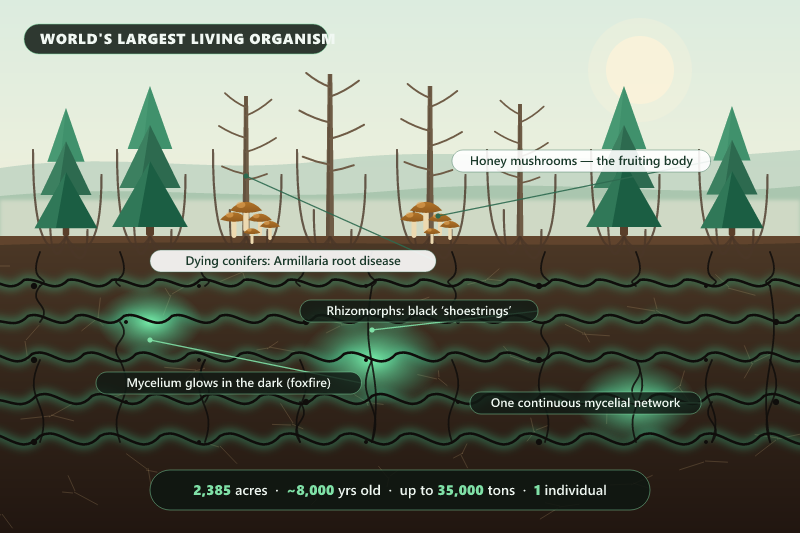
It lives underground in the Blue Mountains of eastern Oregon, in the Malheur National Forest. It is a fungus — specifically a honey fungus, Armillaria ostoyae (also written Armillaria solidipes) — and scientists have nicknamed it the "Humongous Fungus." It is, by area and by total mass, the largest single living organism ever documented on our planet.
Why We Almost Never Noticed It
Here is the strange part: for thousands of years, nobody knew this colossus was there — because 99% of it is invisible. What we call "a mushroom" is only the fruiting body, the temporary reproductive structure that pushes up above the soil for a few weeks each autumn. The actual organism is a vast, thread-like web of fungal filaments living hidden in the soil and inside tree roots.
The Humongous Fungus was not discovered by someone finding a giant mushroom. It was discovered by foresters investigating death. Starting in 1988, U.S. Forest Service pathologists noticed large, expanding patches of Douglas-firs and true firs dying across the Malheur forest. When they mapped the dying trees from the air, they saw sprawling rings and blotches of mortality — the tell-tale signature of Armillaria root disease.
The obvious assumption was that these were many separate fungal infections. To check, researchers collected fungal samples from trees scattered kilometres apart and compared them using DNA fingerprinting and clonal analysis. The result astonished them: sample after sample, across the entire 2,385-acre area, was genetically identical. This was not a colony of many fungi. It was a single individual that had been quietly knitting itself together for millennia.
The Mushroom Is Just the "Apple" — the Tree Is Underground
To understand how a fungus can be this big, you have to abandon the everyday idea of what a mushroom is. The cap-and-stem mushroom you recognise is to the fungus roughly what an apple is to an apple tree: a small, seasonal, spore-releasing fruit. The real, permanent body of the fungus is the mycelium — a branching network of microscopic threads called hyphae that thread through soil, wood, and roots.
In Armillaria, the mycelium does something extraordinary. It bundles its threads together into tough, dark, bootlace-like cords called rhizomorphs (from the Greek for "root-shaped"), nicknamed "shoestrings." These black cords can travel through soil and beneath tree bark, foraging outward like living cables:
- They are the fungus's transport network — moving water, nutrients, and signals across long distances, allowing the organism to invest resources in reaching new trees far from any food source
- They are how it hunts — a rhizomorph tip that touches a healthy root can penetrate it, colonise the tree, and feed on it
- They are why it is so hard to kill — cut down an infected tree and the rhizomorphs simply grow on to the next one through the soil
Every tree in that 2,385-acre patch is, in effect, plugged into the same underground body. That is what "one organism" really means here — not a scattering of cousins, but a single connected creature the size of a small town.
How Do You Weigh — and Age — Something You Can't Dig Up?
You obviously cannot put a 2,385-acre fungus on a scale. So how do scientists arrive at figures like "up to 35,000 tonnes" and "8,000 years old"? They estimate.
Estimating the mass
Researchers measure the density of fungal material — mycelium in the soil, rhizomorphs, and the fungal tissue inside infected roots — within sample plots, then scale that up across the mapped area. Because so much of the biomass is diffuse and buried, the estimates carry a wide margin, which is why you see a range from about 7,500 tonnes to 35,000 tonnes rather than a single tidy number. Even the conservative end of that range dwarfs any animal that has ever lived.
Estimating the age
Age is calculated from how fast the fungus grows outward. By tracking how far the rhizomorphs advance each year — on the order of roughly a metre annually — and dividing that into the radius of the whole colony, scientists back-calculate how long it must have taken to reach its current size. That maths yields a minimum age of about 2,400 years, with many estimates stretching to 8,000 years or more. If the higher figure is right, this fungus was already ancient when the Egyptian pyramids were built.
A Slow-Motion Forest Predator
It is tempting to romanticise the Humongous Fungus as a gentle giant, but ecologically it is a pathogen. Armillaria ostoyae causes Armillaria root disease, one of the most damaging root rots of conifers in the world. It attacks Douglas-fir, true firs, pines, and hemlocks, decaying the roots and the base of the trunk until the tree weakens, stops growing, and eventually dies or is blown over.
This is why the fungus reveals itself as expanding "rings of death" in the forest: as the organism grows outward from its centre, it kills trees at its advancing edge while the interior slowly recycles what it has already consumed. In a managed timber forest this is an economic problem worth millions. But in the bigger picture, Armillaria is also a master decomposer — by breaking down dead and dying wood, it returns locked-up carbon and nutrients to the soil, shaping which trees thrive and clearing space for new growth. It is both undertaker and gardener of the forest.
And It Glows in the Dark
As if being the largest organism on Earth were not enough, Armillaria has one more trick: its mycelium is bioluminescent. Under the bark of infected wood, the fungal threads emit a faint, eerie green glow — a phenomenon known for centuries as "foxfire" or "fairy fire." Early naturalists, sailors, and miners reported glowing wood in damp forests and mine timbers long before anyone understood the cause.
The light is produced by a chemical reaction between a molecule called luciferin and the enzyme luciferase, the same family of chemistry that powers a firefly's flash. Scientists still debate exactly why fungi glow — leading hypotheses suggest the light attracts insects that help disperse spores, much as a flower's colour attracts pollinators. Whatever the reason, it means the largest living thing on Earth quietly shines in the dark.
The Bigger Family of Giants
The Humongous Fungus is not the only titan hiding in plain sight. In Utah, a clonal grove of quaking aspen called "Pando" — around 47,000 genetically identical tree trunks sharing one root system — weighs an estimated 6,000 tonnes and is often cited as one of the heaviest single organisms. There are also competing Armillaria patches in Michigan and Washington state, each enormous in its own right.
But by the two measures that matter most — total ground area covered and total biomass — the Oregon Armillaria ostoyae remains the reigning champion, "possibly covering more total geographical area than any other single living organism" on the planet.
What This Means for the Mushrooms on Your Plate
Here is the connection that makes this fact more than a curiosity. The button mushrooms we grow at Dr. Dahiya Mushroom Farm follow exactly the same hidden logic as the Oregon giant. When you buy a 200-gram punnet of fresh mushrooms, you are holding fruiting bodies — the "apples." The true organism was the dense white mat of Agaricus bisporus mycelium that spent weeks colonising the compost, completely out of sight, before it ever pushed a single pinhead to the surface.
Every mushroom farmer is really a farmer of mycelium. We spend most of our effort feeding, cooling, humidifying, and protecting an organism we almost never see, coaxing it to fruit only when conditions are perfect. The Humongous Fungus is that same biology scaled up to the size of a forest and run for 8,000 years without interruption.
So the next time you slice a mushroom for your curry, remember what you are actually looking at: the visible tip of a vast, mostly invisible way of being alive — the same body plan that, left undisturbed in an Oregon forest, grew into the single largest living thing our planet has ever produced.