You've Eaten a Fungus Every Day of Your Life — It's Called Yeast
Ask someone to name a fungus and they will say "mushroom." Ask them to name a food made from a fungus and they will point at the mushrooms again. Almost nobody points at the bread.
But they should. The single most important fungus in human history is not a mushroom at all. It is a microscopic, single-celled organism you have almost certainly consumed today, and probably every day of your life. It is yeast — and it is a fungus, as much a member of the fungal kingdom as any mushroom on our farm.
Every risen loaf of bread, every glass of beer, every bottle of wine, is the direct product of this one organism doing what it does. We have been partnered with it for longer than we have had writing, and for most of that time we had no idea it was even alive.
A Fungus Without a Mushroom
The first surprise is simply that yeast is a fungus. It looks nothing like one. There is no cap, no stem, no gills, no visible body at all — a single yeast cell is only a few micrometres across, far too small to see. A speck of dust dwarfs it.
But biologically it belongs squarely in the kingdom Fungi. Yeasts are essentially fungi that gave up the multicellular, mushroom-forming lifestyle and went single-celled — living as free-floating individual cells that feed on sugars and reproduce by budding. They are, in a real sense, mushrooms' tiny, solitary cousins.
This kinship is not a technicality. Because yeast is a fungus, it shares the deep cellular machinery of the whole kingdom — the same kind that makes fungi, as we've written before, more closely related to animals than to plants. That shared biology is exactly why yeast became the workhorse of modern science, a point we will come back to.
The One Trick: Fermentation
Yeast's world-changing ability is fermentation, and the chemistry is worth understanding because it explains everything that follows.
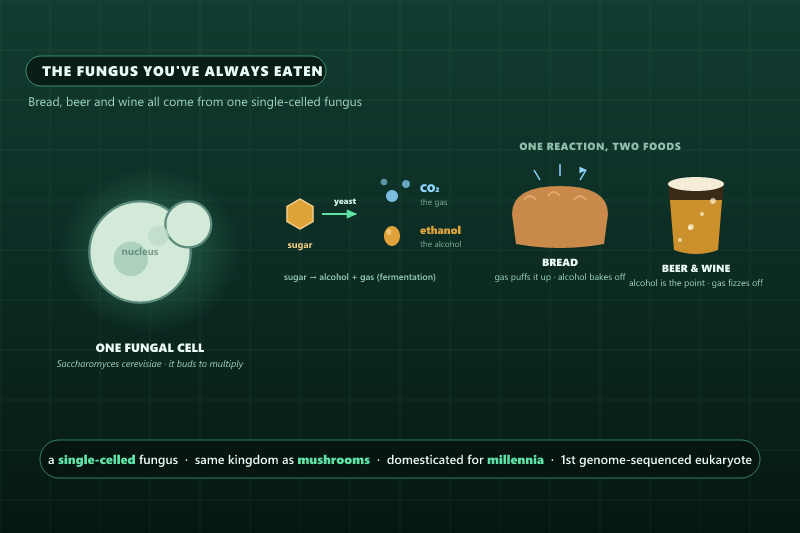
Like us, yeast prefers to "breathe" — to use oxygen to extract energy from sugar, producing water and carbon dioxide, exactly as mushrooms and humans do. But yeast has a crucial backup skill. When oxygen runs out — inside a sealed dough, or deep in a vat of grape juice — it switches to anaerobic fermentation: it keeps breaking down sugar for energy without oxygen, and in doing so it excretes two waste products.
Those two "waste" products are the entire foundation of baking and brewing:
- Carbon dioxide — a gas.
- Ethanol — alcohol.
That is the whole secret. Sugar in; gas and alcohol out. To yeast, both are simply waste. To us, one of them raises bread and the other makes wine. Everything humanity has built on yeast rests on this single, humble metabolic shortcut.
One Reaction, Two Great Foods
Here is the detail that delights people once they see it: bread and beer are the same process. The difference is only which waste product you keep and which you throw away.
Bread: keep the gas, lose the alcohol
When you knead yeast into dough, the cells feast on the sugars in the flour and release carbon dioxide. But the gas is trapped inside the stretchy gluten network of the dough, inflating it like thousands of tiny balloons. That is what "rising" is — a dough riddled with pockets of fungal CO₂. When the loaf goes into the oven, the heat kills the yeast and the alcohol evaporates away, leaving a light, airy crumb. In bread, the gas is the prize and the alcohol is discarded.
Beer and wine: keep the alcohol, lose the gas
In brewing and winemaking you do the exact opposite. Yeast is added to a sugary liquid — malted grain for beer, grape juice for wine — and left to ferment. Here, the alcohol is the whole point, and it stays dissolved in the liquid. The carbon dioxide mostly bubbles off and escapes (or, in beer and sparkling wine, is partly kept to provide the fizz). Same organism, same reaction — but now the alcohol is the prize and the gas is the by-product.
Bread, beer, wine: one fungus, one reaction, three of the oldest and most beloved products of human civilisation, distinguished only by which molecule the cook decided to keep.
The Oldest Partnership We Never Understood
Humans have been using yeast since prehistoric times — bread and fermented drinks are older than writing, older than the wheel. For almost all of that history, we did it blind. Nobody knew yeast existed. Bakers and brewers simply knew that a bit of yesterday's frothy dough or foamy beer, stirred into a fresh batch, would reliably make it rise or ferment — a practice called "backslopping."
They were, without knowing it, saving and transferring a living organism from batch to batch — selecting, over thousands of generations, the strains that performed best in their kitchens and breweries. This is domestication, exactly like the domestication of wheat or cattle, except the domesticated species was an invisible microbe and the farmers had no idea they were farming it. Modern brewing and baking yeasts are genuinely domesticated lineages, changed by millennia of human use and, in many cases, no longer quite like their wild ancestors.
It was only in the 19th century that Louis Pasteur demonstrated that fermentation was the work of a living microorganism, not a spontaneous chemical event — settling the question and founding the science of microbiology in the process. We had been in a working partnership with yeast for thousands of years before we finally met our partner.
Science's Favourite Fungus
There is a final reason Saccharomyces cerevisiae deserves the title of most important fungus, and it has nothing to do with food.
Because yeast is a eukaryote — a cell with a proper nucleus and internal machinery like our own — but is also tiny, harmless, and grows explosively fast in a dish, it became biology's ideal model organism. Much of what we understand about how our own cells divide, age, repair their DNA and go wrong in cancer was first worked out in yeast. In 1996 it became the first eukaryotic organism to have its entire genome sequenced — a landmark in the history of biology.
So this single-celled fungus has not only fed and cheered humanity for millennia; it has also been one of our most important windows into the workings of life itself, including our own.
Why We Tell This on a Mushroom Farm
We grow mushrooms, not yeast — but yeast belongs at the heart of how we teach people to think about fungi.
- Fungi are not a curiosity at the edge of your life — they are woven through the middle of it. People arrive thinking fungi means "the mushrooms on a pizza." The moment they realise their morning toast, their evening drink and half the world's cuisine all run on a fungus, the entire kingdom stops being exotic and starts being essential. That shift is the whole point of our educational visits.
- It reframes what a mushroom farmer really does. Bakers and brewers are, in a sense, fungus farmers who never see their crop. We grow the fungi you can see. Both are the same ancient craft — cultivating fungi for human benefit — practised on organisms at opposite ends of the size scale.
- It puts fermentation and mushroom growing in the same family. Both are about giving a fungus the right food and the right conditions and letting its metabolism do the work. Understanding one deepens your feel for the other.
So tonight, when you tear a piece of bread or pour a drink, take a second to recognise what you are actually holding: the handiwork of a single-celled fungus, a distant relative of every mushroom we grow, that has been quietly working for humanity since before history began — and that we only thought to say thank you to about 150 years ago.