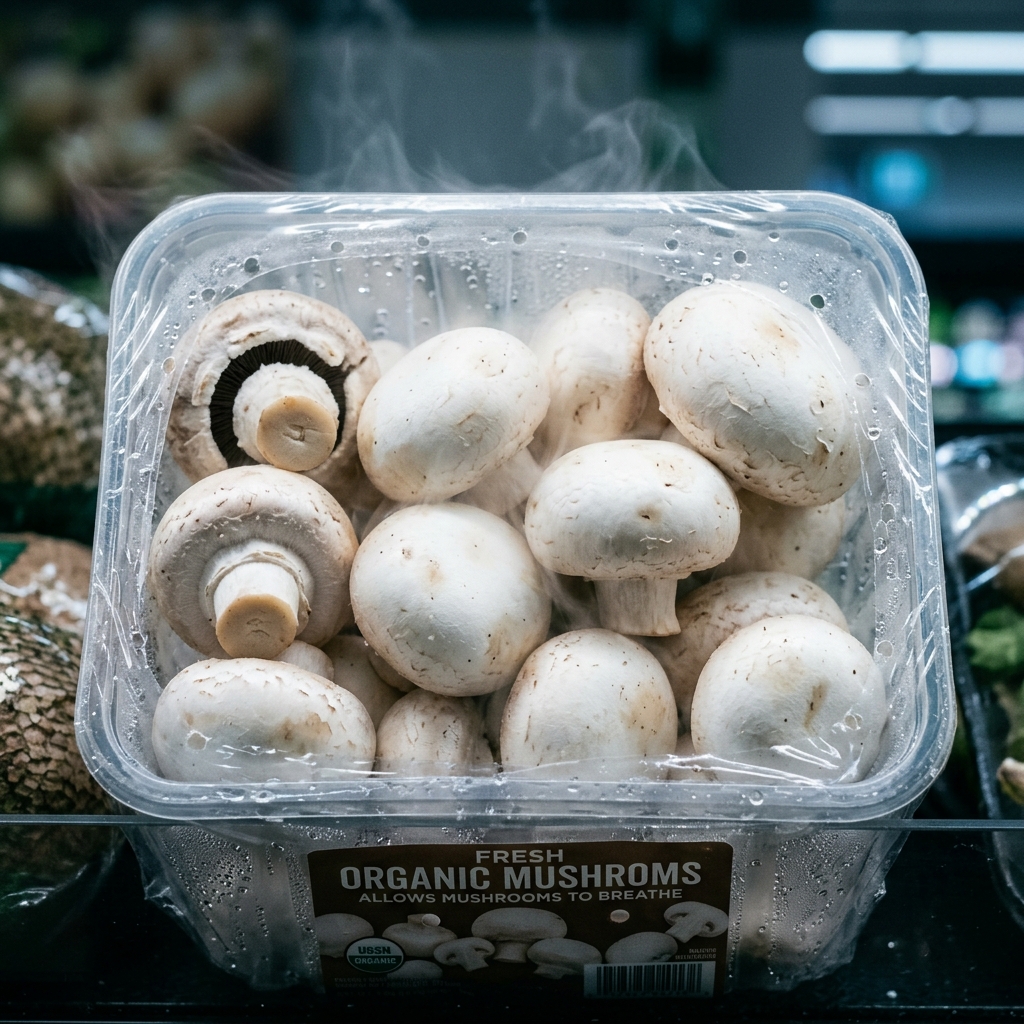
Button Mushrooms Breathe Oxygen and Exhale Carbon Dioxide — Just Like Humans Do
The next time you pick up a pack of button mushrooms at the grocery store, consider this: the mushrooms in that package are still alive. Not metaphorically. Not in some poetic, spiritual sense. They are biologically alive — performing active cellular respiration, consuming oxygen from the air around them, and exhaling carbon dioxide, exactly the way you do right now as you read this sentence. They are breathing. In your fridge. On the shelf. In the delivery truck. From the moment they are harvested until the moment they finally decompose, button mushrooms never stop breathing.
Why Mushrooms Breathe Like Animals, Not Like Plants
To understand why mushroom respiration is so remarkable, you need to remember what mushrooms are — and what they are not.
Mushrooms are fungi, not plants. Unlike plants, they cannot photosynthesise. They have no chlorophyll, no chloroplasts, and no ability to use sunlight to convert CO₂ and water into sugars. Instead, fungi obtain their energy the same way animals do — by breaking down pre-existing organic molecules through cellular respiration. The biochemistry is essentially identical to what happens in your own mitochondria:
C₆H₁₂O₆ + 6O₂ → 6CO₂ + 6H₂O + energy (ATP)
Glucose + Oxygen → Carbon dioxide + Water + Energy
This is the same equation that describes human respiration. The same equation that describes a dog breathing, a fish using its gills, or a beetle ventilating through its spiracles. Mushrooms use mitochondria — the same organelles found in animal cells — to perform oxidative phosphorylation and generate ATP. In terms of fundamental energy metabolism, a button mushroom has more in common with a human being than it does with a lettuce leaf.
But Wait — Don't Plants Breathe Too?
Yes, plants also perform cellular respiration (they have mitochondria too). But plants have a crucial advantage: during daylight hours, photosynthesis produces more O₂ and fixes more CO₂ than respiration consumes. So the net effect of a living plant is to absorb CO₂ and release O₂ — the opposite of breathing.
Mushrooms don't have this counterbalancing process. They are pure consumers — inhaling O₂ and exhaling CO₂ around the clock, with no photosynthetic offset. In a sealed environment, they will consume all available oxygen and flood the space with carbon dioxide, just like a small animal would.
The Numbers: How Fast Do Mushrooms Breathe?
What makes mushroom respiration particularly remarkable is not just that it happens, but how fast it happens. Button mushrooms have one of the highest respiration rates of any commercially sold produce item:
- Button mushrooms at 20°C: approximately 150–280 mg CO₂ per kg per hour
- Bananas at 20°C: approximately 40–80 mg CO₂/kg/hr
- Apples at 20°C: approximately 15–40 mg CO₂/kg/hr
- Tomatoes at 20°C: approximately 20–40 mg CO₂/kg/hr
- Lettuce at 20°C: approximately 25–50 mg CO₂/kg/hr
At room temperature, button mushrooms breathe at roughly 3–7 times the rate of most common fruits and vegetables. This is why they spoil so much faster — they are burning through their internal energy reserves at an extraordinary rate, and every molecule of stored sugar that gets respired away is a molecule that is no longer available to maintain cell structure, firmness, and flavour.
Temperature Is Everything
Like all biological processes, mushroom respiration rate is highly temperature-dependent. For every 10°C increase in temperature, the respiration rate roughly doubles or triples:
- At 0°C (ideal storage): ~20–40 mg CO₂/kg/hr — slow, controlled breathing
- At 5°C (typical fridge): ~40–70 mg CO₂/kg/hr — manageable
- At 10°C (bad fridge or during transport): ~70–130 mg CO₂/kg/hr — accelerating decay
- At 20°C (room temperature): ~150–280 mg CO₂/kg/hr — rapid spoilage
- At 30°C (hot day, unrefrigerated): ~300–500+ mg CO₂/kg/hr — ruinously fast decay
This is why the single most important factor in mushroom shelf life is cold chain maintenance. A pack of button mushrooms kept at 0–2°C can last 7–10 days. The same pack left at room temperature will show visible deterioration — browning, sliminess, off-odours — within 24–48 hours. The mushrooms are literally breathing themselves to death.
Why Mushrooms Have No Skin — and Why That Matters
Here's another crucial difference between mushrooms and most other produce: mushrooms have no protective cuticle — no waxy, waterproof outer skin.
Most fruits and vegetables — apples, tomatoes, peppers, cucumbers — have a waxy cuticle layer on their surface that serves as a barrier against moisture loss and gas exchange. This cuticle slows down both transpiration (water evaporation) and respiration, acting like a natural "packaging" that extends shelf life.
Mushrooms have nothing comparable. Their surface is essentially naked, porous tissue — fully exposed to the surrounding air. This means:
- Water loss is extremely rapid: Fresh mushrooms are ~90% water, and without a cuticle, they lose moisture quickly through direct evaporation. This causes shrivelling, loss of firmness, and weight loss — mushrooms can lose 2–5% of their weight per day even under refrigeration.
- Gas exchange is unregulated: Oxygen and CO₂ flow freely in and out of the mushroom tissue, which means the respiration rate is limited only by internal metabolic capacity, not by surface permeability. There's no natural "throttle" on their breathing.
- Browning is accelerated: Without a cuticle, the enzyme polyphenol oxidase (the same enzyme that browns cut apples) is directly exposed to atmospheric oxygen, triggering rapid enzymatic browning — the telltale sign that a mushroom is past its prime.
The Packaging Mystery Solved
Now you can understand why mushroom packaging at the grocery store looks the way it does — and why it's designed so carefully.
The Perforated Film
Look closely at any commercial pack of fresh button mushrooms. You'll notice that the plastic film covering the tray has tiny holes — sometimes visible perforations, sometimes micro-perforations so small you can barely see them. These are not manufacturing defects. They are precisely engineered breathing holes.
The perforations serve a critical dual purpose:
- Oxygen in: The holes allow fresh oxygen from the outside air to enter the package, replacing the O₂ that the mushrooms are continuously consuming through respiration.
- CO₂ out: The holes allow the carbon dioxide that the mushrooms are continuously exhaling to escape from the package, preventing a dangerous buildup of CO₂.
The goal is to maintain what food scientists call a Modified Atmosphere — a specific balance of O₂ and CO₂ inside the package that slows respiration (extending shelf life) without completely cutting off oxygen (which would be lethal). The ideal atmosphere for fresh button mushrooms is approximately 3–5% O₂ and 10–15% CO₂ — compared to normal air, which is 21% O₂ and 0.04% CO₂.
Why You Should Never Seal Mushrooms Airtight
This brings us to the most important — and potentially life-saving — practical takeaway of this entire article.
Never store fresh mushrooms in a sealed, airtight container or non-perforated plastic bag.
If you seal mushrooms in an airtight environment, their rapid respiration will consume all the available oxygen within hours. Once the oxygen is gone, two dangerous things happen:
- Anaerobic respiration begins: Without oxygen, the mushroom cells switch to fermentation — producing ethanol and off-flavours. The mushrooms become slimy, develop an unpleasant alcoholic smell, and deteriorate rapidly.
- Clostridium botulinum risk: This is the truly dangerous part. Clostridium botulinum is a bacterium whose spores are commonly found in soil — and therefore commonly present on fresh mushrooms. Under normal conditions (in the presence of oxygen), these spores are harmless and dormant. But in an anaerobic (oxygen-free), low-acid environment — exactly the conditions created inside a sealed package of rapidly respiring mushrooms — C. botulinum spores can germinate, grow, and produce botulinum toxin, one of the most lethal substances known to science. A dose as small as 1 nanogram per kilogram of body weight can be fatal.
The critical danger is that C. botulinum can produce lethal toxin levels before the mushrooms show obvious signs of spoilage. The mushrooms might look slightly off but not obviously rotten — yet they could contain enough toxin to cause severe illness or death.
This is why the Canadian Food Inspection Agency, the USDA, and food safety authorities worldwide explicitly warn against storing fresh mushrooms in sealed, non-perforated packaging. The perforated film on commercial mushroom packs is not a convenience — it is a food safety feature.
What This Means for Mushroom Farmers
Understanding mushroom respiration is not just a consumer curiosity — it is a critical commercial skill for mushroom farmers and traders.
- Harvest timing: Mushrooms should be harvested as close to the point of sale as possible. Every hour between harvest and sale is an hour of active respiration — burning through reserves, losing weight, and accumulating metabolic waste products that reduce quality.
- Pre-cooling: Immediately after harvest, mushrooms should be cooled to 2–4°C as quickly as possible. This is called "pre-cooling" and it can reduce the respiration rate by 70–80% compared to room temperature, dramatically extending shelf life.
- Transport: Cold-chain integrity during transport is crucial. A single break in the cold chain — a truck left idling in the sun, a warehouse without refrigeration, a market stall without shade — can cut mushroom shelf life in half.
- Packaging selection: The choice of packaging material — its permeability to O₂ and CO₂, the number and size of perforations, the volume of headspace around the mushrooms — directly determines how long the mushrooms will remain saleable. This is an area of active research and innovation in the Indian mushroom industry.
The Bigger Picture: You're Eating Something Alive
There's something philosophically fascinating about mushroom respiration. When you buy a carrot, a potato, or a head of lettuce, you might think of it as "fresh" — but the vegetable's metabolic activity is relatively low. When you buy a button mushroom, you are buying something that is actively, vigorously, measurably alive — breathing in and out, burning fuel, generating heat, exhaling waste gases — right there in your shopping bag.
And this aliveness is not incidental to the mushroom's quality. It is the quality. A fresh mushroom is firm, white, fragrant, and flavourful precisely because its cells are alive and maintaining their structure through active metabolism. The moment those cells stop respiring — the moment the mushroom truly "dies" — decay begins immediately. The browning, the sliminess, the off-odours — these are all signs that cellular respiration has ceased and decomposition has taken over.
So those tiny holes in the packaging? They're not just holes. They're the mushroom's lifeline — the breathing tubes that keep it alive, fresh, and safe to eat for just a few more precious days. Every pack of mushrooms on the grocery shelf is a small lesson in biology, food science, and the remarkable metabolic kinship between fungi and animals. The mushroom in your fridge is breathing. Just like you.