The Secret Kinship: Why Mushrooms Are More Like Humans Than Plants
When you walk through the produce aisle at any supermarket, mushrooms are always nestled right next to the lettuce, carrots, and broccoli. Because they grow out of the ground and don't move around, humans spent centuries classifying them as quirky, non-flowering plants. Even Linnaeus, the father of modern taxonomy, placed fungi firmly inside the kingdom Plantae in his 1753 classification system.
But modern molecular genetics has overturned that centuries-old assumption with a startling revelation: mushrooms are closer relatives to humans and animals than they are to the green plants in your garden.
The Evolutionary Split: How We Know
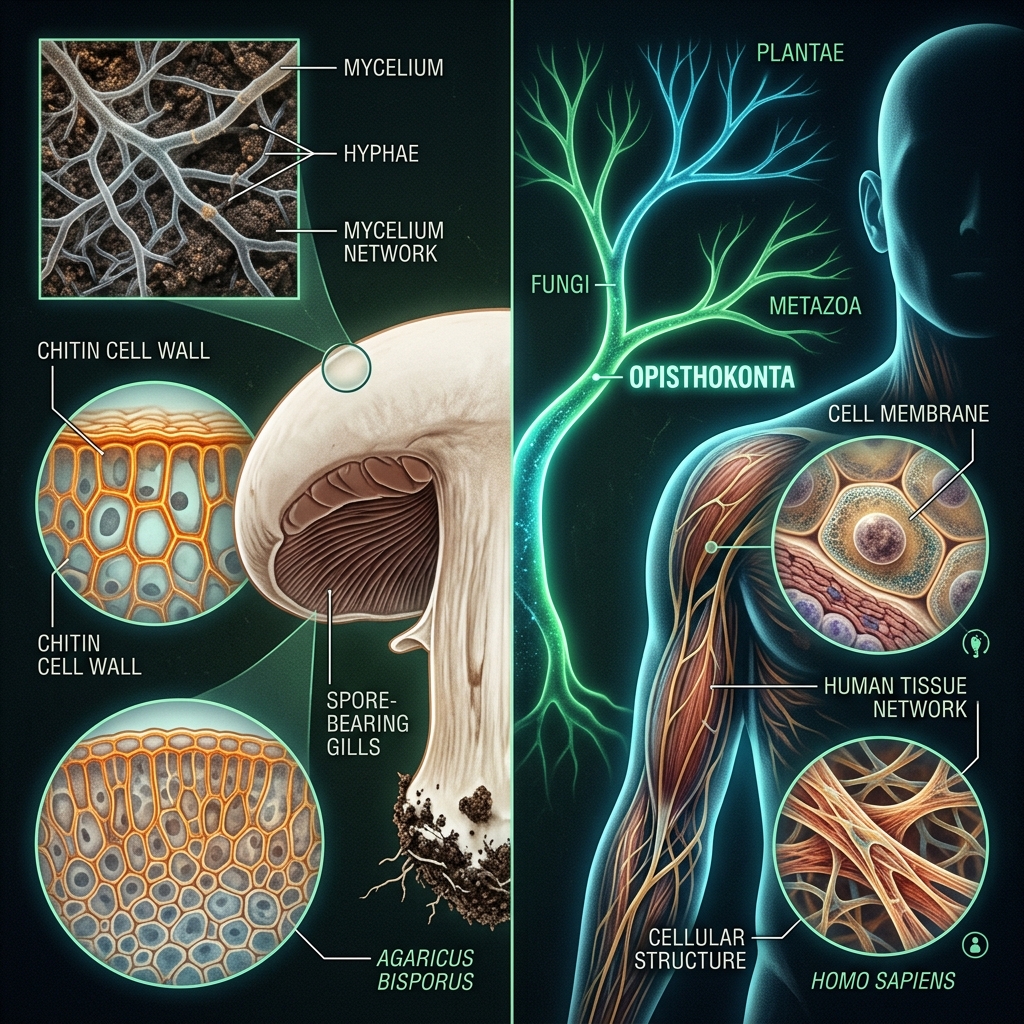
The breakthrough came in the 1990s when molecular phylogeneticists began comparing ribosomal RNA gene sequences across all domains of life. The data was unambiguous: fungi clustered with animals, not plants, on every phylogenetic tree constructed from genetic data. In 1998, a landmark paper by Baldauf and Palmer in the journal Proceedings of the National Academy of Sciences formally established the super-group Opisthokonta, uniting fungi and animals under one evolutionary umbrella.
The name "Opisthokonta" comes from the Greek opistho- ("rear") and kont- ("pole" or "flagellum"), referring to the single rear-mounted flagellum found in the motile cells of both animals (sperm cells) and primitive fungi (zoospores of chytrids). Plants, algae, and most other eukaryotes have flagella at the front, not the rear. This tiny structural detail turned out to be a 1.5-billion-year-old evolutionary fingerprint linking fungi to animals.
1. The Cellular Secret: Chitin vs. Cellulose
If you look at a plant cell under a microscope, its structure is held together by cellulose — a rigid carbohydrate polymer that gives wood its strength and lettuce its crunch. Animals don't have cell walls at all; their cells are bounded only by a flexible lipid membrane.
Fungi, however, protect and structure their cells using a completely different molecule: a tough glucose derivative called chitin. If "chitin" sounds familiar, that's because it is the exact same material that crabs, lobsters, shrimp, and insects use to build their hard outer shells (exoskeletons). The chitin in a mushroom's cell wall is chemically identical to the chitin in a beetle's armour.
Plants cannot produce chitin — they lack the enzyme chitin synthase entirely. This enzyme is shared exclusively by the animal and fungal kingdoms, a direct molecular inheritance from their shared Opisthokont ancestor. When you bite into a button mushroom and feel that distinctively firm, slightly rubbery texture (so different from the crunch of a carrot or the softness of a tomato), you are literally chewing chitin — an animal-kingdom material.
2. Mushrooms Breathe Oxygen and "Exhale" Carbon Dioxide
Plants are famous for photosynthesis: they absorb sunlight, drink in carbon dioxide, and release fresh oxygen back into the atmosphere. This is the fundamental metabolic process that defines the plant kingdom.
Mushrooms do the exact opposite. Because they completely lack chlorophyll (the green pigment that captures light energy), they cannot photosynthesize. Instead, they perform aerobic cellular respiration — they inhale oxygen from their environment and exhale carbon dioxide as a metabolic waste product, precisely the way every animal on Earth does, from bacteria-sized nematodes to blue whales.
This is not a superficial similarity. At the molecular level, fungi use the same mitochondrial electron transport chain and citric acid cycle (Krebs cycle) as animals to extract energy from organic molecules. Their respiratory biochemistry is far more similar to ours than to a plant's photosynthetic apparatus. This shared metabolic strategy is another direct inheritance from the Opisthokont common ancestor.
3. They Don't Make Food — They "Eat" It
Because plants make their own food via sunlight, they are classified as autotrophs ("self-feeders"). Animals, by contrast, are heterotrophs ("other-feeders") — we must consume other organisms to survive.
Mushrooms are also heterotrophs. Instead of creating energy from the sun, they must find external food sources. They do this by secreting powerful extracellular enzymes (including cellulases, laccases, and proteases) into their surroundings — soil, decaying wood, compost — to break down complex organic matter into simple sugars and amino acids. These dissolved nutrients are then absorbed directly through their root-like network of hyphae, called the mycelium.
In a biological sense, mushrooms are eating their environment. They have simply externalized the digestive process: whereas animals digest food inside a stomach, fungi digest food outside their body and then absorb the results. This strategy, called absorptive heterotrophy, is unique to fungi but shares the same fundamental principle as animal digestion — breaking down complex organic matter using enzymes to extract energy.
4. Mushrooms Make Their Own Vitamin D via Sunlight
When human skin is exposed to ultraviolet (UV) radiation from the sun, a cholesterol precursor called 7-dehydrocholesterol in our skin cells converts into Vitamin D3 (cholecalciferol). This is one of the defining biochemical traits of animal biology. Plants lack this capability completely — they neither produce nor require Vitamin D.
Mushrooms, however, react to sunlight in almost exactly the same way humans do. Their cell membranes contain a compound called ergosterol, which is structurally similar to the cholesterol precursor in human skin. When exposed to UV light, ergosterol converts into Vitamin D2 (ergocalciferol) — a biologically active form of Vitamin D that humans can absorb and use.
This has a remarkable practical implication: if you leave store-bought white button mushrooms gill-side-up in direct sunlight for just 15 to 30 minutes before cooking them, their Vitamin D2 content can skyrocket from near-zero to over 400% of the daily recommended intake per 100g serving, according to research published in the journal Dermato-Endocrinology. No plant in the world can do this. It is a capability shared only by animals and fungi.
Why This Matters: The Ultimate Recyclers
Understanding that fungi are closer to animals than plants fundamentally changes how we view our ecosystem. Fungi act as the planet's primary decomposers — the clean-up crew that recycles dead organic matter back into the nutrient cycle. Because of their advanced, animal-adjacent cellular machinery — their chitinous structures, their aerobic respiration, their powerful extracellular enzymes — they can break down complex materials that plants simply cannot, including lignin (the tough structural polymer in wood that no animal can digest either).
White-rot fungi, for example, are the only organisms on Earth capable of fully decomposing lignin. Without them, fallen trees would accumulate indefinitely, locking away carbon and nutrients forever. The entire forest carbon cycle depends on these animal-adjacent organisms.
At Dr. Dahiya Mushroom Farm, we see this kinship every day. The button mushrooms we grow are not passive plants absorbing light — they are active, breathing, eating organisms that respond to temperature, humidity, and CO₂ levels the way an animal would. Managing a mushroom crop is far closer to animal husbandry than it is to gardening.
The next time you slice up mushrooms for dinner, remember: you aren't just eating a vegetable. You're enjoying a distant evolutionary cousin.