A 5,300-Year-Old Iceman Was Found Carrying Two Mushrooms — One for Fire, One for Medicine
In September 1991, two hikers crossing a glacier high in the Ötztal Alps, on the border between Austria and Italy, found a body emerging from the melting ice. They assumed it was an unlucky modern climber. It was not. The man had died there roughly 5,300 years ago, and the glacier had preserved him — skin, tattoos, clothing, tools and stomach contents — with astonishing completeness.
We call him Ötzi, and he is the oldest natural human mummy in Europe: a real person from the Copper Age, frozen mid-journey with everything he was carrying. Archaeologists have spent decades cataloguing his equipment — a copper axe, a bow, a quiver, fire-making kit, clothing of remarkable sophistication.
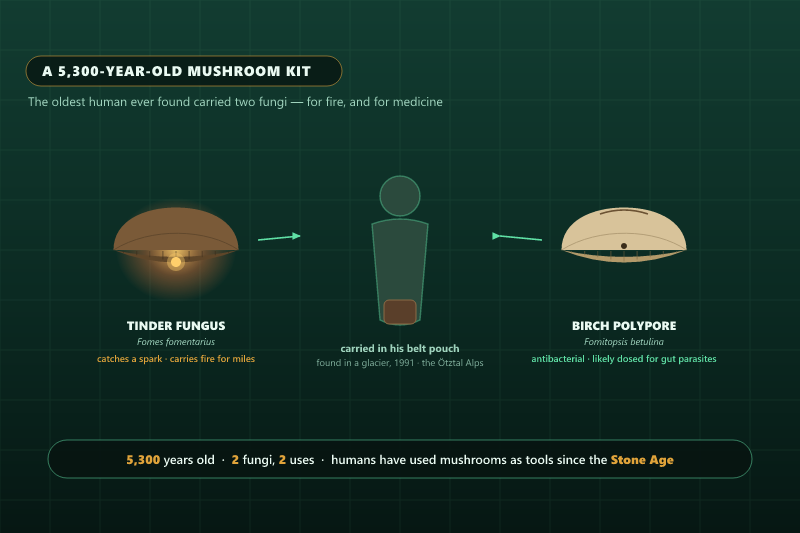
And in among it all, carefully kept, were two different fungi. Not food. Tools. They tell us that 5,000 years ago, humans already understood mushrooms well enough to use one to carry fire and another as medicine.
The Fire-Carrier: Tinder Fungus
Before matches — before, really, the reliable ability to make fire on demand — the hardest problem in a traveller's day was not starting a fire but keeping one. Striking a spark from flint and pyrite is difficult and unreliable in cold, damp mountain air. Far better to never let your fire fully die.
That is what Fomes fomentarius solves, and it is why the fungus has been used for the purpose for thousands of years across Europe. It is a woody bracket fungus that grows on dead and dying trees — and its inner flesh, when prepared, has extraordinary properties:
- It catches a spark almost instantly. The processed inner layer is so flammable to a spark that a single strike of flint on iron pyrite will set it glowing.
- It smoulders, rather than burning. Once caught, it does not flare up and consume itself. It glows slowly and steadily, like the tip of a cigarette, for a very long time.
- So it can be carried. A smouldering piece could be sealed into a container — a hollow horn, a shell, a pouch packed with dry moss — and carried for hours or even days. At the next camp, that ember was coaxed back into flame. The traveller had, in effect, a portable fire.
The prepared material has its own name in traditional European craft — amadou — and beyond fire-lighting it was pounded into a soft, felt-like fabric used for hats, and as an absorbent dressing to stop bleeding. Ötzi's fire-making kit shows he was equipped exactly as a Copper Age traveller needed to be: not with the ability to conjure fire from nothing, but with the far more practical ability to keep the fire he already had.
The Medicine: Birch Polypore
The second fungus is the more remarkable, because it points to something we do not usually credit to people 5,000 years dead: a working pharmacology.
Fomitopsis betulina, the birch polypore, grows almost exclusively on birch trees. Ötzi's two pieces were not loose in a pouch — they had been bored through and strung on a leather cord, which tells us they were valued, kept deliberately, and carried close. You do not thread your firewood onto a necklace. You do that with something you want to keep and use.
And there is good reason to want to keep it. Modern analysis of birch polypore has confirmed real bioactivity:
- Antibacterial action. Extracts show broad-spectrum antibacterial activity against organisms including Escherichia coli, Bacillus subtilis and Staphylococcus aureus. The fungus even yields a specific antibiotic compound, piptamine.
- Anti-inflammatory and wound-care use. In European folk medicine, fresh birch polypore was used to make antiseptic, anti-bleeding dressings, and the dried powder was used to ease pain. Its active triterpenoids — including polyporenic acid C and betulinic acid — underpin these effects.
Here is the detail that ties it together, and it is worth stating with appropriate care. When scientists examined Ötzi's remains, they found he was carrying an intestinal parasite — the eggs of the whipworm Trichuris trichiura, which would have caused him abdominal pain and could contribute to anaemia. The anthropologist who first studied this proposed that Ötzi's birch polypore was a deliberate treatment for exactly that affliction.
It must be said plainly that this remains an interpretation, not a proven fact. We cannot interview Ötzi. But it is a well-motivated one: he was carrying a parasite that causes gut distress, and he was also carrying — strung carefully on a cord — a fungus with real antimicrobial and gut-active properties, of no use as food or fuel. The simplest explanation for why is that he knew it helped.
What This Actually Tells Us
Strip away the romance of the frozen man and a genuinely important point remains about the history of our species' relationship with fungi.
We tend to think of "using mushrooms" as either eating them or, more recently, as a modern wellness trend. Ötzi demolishes both assumptions. Five thousand three hundred years ago — before writing, before the wheel reached his valley, before the pyramids — an ordinary man in the Alps was carrying a curated fungal toolkit, with different species selected for different, sophisticated purposes:
- One fungus chosen for a physical property — the way it holds an ember — to solve the problem of transporting fire.
- Another chosen for a chemical property — its antimicrobial action — to solve a problem inside his own body.
That is not foraging. That is applied mycology, passed down as knowledge, thousands of years before anyone wrote a word of it down. The understanding that certain mushrooms could catch fire and certain mushrooms could heal was already old when Ötzi carried it up that mountain.
The Thread to a Modern Mushroom Farm
It is humbling, and clarifying, to sit at the far end of that thread.
- We are continuing a 5,000-year-old craft. The knowledge that fungi are useful — for food, for medicine, for materials, for fire — is one of humanity's oldest and most continuous bodies of practical science. A modern mushroom farm is not a novelty; it is the latest chapter of something Ötzi already understood.
- The "medicinal mushroom" is ancient, not a fad. Long before it was a marketing term, birch polypore was strung on a Copper Age man's cord for its antibacterial effect. Traditions like this are worth taking seriously — and worth studying properly, which is exactly what modern researchers isolating compounds like piptamine and betulinic acid are doing.
- Respect for the organism runs deep. These bracket fungi are close relatives of the wood-rotting fungi and enzyme-rich decomposers that make the whole cycle of life on land possible. Ötzi did not know the biochemistry. He knew they worked. We now get to know both.
The next time you handle a mushroom, remember the man in the ice. He carried two of them up a mountain 5,300 years ago — one to keep his fire alive, one to keep himself alive — and then he lay down in the snow, and the fungi, and the knowledge they represent, waited there for us to find.