The Deadliest Mushroom on Earth Lets You Feel Better Before It Kills You
Most poisons announce themselves. You eat something wrong, and within minutes or an hour your body tells you in no uncertain terms. That warning is a gift: it buys time, and time is what medicine needs.
The death cap — Amanita phalloides — offers no such warning. It is responsible for the overwhelming majority of fatal mushroom poisonings worldwide, and it achieves that not by being the most toxic substance in nature, but by being patient.
It tastes, by the account of people who survived it, pleasant. Then nothing happens for the better part of a day. And when the illness finally arrives and passes, the victim appears to recover — precisely while the damage becomes irreversible.
How It Actually Kills: Switching Off the Instructions
To understand α-amanitin you have to understand what it targets, because it is not a crude cellular poison. It is closer to sabotage of a specific machine.
Every cell in your body holds your DNA — the master library. But DNA never leaves the nucleus and is never used directly. To make a protein, the cell first transcribes the relevant gene into a working copy called messenger RNA. The enzyme that performs that transcription is RNA polymerase II.
α-Amanitin binds to RNA polymerase II with extraordinary affinity, settling into a funnel-shaped pocket beneath the enzyme's "bridge helix," right at its active site. It does not smash the enzyme. It jams the mechanism, blocking the translocation step by which the polymerase ratchets along the DNA strand.
The consequence is total and quiet. The cell cannot transcribe genes. It cannot make new messenger RNA. As the existing mRNA molecules are used up and degrade naturally, protein production simply runs down and stops. The cell has not been attacked — it has been cut off from its own instructions, and it dies when its existing supplies are exhausted.
This is precisely why the delay exists. The toxin acts immediately; the symptoms cannot appear until enough cells have exhausted their stock of working proteins. You feel fine because your cells are still running on what they made yesterday.
Why the liver takes the damage
The toxin is absorbed through the gut and delivered straight to the liver, whose hepatocytes take it up readily. The liver is also one of the most metabolically demanding organs in the body — it is constantly synthesising proteins, so it depends utterly on continuous transcription. An organ that must keep manufacturing is the organ most vulnerable to having its blueprints confiscated. Hepatocellular failure can follow within a few days of ingestion.
The Four Phases — and the Trap
Clinicians describe a characteristic progression, and its shape is the reason this mushroom is so lethal:
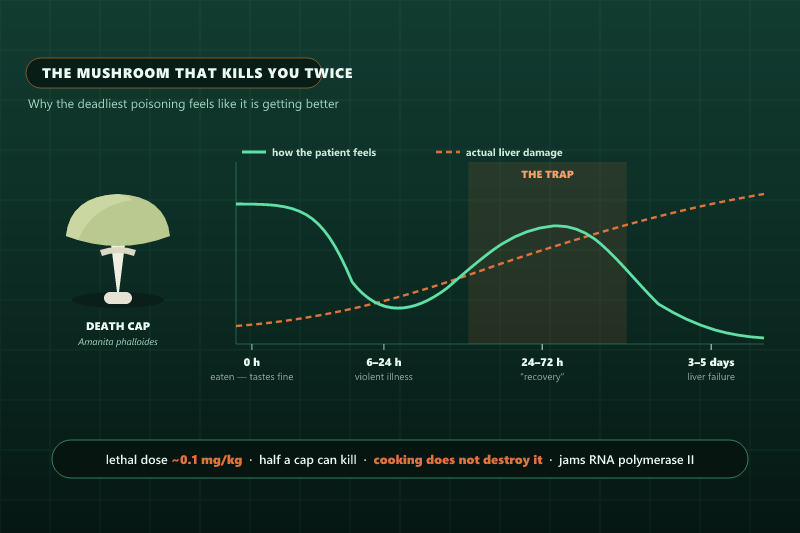
- Phase 1 — Latency (roughly 6–24 hours). Nothing. No pain, no nausea, no warning. The victim eats dinner, sleeps well, and wakes normally. Meanwhile the toxin is already in the liver.
- Phase 2 — Gastrointestinal crisis (roughly 24 hours in). Sudden, severe vomiting, cramping and profuse watery diarrhoea. Dangerous dehydration. Crucially, this looks exactly like ordinary food poisoning or gastroenteritis — and is very often diagnosed as such.
- Phase 3 — The false recovery (roughly 24–72 hours). The gastrointestinal symptoms subside. The patient feels substantially better and may be discharged, or may decide against seeking help at all. This is the most dangerous moment of the entire illness. Liver enzymes are climbing steeply; the destruction is accelerating behind an appearance of improvement.
- Phase 4 — Hepatic failure (roughly 3–5 days). Jaundice, coagulation failure, encephalopathy, and progression to multi-organ failure. By this point the damage may be beyond anything but a liver transplant.
Look again at the illustration above. The green line is how the patient feels. The dashed orange line is what is actually happening to the liver. The tragedy of the death cap lies entirely in the gap between them.
Why There Is No Simple Antidote
Treatment is supportive and difficult: aggressive rehydration, activated charcoal if the patient presents early, and agents including silibinin (a milk-thistle derivative believed to block toxin uptake into liver cells) and N-acetylcysteine. In severe cases the only definitive treatment is an emergency liver transplant.
The core obstacle is timing. By the time anyone knows they have been poisoned, the toxin has already bound its target and the transcriptional shutdown is under way. There is no drug that unbinds α-amanitin from RNA polymerase II and restores a cell that has already run down. Medicine is left supporting a patient through the consequences rather than reversing the cause.
The Myths That Get People Killed
Nearly every piece of traditional folklore about telling safe mushrooms from poisonous ones is false, and several of them are false in ways that point directly at the death cap:
- "Cooking destroys the poison." It does not. Amatoxins are remarkably heat-stable — cooking, drying, freezing and boiling leave them intact. This single myth is among the deadliest.
- "Poisonous mushrooms taste bitter or unpleasant." Survivors consistently report that the death cap tasted good.
- "A silver spoon will blacken" / "it will curdle milk" / "if animals eat it, it's safe." None of these have any basis. Other animals metabolise toxins differently from humans.
- "Poisonous mushrooms are brightly coloured." The death cap is a modest, pale greenish-to-olive mushroom with white gills. It looks entirely unremarkable — which is exactly the problem.
The genuine danger is mistaken identity. Young death caps, still enclosed in their universal veil, can resemble edible puffballs, and the mature mushroom has been confused with edible species by foragers across Europe, Asia, North America and Australia. The species has also spread far beyond its native range, travelling with the roots of imported ornamental and timber trees, so it now appears in places where local foraging traditions never had to account for it.
Which Is the Whole Argument for Cultivation
We are a mushroom farm, and this is the fact we most want people to take seriously — including the students who visit us.
- Never eat a wild mushroom identified from a photograph, an app, or a website — including this one. Reliable identification depends on features an image rarely captures: the base of the stem (the death cap's cup-like volva is often buried and gets left in the ground), the gill attachment, the spore print colour, the habitat and the associated trees.
- There is no general rule. No single visual test separates edible from deadly. Expertise here is species-by-species knowledge, not a trick.
- Cultivated mushrooms remove the question entirely. When you buy button mushrooms from us, you are buying a known clonal strain, grown from laboratory spawn on prepared, pasteurised substrate in a controlled room. There is no identification step, because there was never any ambiguity about what was growing. As we've written elsewhere, commercial growing is clonal rather than seed-based — and that traceability is a safety feature, not just an agronomic one.
- If you suspect mushroom poisoning, go to hospital immediately — even if you feel fine, and especially if you have started to feel better. Take a sample of the mushroom with you if you can. Do not wait for symptoms to worsen. With amatoxins, feeling better is not evidence of recovery.
Fungi are extraordinary, and most of this site is a celebration of them. But the same kingdom that gives us umami, penicillin and bread also produced a molecule that quietly confiscates a cell's instruction manual and waits.
Respect that, and buy your mushrooms from someone who knows exactly what they grew.