Around 100 Species of Mushroom Glow in the Dark — and We Finally Know Why
Walk into a damp tropical forest on a moonless night and, if you are very lucky, the forest floor will be softly lit — a cool, greenish glow coming from the fallen leaves, from rotting logs, from the mushrooms themselves. Sailors, soldiers and miners have reported it for millennia. They called it foxfire, or "cold fire," or ignis fatuus. Aristotle wrote about glowing wood around 350 BCE, noting that unlike ordinary fire, it was cold to the touch.
For almost all of the 2,300 years since, nobody could explain it. It is only in the last decade that the full chemistry has been worked out — and the answer is more elegant, and more purposeful, than anyone expected.
How a Mushroom Makes Light
All bioluminescence — in fireflies, in deep-sea fish, in these fungi — works on the same general principle: a molecule called a luciferin is oxidised by an enzyme called a luciferase, and the reaction releases energy as light instead of heat. What differs between organisms is the specific chemistry, and the fungal version turns out to be unique — and, remarkably, a self-renewing loop.
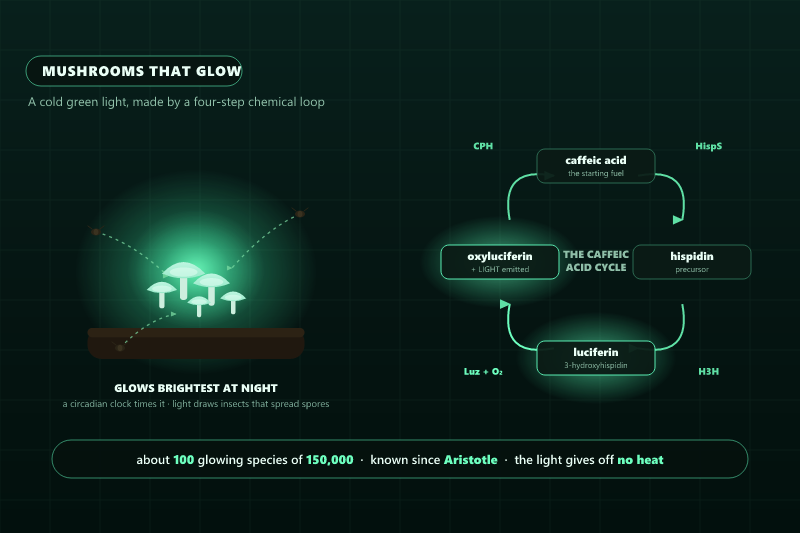
The starting material is caffeic acid, one of the most common building blocks in the plant and fungal world (it is a routine product of breaking down lignin — the very polymer these wood-rotting fungi specialise in digesting). From there, four enzymes turn the handle:
- Caffeic acid → hispidin. An enzyme called hispidin synthase (HispS) converts the raw material into a precursor.
- Hispidin → luciferin. A hydroxylase (H3H) adds an oxygen atom, producing the actual fuel: 3-hydroxyhispidin, the fungal luciferin.
- Luciferin → light. The luciferase (Luz) adds molecular oxygen, forming a high-energy intermediate that breaks down into oxyluciferin — and, in that instant, emits a photon of green light.
- Oxyluciferin → caffeic acid. A fourth enzyme (CPH) recycles the spent molecule back into caffeic acid, so the cycle can run again.
That last step is what makes the fungal system special: it is a closed loop. The fungus does not consume a limited stock of fuel and then go dark — it continuously regenerates its own luciferin from an abundant, cheap starting material. That is precisely why a rotting log can glow steadily for weeks.
It is also why this discovery caused excitement well beyond mycology. Because the whole pathway starts from caffeic acid — something virtually all plants already make — researchers realised the four fungal genes could be transferred into other organisms to make them glow autonomously, with no added chemicals. This has since been used to create continuously glowing plants, lit from within by borrowed mushroom chemistry.
The Clue That It Has a Purpose
A glow could easily be a meaningless by-product — a chemical accident with no function. The evidence that it is not came from studying a large, brightly luminous Brazilian mushroom, Neonothopanus gardneri, known locally as "flor-de-coco" because it grows at the base of palms.
An international team — including Cassius Stevani in São Paulo and Jay Dunlap and Dennis Desjardin in the United States — made two findings that together are hard to dismiss:
- The glow is on a clock. The mushroom does not glow at constant brightness. Its light is regulated by a temperature-compensated circadian rhythm — the same kind of internal ~24-hour clock that governs sleep in animals — and it peaks at night, exactly when a glow would actually be visible. As Dunlap put it, the fact that the light is regulated strongly implies it has an adaptive function. An organism does not evolve careful timing control for something useless.
- The light attracts animals. Using infrared cameras to watch the mushrooms at night, researchers found that the glowing caps drew in beetles, flies, wasps and ants far more than non-glowing controls. Complementary experiments with fake, LED-lit acrylic "mushrooms" showed the same pull: lit ones attracted more insects than dark ones.
The leading interpretation follows naturally. These fungi live on the dark forest floor, where there is little wind to carry spores away. So instead of relying on air, they may advertise: the light summons insects, the insects crawl over the mushroom, and they leave carrying spores to new locations. It is the fungal equivalent of a flower using colour and scent to attract a pollinator — except the mushroom uses light, and the "pollinator" is really a courier.
This connects directly to a theme we've explored before: fungi are extraordinary at getting their spores to travel. Most use air. These few, on the still forest floor, evolved to use light and living couriers instead.
The Honest Caveat
It would be neat to end there, but the truth is more nuanced, and worth stating plainly.
The "attracting spore dispersers" explanation is well supported for Neonothopanus gardneri and a few similar large, cap-glowing tropical species. It is not established as the universal reason all fungi glow. In many species — including the honey fungus Armillaria, whose glowing underground mycelium produces the classic foxfire of rotting logs — it is the mycelium that glows, not the fruiting body, and often faintly. A glowing thread buried inside a log is in no position to attract anything.
For those cases, the glow may be a non-adaptive by-product — a side effect of the fungus's ordinary metabolism (perhaps a way of dealing with reactive oxygen produced during wood decay) that simply happens to emit light. In other words: some fungi may glow for a reason, and others may just glow. The science has firmly established the how; the why is answered for some species and genuinely open for others.
A Light With No Heat
One detail deserves a moment on its own, because it is quietly astonishing. Fungal bioluminescence is a "cold light." An incandescent bulb wastes the overwhelming majority of its energy as heat and emits only a little light. This reaction does almost the exact opposite: nearly all the released energy becomes photons, with negligible heat.
A mushroom cannot afford to run a furnace. It is mostly water, it has no way to withstand high temperatures, and it certainly cannot spare the energy. So life solved the problem of making light the only way a soft, cool, water-filled organism could: with chemistry so efficient it produces light and essentially nothing else. Human lighting technology took until the age of the LED to begin approaching that kind of efficiency. The fungi have been doing it since before Aristotle noticed.
What This Means for Us
The button mushrooms we grow do not glow — bioluminescence is confined to a small set of mostly wood-rotting species, and Agaricus bisporus is not among them. But the fact still matters to how we think about, and talk about, the crop.
- It shows how much chemistry hides in a mushroom. A crop we treat as a simple food is, at the biochemical level, capable of feats — like generating light with near-perfect efficiency — that we spent centuries trying to engineer. Respect for the organism is well earned.
- It is one of our best teaching moments. On our educational farm visits, "some mushrooms glow in the dark, and here is the four-step chemical loop that does it" is exactly the kind of fact that turns a child's curiosity into an interest in real biochemistry. Wonder is a gateway to understanding.
- It hints at value beyond food. Fungal enzymes are already the backbone of industries from detergents to bioremediation. Now the luminescence pathway has become a tool for biotechnology — glowing plants, living sensors, reporter genes. The fungus that lights a rainforest floor is quietly rewriting what a mushroom is for.
So the next time you hear an old story about ghostly lights in a forest, or a lantern that needed no flame, you will know what it almost certainly was: not spirits, but a fungus — running a tiny, tireless chemical loop, turning the leftovers of rotting wood into a cold green light, and possibly calling in the insects that will carry its children out into the world.