Mushroom Season in India: A Month-by-Month Growing Calendar
⏱ The short answer
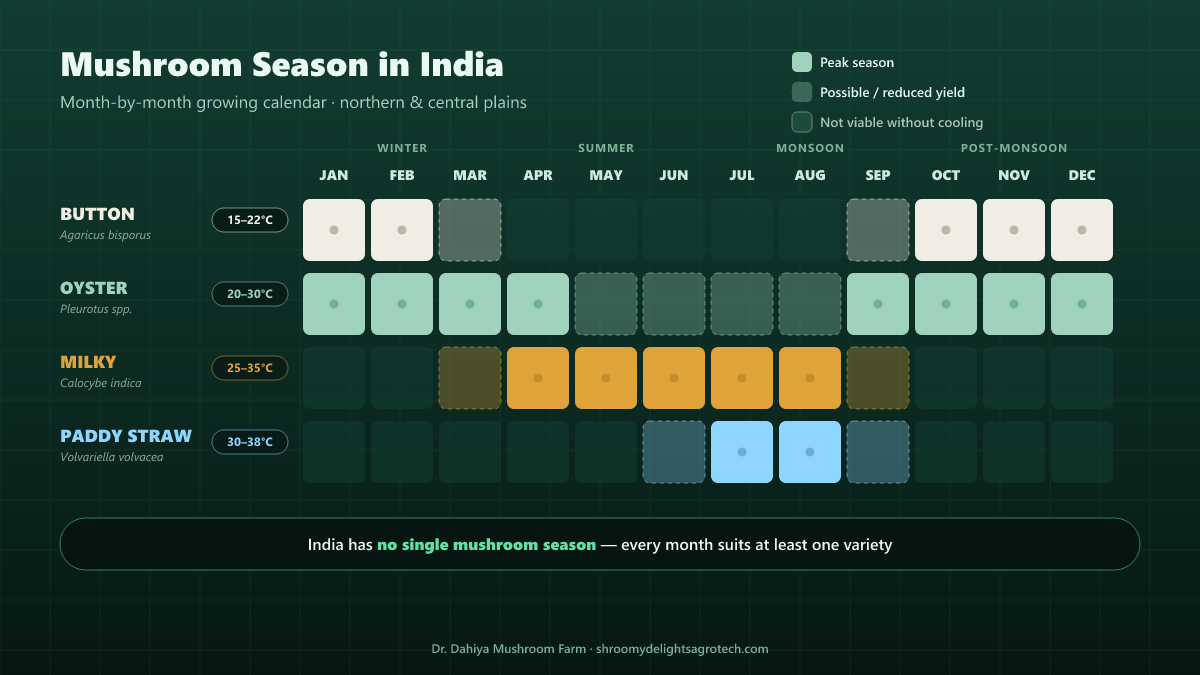
India has no single mushroom season — it has four, one per variety. Button runs October to March in the plains. Oyster grows year-round across most of the country. Milky is the summer crop, fruiting happily when everything else struggles. Paddy Straw belongs to the monsoon in the humid east. Pick the mushroom that suits the month you are in, rather than waiting for a season that never arrives.
Ask when mushroom season is in India and you will get contradictory answers, because most of what is written on the subject quietly assumes North India and Button mushroom. That assumption is reasonable enough — Button accounts for the large majority of India’s commercial production, and it genuinely does have a season. But it leaves a grower in Kerala or Assam with advice that does not fit their weather at all, and it leaves a grower anywhere in India believing that eight months of the year are simply unavailable.
They are not. Somewhere in the country, in every month of the year, one of these four mushrooms is in its ideal range. This guide sets out which one, and when.
📋 What this guide covers
- Why India has four seasons, not one
- The month-by-month calendar
- Temperature and humidity requirements
- Button mushroom season
- Oyster mushroom season
- Milky mushroom season
- Paddy straw mushroom season
- Spawn-to-harvest: how long each crop takes
- Season by region and climate zone
- Growing through the monsoon
- How season affects price and profit
- How to grow off-season
- Five seasonal mistakes that cost growers money
- Frequently asked questions
1. Why India has four seasons, not one
Mushrooms do not respond to the calendar. They respond to temperature and humidity, and each species has a narrow band it fruits in. Get the band right and the mushroom crops readily; miss it and no amount of care will produce a decent flush. India’s advantage — and the reason the question has no single answer — is that the country spans enough climate to keep at least one of those bands open at all times.
| Mushroom | Ideal temperature | Natural season | Where it suits |
|---|---|---|---|
| Button | 15–22°C | October–March | Northern plains, hills |
| Oyster | 20–30°C | Year-round | Almost everywhere |
| Milky | 25–35°C | March–September | South, hot regions |
| Paddy Straw | 30–38°C | Monsoon months | East, north-east, coastal |
Read that table as a single continuous strip rather than four separate rows. As the plains warm past Button’s ceiling in March, Milky’s window is opening. As the monsoon arrives and Milky becomes harder to manage, Paddy Straw comes into its own. And Oyster runs quietly underneath all of it, which is precisely why it is the crop we recommend beginners start with.
2. The month-by-month calendar
This calendar describes the northern and central plains, where the seasonal swing is sharpest and the choices matter most. Southern and north-eastern growers should read the regional section below instead, because their year is far flatter.
| Month | Best crop | What is happening |
|---|---|---|
| October | Button (start), Oyster | Nights drop into range. The best month to begin a Button cycle |
| November | Button, Oyster | Peak conditions. First Button flushes from October spawning |
| December | Button, Oyster | Coldest and most productive stretch for Button |
| January | Button, Oyster | Peak continues. Watch for over-cooling in the far north |
| February | Button (final), Oyster | Last reliable Button flushes. Plan the changeover |
| March | Oyster, Milky (start) | Button winds down as days warm. Milky becomes viable |
| April | Milky, Oyster | Heat builds. Milky takes over as the premium crop |
| May | Milky | Peak heat. Oyster slows and needs misting to continue |
| June | Milky, Paddy Straw | Pre-monsoon. Humidity begins to help rather than hinder |
| July | Paddy Straw, Oyster | Monsoon. Contamination pressure at its highest |
| August | Paddy Straw, Oyster | Monsoon continues. Keep batches small and hygiene tight |
| September | Oyster, prepare for Button | Rain eases. Time to prepare compost for the Button season |
💡 The month that decides your year
September is the month most Button growers get wrong. Properly composted substrate takes roughly three to four weeks to prepare, so if you wait until October’s cool weather arrives before starting, you have already lost the first month of the season. Begin composting in early September and you will be spawning exactly as temperatures come into range.
3. Temperature and humidity requirements by variety
“Season” is really shorthand for two numbers: temperature and relative humidity. If you can hold those two figures, the month on the calendar stops mattering. The table below is the one worth pinning to your growing room wall, because almost every seasonal failure traces back to a number in it.
Note that mushrooms need two different temperatures at two different stages. Spawn run — the phase when mycelium colonises the substrate in the dark — generally wants conditions a few degrees warmer than fruiting. Dropping the temperature is part of what tells the crop to start producing mushrooms.
| Variety | Spawn run temp | Fruiting temp | Humidity at fruiting | CO₂ / air |
|---|---|---|---|---|
| Button | 22–25°C | 15–22°C | 80–90% | Needs fresh air; high CO₂ causes long stalks |
| Oyster | 24–28°C | 20–30°C | 80–90% | Very sensitive; poor airflow deforms caps |
| Milky | 28–32°C | 25–35°C | 80–90% | Tolerant; also needs a casing layer |
| Paddy Straw | 32–35°C | 30–38°C | 85–95% | Wants warmth and very damp air |
🌡 The button mushroom temperature question, answered plainly
Button mushroom needs 22–25°C for spawn run and 15–22°C for fruiting, at 80–90% relative humidity. Those figures are why its Indian season is October to March in the plains and nowhere near summer.
The number growers most often miss is the ceiling. Above roughly 25°C at fruiting, Button pins abort, caps open early and turn brown, and yields collapse — and this happens well before the weather feels unbearable to you. A March afternoon that seems merely pleasant can already be outside the crop’s range. Measure the room, not the day.
4. Button mushroom season
Season: October to March in the plains, with the peak from November to February.
Button mushroom fruits at 15–22°C, which in Haryana, Punjab, Uttar Pradesh and Bihar means the cool half of the year and nothing else. This is the crop that gave India its idea of a mushroom season, and in the plains that idea is broadly correct: outside those months you are looking at a cooled room and an electricity bill that rarely justifies itself.
The hills change the arithmetic considerably. Himachal Pradesh has enough natural elevation to grow Button across much of the year, which is why the state became India’s early centre for it and why Solan is still known for mushroom research. Uttarakhand stretches to roughly September through April, and Jammu and Kashmir inverts the pattern entirely with a season running April to November, since its winter is too cold rather than too warm.
One metro is worth singling out. Bengaluru sits at around 900 m, and its November-to-February nights fall close enough to Button’s range that modest insulation and a small cooling unit can bridge the gap — something no other southern metro can claim. We cover that in detail in our Bangalore training guide.
5. Oyster mushroom season
Season: year-round across most of India.
Oyster tolerates 20–30°C, a band that covers the normal working range of the tropical coastal, tropical wet and north-eastern states for the whole year. In Kerala, Goa, Tamil Nadu, Telangana, Assam and the rest of the north-east there is no Oyster season, because every month is one.
Even in the northern plains, Oyster is close to year-round. It runs comfortably from September through May and only genuinely struggles in the peak heat of May and June, when growers either pause for a few weeks or keep going with misting and increased ventilation. Yields fall in those weeks but the crop does not fail.
This is the single most useful fact for a new grower, and it is why we start almost every beginner on Oyster: you do not have to wait for a season to begin. Whatever month you are reading this in, you can start an Oyster batch. Full method is in our oyster mushroom farming guide.
6. Milky mushroom season
Season: March to September, peaking through the hottest months.
Milky mushroom (Calocybe indica, known as paal kaalan in Tamil Nadu and doodh chhatri in the north) is the crop that answers the question every Indian grower eventually asks: what do I grow when it is too hot for everything else? It fruits at 25–35°C, temperatures that would stop Button entirely and slow Oyster to a crawl.
Two further advantages make it worth learning. It has a noticeably longer shelf life than Oyster, which matters when summer transport is unkind to fragile produce. And because relatively few growers bother with it, summer supply is thin and prices hold up well. It is firmly established in Tamil Nadu, Andhra Pradesh, Telangana and Karnataka, and increasingly viable in the central plains during April and May.
7. Paddy straw mushroom season
Season: the monsoon months, roughly June to September.
Paddy straw mushroom (Volvariella volvacea) wants 30–38°C with very high humidity — conditions that describe the Indian monsoon almost exactly. It is the traditional crop of West Bengal, Odisha and the north-eastern states, grown on the rice straw those regions have in abundance, and it turns the most difficult growing months of the year into the easiest.
It is a fast crop, often ready inside two weeks, but a short-lived one: harvest at the button stage before the veil opens, and expect a shelf life measured in days rather than a week. That makes it a local-market mushroom rather than something to ship, which suits a grower selling into a nearby town.
8. Spawn-to-harvest: how long each crop takes
Knowing the season is only half the planning. The other half is knowing how far ahead of it you have to start, because every crop has a lead time between spawning and your first sale. Growers who read the calendar but ignore the lead time consistently begin a month late.
| Variety | Substrate prep | Spawn run | First harvest from spawning | Total crop cycle |
|---|---|---|---|---|
| Button | 3–4 weeks composting | 14–18 days | ~30–35 days (after casing) | 10–14 weeks |
| Oyster | 1–2 days pasteurising | 15–20 days | ~21–25 days | 6–8 weeks |
| Milky | 1–2 days pasteurising | 18–22 days | ~30–35 days (after casing) | 8–10 weeks |
| Paddy Straw | 1–2 days | 7–10 days | ~12–18 days | 3–4 weeks |
Work backwards from these figures and the practical planting dates fall out on their own:
- Button: to harvest through November, start composting in early September. Compost alone eats a month before you have spawned anything.
- Oyster: roughly three weeks from spawning to first flush, so you can respond to a market opening almost within the month.
- Milky: spawn in March to catch the peak summer price window in May and June.
- Paddy Straw: the sprinter, at under three weeks start to finish, which is why it fits neatly into a short monsoon window.
9. Season by region and climate zone
India’s 27 mushroom-growing states fall into a handful of climate zones, and your zone matters more than your state border. The pattern below is drawn from the state-level data behind our 27 state guides.
| Zone | States | Season |
|---|---|---|
| Hot semi-arid | Haryana, Punjab | Button October–March; Oyster most of the year |
| Subtropical plains | Uttar Pradesh, Madhya Pradesh, Bihar, Jharkhand, Chhattisgarh | Button October–March; Oyster year-round |
| Arid | Rajasthan, Gujarat | Button November–February only; Oyster with cooling |
| Tropical coastal | Maharashtra, Karnataka, Tamil Nadu, Andhra Pradesh, Odisha | Oyster year-round; Button November–February at best |
| Tropical wet | Kerala, Goa | Oyster and Milky year-round; Button impractical |
| Tropical humid | West Bengal | Oyster year-round; Paddy Straw in monsoon; Button October–March |
| Temperate hills | Himachal Pradesh, Uttarakhand, Jammu & Kashmir | Longest Button season in India; J&K runs April–November |
| North-east monsoon | Assam, Meghalaya, Tripura, Manipur, Nagaland, Mizoram | Oyster year-round; Paddy Straw through the rains |
The broad rule is simple enough to remember: the further north and higher you are, the more the calendar matters. The further south you are, the less it does. A grower in Kerala can start any week of the year. A grower in Rajasthan has a genuine Button window of about four months and should plan around it.
10. Growing through the monsoon
The monsoon has a reputation as the impossible season, and it is worth being precise about why, because the common belief is wrong. Mushrooms love monsoon humidity — the moisture that makes the air feel heavy is exactly what fruiting bodies want. The difficulty is not the weather. It is that warm saturated air suits Trichoderma, competing moulds and bacteria every bit as well as it suits your crop.
So the monsoon problem is a contamination problem, and it responds to hygiene rather than climate control:
- Pasteurise properly, not approximately. This is the single highest-leverage habit in the wet months, and the one most often rushed.
- Keep a dedicated clean area for spawning. It need not be elaborate — a small, wiped-down, draught-free corner used for nothing else.
- Move air, do not trap it. An exhaust fan matters more than a sealed room. Stagnant humid air is what turns a minor contamination into a lost batch.
- Store substrate dry and raised. Straw that has absorbed monsoon damp before you even begin is already a problem.
- Run smaller batches deliberately. Reducing volume through July and August is a strategy, not a retreat. Losing 20% of a small batch costs far less than losing 20% of your largest.
Growers who plan for a reduced monsoon cycle stay profitable through it. Growers who push peak volume into their hardest conditions lose batches and often conclude, wrongly, that mushrooms simply cannot be grown in the rains.
11. How season affects mushroom price and profit
The calendar is not only about what will grow. It is about what will pay, and the two do not always point the same way. Mushroom prices in India move inversely to supply, and supply is driven by exactly the seasonal pattern described above.
The result is a predictable annual rhythm that many growers only notice after their first full year:
- Peak season means peak supply, and softer prices. Through December and January, every Button grower in the northern plains is harvesting at once. Mandi rates fall precisely when your yields are highest.
- Off-season means thin supply, and stronger prices. In May and June, very little is coming to market. A Milky crop landing in those weeks meets far less competition than a Button crop in December.
- Festival demand is a genuine spike. Demand lifts noticeably around the Diwali-to-wedding-season stretch, which happens to sit right at the start of the Button window — a good reason not to be late with September composting.
This is the strategic argument for learning a second variety. A grower who only knows Button harvests into the most crowded market of the year and sits idle through the months when prices are best. A grower who runs Button in winter and Milky in summer sells in both, and the summer crop often carries the better margin per kilogram despite the smaller harvest.
None of this replaces doing your own numbers — local mandi rates vary widely and the picture in Sonipat is not the picture in Coimbatore. Our mushroom farming cost and profit guide walks through the full calculation, and the subsidy schemes guide covers the support available for building the infrastructure that extends a season.
12. How to grow off-season
If you want to grow a particular mushroom outside its natural window, you have three honest options, and they are not equally sensible.
Switch the variety
By far the cheapest. Grow what the month suits rather than fighting it — Milky in summer, Paddy Straw in the rains.
Modify the room
Insulation, misting and an exhaust fan will stretch a season by several weeks for a modest cost.
Cool the room
Air-conditioning makes any month possible for Button, but the electricity cost only works at commercial scale.
Our advice to nearly every new grower is the first option. Off-season Button in a Chennai or Mumbai summer is technically achievable and almost never worth it; a Milky crop in the same room during the same weeks will cost less and sell for more. Work with the climate you have — the calendar above exists so that you can.
13. Five seasonal mistakes that cost growers money
Across the farmers we have trained, the same five seasonal errors come up again and again. None of them are exotic, and all of them are avoidable once the calendar above is understood.
1. Starting Button in October
October is when Button should be spawned, not when preparation begins. Compost takes three to four weeks, so an October start means a November spawning and a lost month of the best season.
2. Judging temperature by feel
A room that feels comfortable to you can be several degrees above Button’s 22°C fruiting ceiling. A ₹200 thermometer and hygrometer prevents more losses than almost any other purchase.
3. Forcing Button through summer
Running air-conditioning to grow a low-value crop out of season rarely pays at small scale. Switching to Milky costs less and sells for more in the same weeks.
4. Pushing peak volume into the monsoon
July and August are the highest-contamination months of the year. Scaling up then multiplies the risk exactly when hygiene margins are thinnest.
5. Ignoring the second flush
Growers plan the first harvest and forget that later flushes arrive weeks afterwards — often as conditions turn. Plan the whole cycle against the calendar, not just day one.
Doing all five right
Prepare a month early, measure rather than guess, match variety to month, shrink monsoon batches, and plan the full cycle. That is most of seasonal mushroom farming.
🍄 Learn the full growing cycle, whatever month you start
Live online training covering variety selection, substrate, contamination control and selling — ₹1,499.
View TrainingWhatsApp: +91-9911552416
Frequently Asked Questions
What is the mushroom season in India?
There is no single season, because it depends on the variety. Button runs October to March in the plains, Oyster grows year-round across most of India, Milky is a summer crop, and Paddy Straw belongs to the monsoon.
Which month is best for mushroom farming in India?
October and November if you are growing Button in the plains, since you get the full cool season ahead of you. For Oyster, any month works in most of India. Beginners often do best starting an Oyster batch in October, when the weather is mild and contamination pressure is low.
Can mushrooms be grown in summer in India?
Yes, but switch variety. Button is impractical without air-conditioning. Milky mushroom fruits at 25–35°C and is the correct summer crop. Oyster continues in most regions with misting and ventilation, though yields drop in the hottest weeks.
Can you grow mushrooms during the monsoon in India?
Yes. Monsoon humidity helps fruiting; the risk is contamination, not weather. Pasteurise thoroughly, keep a clean spawning area, maintain airflow, and run smaller batches. Paddy Straw mushroom is the traditional monsoon crop in West Bengal, Odisha and the north-east.
What is the season for button mushroom in India?
October to March in the northern plains, peaking November to February. Himachal Pradesh and Uttarakhand have longer seasons thanks to elevation, and Jammu & Kashmir runs April to November. In the far south, Button needs a cooled room in any month.
Is oyster mushroom grown year-round in India?
In most of the country, yes. Oyster suits 20–30°C, which covers the tropical coastal, tropical wet and north-eastern states all year. In the northern plains it slows only during the May–June peak heat.
When should I start composting for button mushroom season?
Early September. Proper compost takes three to four weeks, so starting in September means you are spawning just as October temperatures come into range. Waiting for cool weather before you begin costs you the first month of the season.
What temperature and humidity does button mushroom need?
Button mushroom needs 22–25°C during spawn run and 15–22°C during fruiting, with relative humidity of 80–90% throughout. Above about 25°C at fruiting, pins abort and caps open early, which is why the crop is limited to October–March in the Indian plains.
Which mushroom is best for summer in India?
Milky mushroom (Calocybe indica) is the best summer crop for India. It fruits at 25–35°C, exactly the range that stops Button and slows Oyster, and it has a longer shelf life than Oyster, which matters in summer transport. Summer supply is thin, so prices generally hold up well.
What is the season for milky mushroom in India?
Milky mushroom season runs roughly March to September, peaking through the hottest months. Spawn in March to catch the premium May–June price window. It is well established in Tamil Nadu, Andhra Pradesh, Telangana and Karnataka, and increasingly viable in the central plains through April and May.
How long does it take to grow mushrooms from spawning to harvest?
Paddy Straw is fastest at 12–18 days from spawning to first harvest. Oyster takes about 21–25 days. Milky and Button both take roughly 30–35 days because they need a casing layer. Button also needs three to four weeks of composting before spawning even begins, so its true lead time is the longest of the four.
Which month is mushroom price highest in India?
Prices are generally strongest in the off-season months of May and June, when very little is coming to market, and around the festival and wedding demand from Diwali onwards. They are usually softest in December and January, when every Button grower in the northern plains is harvesting at once and supply peaks.
Related reading