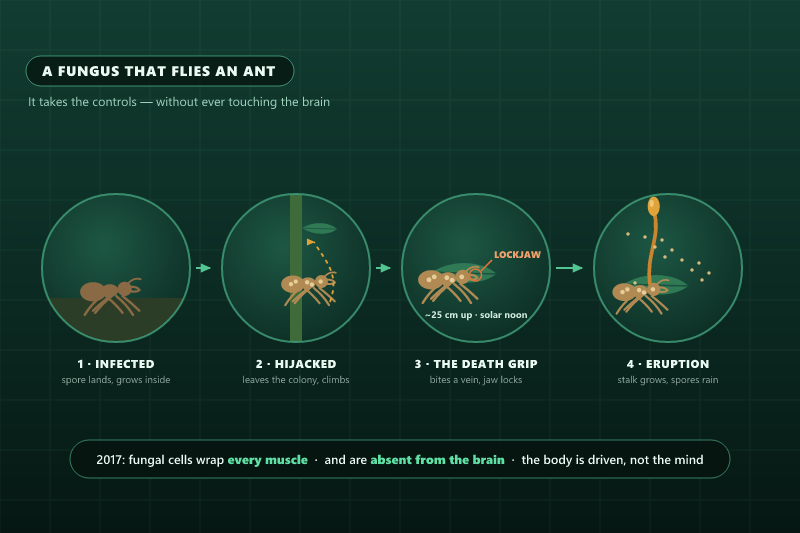
A Fungus Drives an Ant to a Precise Spot, Then Locks Its Jaws — Without Touching the Brain
A carpenter ant in a tropical forest does something it has never done before. It abandons its foraging trail and its colony. It begins to convulse and wander erratically, falling from branches. Then it climbs — not far, but with purpose — and takes up a position on the underside of a leaf.
There, it bites down on the leaf's main vein. And it never lets go.
Within hours the ant is dead. Over the following days, a stalk pushes out through the back of its head, grows several times the length of the ant's body, and begins showering spores onto the forest floor below — where its nestmates are still walking.
None of this is the ant's idea. Every step of it has been driven by a fungus called Ophiocordyceps unilateralis. And the way it does this is far stranger than the phrase "mind control" suggests.
It Never Touches the Brain
This is the part almost every retelling gets wrong, and it is the most interesting thing about the organism.
The intuitive assumption is that a parasite controlling behaviour must be in the brain — that it colonises the central nervous system and issues commands. Researchers at Penn State tested this directly, using serial block-face scanning electron microscopy and machine-learning image analysis to build three-dimensional reconstructions of infected ants, mapping every fungal cell from abdomen to head.
What they found was that a very large fraction of the cells inside the host were fungal, not ant. The fungus had spread through the entire body cavity, wrapping itself intimately around muscle fibres — surrounding them rather than penetrating the cells themselves. It had built what amounted to a tubular scaffolding through the ant's musculature, and a large proportion of those fungal cells were physically interconnected, suggesting they operate as a coordinated network rather than as isolated invaders.
And in the head, packed densely right up against the brain, the fungal cells stopped. The brain itself was untouched.
The researchers likened the fungus to a puppeteer working the strings of a marionette: it is not issuing orders to a mind, it is operating the body directly. Muscles are made to contract by a parasite pressed against them, almost certainly through secreted chemical signals rather than by hijacking the nervous system.
Which raises a genuinely unsettling possibility that the researchers themselves floated: the brain may be left intact deliberately, because the host needs to stay alive and functional long enough to complete the climb and the bite. The ant may remain, in some sense, present — while its body is worked from the outside.
Why 25 Centimetres, and Why Noon
The precision seems excessive until you ask what the fungus needs, at which point it becomes obvious: the ant is not being moved to a location, it is being moved into a climate.
The fungus still has to grow a stalk and mature its spores after the host dies. That requires stable warmth and very high humidity. Infected ants are found concentrated in patches — informally called graveyards — where conditions sit around 20–30 °C and roughly 95% humidity. About 25 cm above the soil, on the shaded underside of a leaf, is where that microclimate reliably exists in a tropical understorey. High enough to be above the leaf litter; low enough to stay in the humid boundary layer; sheltered from direct sun and rain.
The ant is not choosing a place to die. It is being walked into a greenhouse and told to hold still.
The timing is equally deliberate. The transition from erratic wandering to the final death grip is abrupt and clusters around solar noon — a synchronisation that may be driven by clock genes in the fungus itself. A parasite that cannot see the sun is nonetheless keeping time by it.
The Lockjaw
The bite deserves particular attention, because it solves a problem the fungus would otherwise face: a dead ant falls off.
The mandibles penetrate deep into the vein tissue, and this is accompanied by extensive atrophy of the mandibular muscles. The muscles that would normally open the jaws are destroyed. The result is that the grip cannot be released — not by the ant, and not by decay. The corpse remains anchored to the leaf, in exactly the right microclimate, for as long as the fungus needs to finish its work.
The fungus does not merely position its host. It welds it in place.
The Ants Are Not Defenceless
It would be easy to present this as a one-sided horror story. It is not — this is an arms race, and the ants have counter-strategies.
- Social immunity. Colonies detect infected nestmates and respond behaviourally, removing them from the nest and carrying them away. A colony that can identify and eject the infected before spores mature reduces its exposure considerably.
- Avoiding the graveyards. Because infection is concentrated in patches, avoiding those areas is itself protective.
- The fungus has its own parasite. This is the detail that completes the picture: Ophiocordyceps is itself attacked by a hyperparasitic fungus that can castrate the stalk before it releases spores. In many field observations, a large share of the zombie-ant fungi in a graveyard are themselves infected and rendered sterile. The parasite has a parasite — and that third player may be a major reason ant colonies survive at all.
Should You Be Worried? No.
Fiction has made this fungus famous, so it is worth being direct: Ophiocordyceps unilateralis poses no threat to humans.
- It is extraordinarily host-specific. This is not a generalist. Lineages are specialised to particular ant species — so narrowly that what was long treated as one species is now understood as a complex of many, each tuned to its own host. A fungus this specialised cannot casually switch to an unrelated animal, let alone a mammal.
- Our body temperature is a barrier. Most fungi cannot grow at mammalian body temperature. Our warmth is, in itself, a broad antifungal defence — one reason fungal infections of healthy humans are overwhelmingly confined to cool surfaces like skin and nails.
- We have an immune system it has never encountered. The vertebrate immune system is a fundamentally different obstacle from an insect's, and this organism has no evolutionary history of contending with it.
The horror here is real, but it belongs entirely to the ants.
The Same Principle, Put to Work
Strip away the theatre and what remains is a fungus that kills a specific insect with high reliability. That is not only a curiosity — it is the operating principle behind an entire class of agricultural tools.
Entomopathogenic fungi — insect-killing fungi such as Beauveria bassiana and Metarhizium species — are produced commercially as biopesticides and used against crop pests worldwide. Their appeal is precisely the property on display here: host specificity. A well-chosen fungal agent can suppress a target pest while leaving pollinators, people and the wider ecosystem alone — which a broad-spectrum chemical insecticide cannot promise.
The relevance to a mushroom farm is direct, if less dramatic. Our most persistent pests are sciarid and phorid flies — fungus gnats whose larvae tunnel through compost, feed on mycelium, and can carry disease from crop to crop. Managing them is a real economic problem, and the answer is integrated pest management: fine mesh screening on air intakes, rigorous sanitation between crops, correct composting, and biological controls rather than reflexive chemical spraying.
There is an irony worth appreciating here. On a mushroom farm we spend the entire crop cycle protecting our fungus from insects — while in the forest outside, a fungus is doing the reverse with extraordinary sophistication. It is the same ancient conflict between fungi and arthropods, running in both directions, and our growing rooms are simply one front of it.
The ant that climbs to exactly the right height, faces the right way, and bites at noon is not being commanded. It is being carried — by something that has grown through it, wrapped every muscle, and left the mind alone because it never needed it.
Its more famous relative, the caterpillar fungus of the Himalayas, does something similar to moth larvae — and people pay more than the price of gold for it.