A Ring of Mushrooms Is a Single Fungus Marking Its Own Edge — Some Are 700 Years Old
Walk across an old meadow or a neglected lawn and you may find them: mushrooms arranged in an almost perfect circle, as though someone had planted them by hand with a length of string and a peg. For most of human history, no one could explain it. The circle is too regular, too deliberate, to look like an accident of nature.
So people reached for the only explanation that fit the geometry: something had danced there. Fairies, witches, elves, dragons — depending on where you lived, the ring was the footprint of a supernatural gathering. These circles have been called fairy rings in English for centuries, and the name has stuck even though we now know exactly what makes them.
The truth is, if anything, stranger than the folklore. That ring of mushrooms is not many mushrooms arranged in a circle. It is a single fungus, drawing its own outline.
Why a Circle, and Only a Ring?
The geometry is not mystical — it is the inevitable result of how mycelium grows, and it is worth understanding because it is the same principle behind the largest organism on Earth.
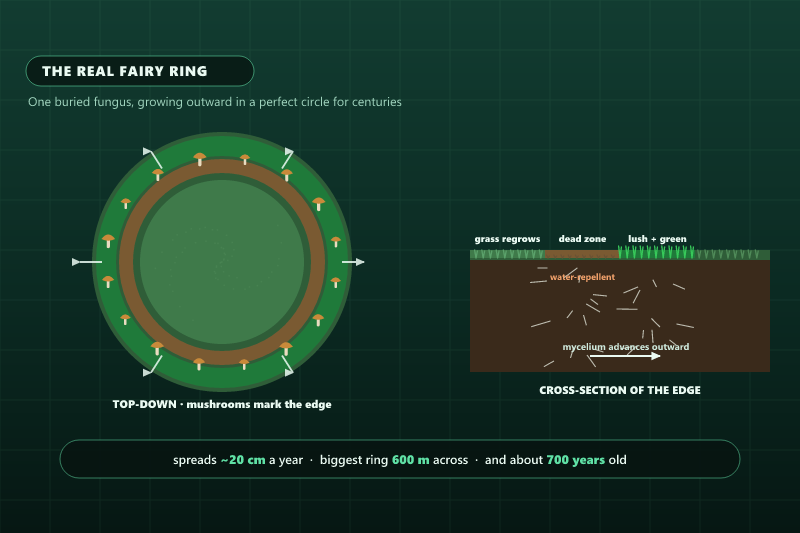
A germinating spore sends out hyphae in every direction at once. With no reason to prefer one direction over another, the colony expands as a growing circle — the two-dimensional equivalent of a ripple spreading on a pond. As it advances, the fungus consumes the nutrients in the soil it passes through.
And there is the key: the centre is exhausted. The soil in the middle was stripped of its food years or decades ago, and the mycelium there has died back. All the living, actively feeding fungus is concentrated in a narrow band at the growing front — the frontier where fresh, unconsumed soil lies just ahead. Mushrooms are fruiting bodies, and a fungus only fruits where it is thriving. So it fruits along that advancing edge, and nowhere else.
The ring is not the shape of the fungus. It is the shape of the fungus's current frontier — the perimeter of a much larger, mostly dead-in-the-middle disc. This is exactly the logic behind the humongous fungus of Oregon: radial clonal growth from a single origin, just scaled up to a forest and run for thousands of years.
The Grass Tells the Whole Story
Often you don't even need the mushrooms to spot a fairy ring, because the grass gives it away — in two opposite ways at once. Reading the grass reveals three distinct zones, and each one is a different stage of the fungus's passage.
The green zone: a burst of free fertiliser
Just ahead of and over the advancing edge, the grass is often darker, taller and thicker than the surrounding lawn — a vivid green band. This is the fungus doing what fungi do best: decomposing. As it digests dead organic matter in the soil, it releases a flush of nitrogen in forms plants can absorb. The grass is being fertilised, for free, by the fungus breaking down material it could never have used itself. The ring, in effect, fertilises its own leading edge.
The dead zone: the paradox
Immediately behind that lush band, the grass is often brown, thin or dead — a bare ring inside the green one. This is the counter-intuitive part, and there are two mechanisms at work, both real:
- Water repellency. Where the mycelium is densest, it forms a thick mat and coats soil particles with water-repellent proteins (hydrophobins). This makes the soil hydrophobic — rain and irrigation run off or bead up instead of soaking in. The grass roots directly above the mat are effectively cut off from water and die of drought, even in a well-watered lawn.
- Nutrient depletion and toxins. The mycelium there is at peak density and has consumed the local nutrients. Some fairy-ring species also release hydrogen cyanide into the root zone, which is toxic to grass roots.
So the same fungus feeds the grass at its front and kills it just behind — fertiliser and drought, centimetres apart. And behind the dead zone, once the mycelium has moved on and died back, the nutrients it locked up are released again and the grass recovers. Three concentric zones, each a snapshot of a different moment in the fungus's slow outward march.
Reading a Ring's Age
Because free rings expand at a fairly steady rate, they are effectively living clocks. If a ring is growing outward at around 20 cm per year and its radius is 30 metres, the fungus has been alive and expanding for roughly 150 years — quietly, invisibly, through wars and generations, doing nothing but growing outward under a field.
Run that logic on the giant French ring and you arrive at a startling number: a 600-metre circle implies a fungus that has been continuously alive for something like seven centuries — one of the oldest living things in Europe, and one almost nobody would look at twice. It is not a monument. It is a faint discolouration in the grass.
Rings only stop when they hit a barrier — a path, a wall, a patch of soil the fungus can't cross, or a rival colony. Two rings that grow into each other tend to annihilate along the line where they meet, each having already stripped the soil the other needs.
Why Every Culture Invented a Story
Before mycology, the fairy ring was a genuine mystery, and the explanations people reached for are a small tour of world folklore. They are worth recording, because they show how universally the pattern demanded an answer:
- England and Celtic lands: the rings marked where fairies or elves danced at night. To step inside was dangerous — you might be compelled to dance until you collapsed, or be spirited away for what felt like a night but was really years.
- Germany: they were Hexenringe, "witches' rings," where witches danced on Walpurgisnacht.
- France: ronds de sorcières — witches' circles, sometimes said to be guarded by toads that cursed intruders.
- Austria: they were scorched into the earth by the fiery tails of dragons.
- The Netherlands: the bare centre was where the Devil rested his milk churn.
Different continents, different spirits — but the same instinct: a circle that perfect could not be natural. That every one of these cultures independently sensed something uncanny in a ring of mushrooms is, in its way, a compliment to the fungus. It really is doing something remarkable. They simply had the mechanism wrong.
What a Grower Sees in a Fairy Ring
To a mushroom farmer, a fairy ring is not folklore or a lawn-care nuisance — it is a free, life-sized diagram of everything we manage indoors.
- It makes the invisible visible. The single most important idea in all of mushroom growing is that the mushroom is only the fruit; the real organism is the hidden mycelium. A fairy ring draws that mycelium's boundary on the ground for you to see. The ring is the colony's edge.
- It shows colonisation as a front. Watch a bag of substrate colonise and you are watching the same radial advance — mycelium sweeping outward through fresh food, exhausting what it passes. A fairy ring is that process run for centuries instead of weeks.
- It shows why we fruit at the edge of freshness. The fungus fruits where the food is newest. In cultivation we engineer that same condition deliberately — fresh substrate, the right trigger — to make fruiting happen where and when we want it.
- It is a reminder of scale and patience. The organism under that field has outlived everyone who ever named it. Fungi are not fast or loud, but they are extraordinarily persistent — the quality every grower comes to respect.
So the next time you find mushrooms standing in a circle in a quiet field, you can skip the fairies. What you have found is a single living thing, possibly older than the oldest building in sight, patiently drawing its own circumference in mushrooms — one ring, one year at a time.
It has been doing it, unseen, the entire time. The mushrooms are just the one week a year it lets you watch.