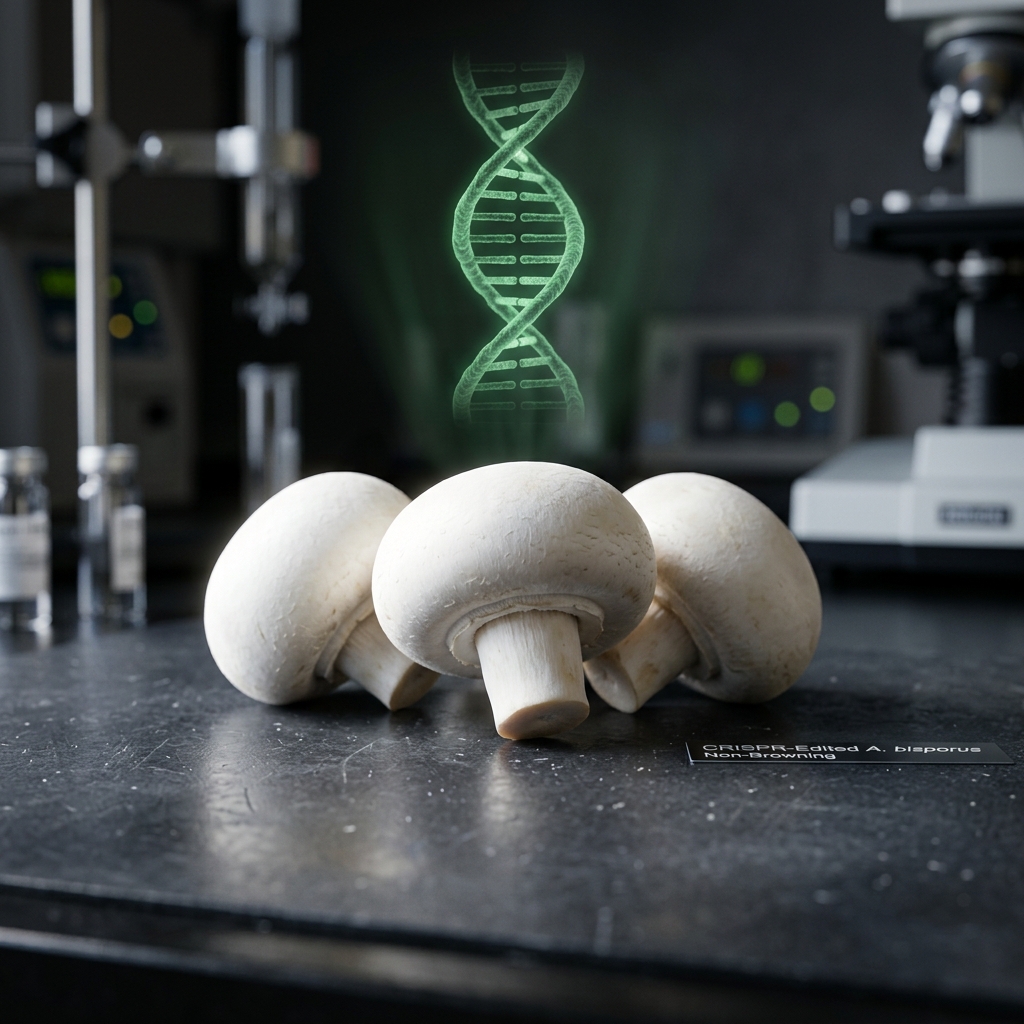
How the White Button Mushroom "Hacked" the Government's Definition of a GMO
Here is a modern, cutting-edge fact about button mushrooms that changed the entire agricultural industry: in April 2016, a plant pathologist at Pennsylvania State University named Dr. Yinong Yang did something that no scientist in history had done before. He took the common white button mushroom — Agaricus bisporus, the same species that accounts for roughly 90% of all mushrooms consumed in the United States — and used a revolutionary gene-editing tool called CRISPR-Cas9 to make a single, tiny change to its DNA. The result was a mushroom that resisted browning when sliced or bruised. But the truly extraordinary part wasn't the science itself — it was what happened next.
The Problem: Why Do Mushrooms Turn Brown?
To understand the significance of Dr. Yang's achievement, you first need to understand the biological problem he was solving — and why it matters so much to the mushroom industry.
When you slice a fresh white button mushroom, within minutes the cut surface begins to turn an unappealing shade of brown. This is not decay, mould, or contamination — it is an enzymatic browning reaction driven by a family of enzymes called polyphenol oxidases (PPOs). When a mushroom's cells are damaged (by a knife, by handling, or even by slight pressure during packaging), the PPO enzymes are released from cellular compartments and come into contact with phenolic compounds in the cell. In the presence of oxygen, PPO catalyses the oxidation of these phenolics into melanins — the same class of dark pigments responsible for human skin colour, age spots, and the browning of cut apples and avocados.
The white button mushroom genome contains six different PPO genes (PPO1 through PPO6), and the enzyme they produce is extraordinarily active. Even minor handling during harvest, transport, or shelf stacking can trigger visible browning within hours. This is not merely an aesthetic problem — it is an enormous economic one:
- Consumers overwhelmingly prefer pristine white mushrooms and will reject any pack showing brown spots, even if the mushroom is perfectly fresh and safe to eat.
- Retailers impose strict appearance standards; mushrooms that fail visual inspection are downgraded from fresh-market premium grade to processed-only grade (for canning, soups, or sauces), which can reduce their value by 50–70%.
- The mushroom industry estimates that browning-related losses and downgrades cost the global supply chain hundreds of millions of dollars annually.
For decades, the industry's only defences against browning were careful handling, cold-chain management, and modified-atmosphere packaging (flushing packs with nitrogen to reduce oxygen exposure). These methods slow browning but do not prevent it. What the industry truly wanted was a mushroom that simply didn't brown — or at least browned much more slowly. Dr. Yang set out to create exactly that.
The Tool: What Is CRISPR-Cas9?
CRISPR-Cas9 is often described as "molecular scissors" — a gene-editing system that allows scientists to make precise, targeted changes to an organism's DNA. Originally discovered as part of the immune defence system of bacteria (which use it to recognise and cut the DNA of invading viruses), CRISPR was adapted for laboratory use in 2012 by Jennifer Doudna and Emmanuelle Charpentier, who would later share the 2020 Nobel Prize in Chemistry for this work.
The system works in two parts:
- A guide RNA — a short, custom-designed RNA molecule that is programmed to match a specific sequence in the target organism's genome. It acts as a GPS coordinate, directing the system to exactly the right location in the DNA.
- The Cas9 protein — an enzyme that acts as the "scissors," cutting both strands of the DNA at the precise location specified by the guide RNA.
Once the DNA is cut, the cell's own natural repair machinery kicks in. If no template is provided for repair, the cell often makes small errors during the healing process — typically tiny deletions of 1 to 14 base pairs. These small deletions can effectively "knock out" a gene, preventing it from producing its protein product.
Crucially — and this is the detail that changes everything from a regulatory perspective — CRISPR-Cas9 does not insert any foreign DNA into the organism. The guide RNA and Cas9 protein are introduced temporarily, do their work, and are then degraded by the cell. The final edited organism contains only its own DNA, with a few base pairs missing. No bacterial genes. No viral sequences. No antibiotic resistance markers. Nothing "foreign" at all.
The Edit: Deleting Browning From the Mushroom's Genome
Dr. Yang and his team targeted one of the six PPO genes in the button mushroom genome. Using CRISPR-Cas9, they introduced small deletions (just a few base pairs each) into this single gene, effectively silencing it. Because the six PPO genes share significant sequence similarity, the edit had a cascading effect — the disruption of one gene reduced overall PPO enzyme activity by approximately 30%.
A 30% reduction might not sound dramatic, but it was enough to produce a visibly and measurably significant delay in browning. The edited mushrooms retained their white appearance for substantially longer after slicing and handling compared to unedited controls — a meaningful improvement for both retailers and consumers.
The Regulatory Hack: Why the USDA Said "Not a GMO"
This is where the story becomes truly fascinating — and where the humble mushroom inadvertently exposed a fundamental flaw in how the United States regulates genetically engineered organisms.
In the United States, the regulation of GMOs is governed by the Coordinated Framework for the Regulation of Biotechnology, established in 1986. Under this framework, three federal agencies share responsibility:
- USDA-APHIS (Animal and Plant Health Inspection Service) — regulates organisms that may pose risks as "plant pests."
- EPA (Environmental Protection Agency) — regulates pesticidal substances produced by plants.
- FDA (Food and Drug Administration) — oversees the safety of food products.
The critical detail is in how USDA-APHIS defined what it regulated. For decades, the agency's authority was based on the Plant Protection Act, which gave it jurisdiction over organisms modified using "plant pests" — specifically, organisms created using Agrobacterium tumefaciens (a soil bacterium commonly used to shuttle foreign DNA into plant genomes) or other bacterial/viral vectors. If a genetically engineered organism was created using these plant pest vectors, it was a "regulated article" and required full USDA review. If it was not — the regulations simply did not apply.
Dr. Yang's CRISPR-edited mushroom fell squarely into the gap:
- No Agrobacterium was used as a delivery vector.
- No plant pest DNA of any kind was involved.
- No foreign DNA whatsoever was present in the final organism.
- The edit consisted solely of small deletions in the mushroom's own genome — changes that were, in principle, indistinguishable from natural mutations that could occur spontaneously.
On April 13, 2016, USDA-APHIS sent Dr. Yang a letter confirming that his CRISPR-edited mushroom "does not contain any introduced genetic material" and therefore "would not be regulated" under its existing framework. The mushroom was free and clear — no environmental impact assessment, no field trial approval, no years-long regulatory review process, no multi-million-dollar compliance costs.
Why This Was a Seismic Moment
The USDA's letter was just one page long, but its implications were enormous. Here's why:
1. It Was the First
The Penn State mushroom was the very first CRISPR-edited organism in the world to receive official confirmation from a government regulator that it did not fall under GMO oversight. It set a precedent that would be cited in hundreds of subsequent regulatory decisions across the globe.
2. It Exposed the "Process vs. Product" Divide
The decision crystallised a fundamental philosophical divide in biotechnology regulation:
- Product-based regulation (the US approach): asks, "What is the final product? Does it contain foreign DNA? Does it pose specific, defined risks?" If the answer is no, it is not regulated — regardless of the process used to create it.
- Process-based regulation (the EU approach): asks, "Was this organism created using genetic engineering techniques?" If yes, it is regulated — regardless of whether the final product contains foreign DNA or poses any identifiable risk.
The mushroom case demonstrated that in a product-based system, CRISPR-edited organisms could potentially bypass regulation entirely — as long as no foreign DNA remained in the final product. This realisation alarmed some consumer advocacy groups and thrilled the agricultural biotech industry in equal measure.
3. It Opened the Floodgates
After the mushroom decision, a wave of CRISPR-edited crops followed the same regulatory pathway. Non-browning potatoes, herbicide-tolerant canola, higher-yield tomatoes, drought-resistant soybeans — all received similar "not regulated" determinations from the USDA. By 2020, dozens of gene-edited crop varieties had been cleared without traditional GMO review. The mushroom had opened the door, and the entire agricultural biotech industry walked through it.
4. It Forced Global Regulatory Recalibration
The decision triggered urgent regulatory reviews in countries around the world:
- European Union: In 2018, the European Court of Justice ruled that CRISPR-edited organisms are GMOs under EU law and must comply with the full GMO regulatory framework — taking the opposite position to the United States. This decision was widely criticised by European scientists and is currently under review.
- Japan: Adopted a US-like approach, ruling that gene-edited foods without foreign DNA do not require GMO safety assessments.
- Argentina: Became the first country to establish a dedicated regulatory framework specifically for gene-edited organisms, treating them separately from traditional GMOs.
- India: The regulatory status of CRISPR-edited crops remains under active discussion, with the Department of Biotechnology working to establish clear guidelines. This is particularly relevant to the Indian mushroom industry, which is the fastest-growing in the world.
The Irony: Why the Non-Browning Mushroom Still Isn't in Stores
Here is perhaps the most surprising twist in this entire story: despite clearing the regulatory hurdle a decade ago, the CRISPR-edited non-browning mushroom has never been commercially produced or sold.
Why? Several reasons:
- Consumer perception: Despite being legally "not a GMO," consumer surveys consistently show that a significant portion of the public remains wary of gene-edited foods. The mushroom industry, which sells primarily to health-conscious consumers, has been reluctant to be the first to test this sentiment at scale.
- Industry conservatism: The mushroom industry is notoriously risk-averse when it comes to strain changes. Commercial growers use highly optimised strains of Agaricus bisporus that have been bred for decades for specific yield, texture, and disease-resistance characteristics. Introducing a gene-edited strain would require extensive agronomic trials to ensure it performs as well as existing commercial strains.
- The browning problem has alternative solutions: Advances in modified-atmosphere packaging, edible coatings, and cold-chain logistics have significantly reduced browning losses in recent years, diminishing the commercial urgency of a non-browning variety.
- Labelling concerns: Even though the USDA does not require the mushroom to be labelled as a GMO, retailers may choose to label it voluntarily — or consumers may demand it — which could negatively impact sales.
The Bigger Picture: A Mushroom That Changed All of Agriculture
What makes this story truly remarkable is not the mushroom itself — it's what the mushroom represents. A single, small, inexpensive crop organism — one that most people never think twice about — became the test case that defined the global regulatory landscape for an entire generation of gene-edited foods. The USDA's decision on that one white button mushroom in 2016 set in motion a cascade of regulatory, scientific, and ethical debates that are still unfolding today.
Every time a gene-edited crop is approved anywhere in the world without traditional GMO oversight, it traces its regulatory lineage back to Dr. Yang's mushroom. Every time a biotech startup designs a CRISPR-edited organism specifically to avoid triggering GMO regulations — by ensuring no foreign DNA is present — they are following the playbook that the mushroom wrote.
The white button mushroom didn't just "hack" a government definition. It rewrote the rules of modern agriculture.