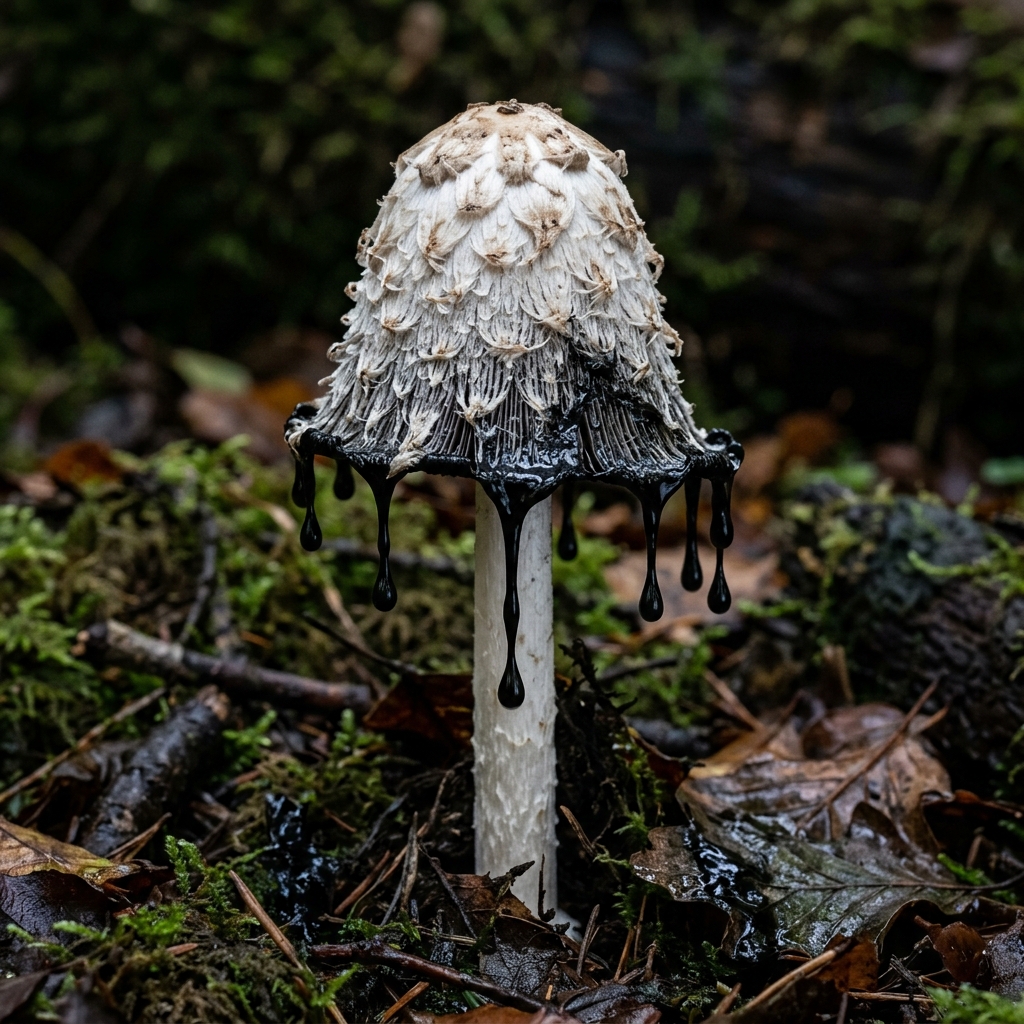
The Mushroom That Deliberately Melts Into Slime
In the natural world, survival is almost always about fighting decomposition. Most living organisms—whether plants, animals, or fungi—spend their entire lives actively protecting their cells from breaking down. Yet, a specific group of mushrooms known as the Inky Caps (genus Coprinus, Coprinopsis, and relatives) has developed a wildly successful evolutionary strategy centered around active, deliberate self-destruction.
Once these mushrooms reach maturity, they do not wither, dry up, or rot slowly. Instead, within a matter of hours, their pristine white caps dissolve into a thick, jet-black, gooey puddle of liquid. This process is called deliquescence or auto-digestion, and it is a masterpiece of biological engineering.
The Geometry of Stagnant Gills
To understand why a mushroom would choose to liquefy its own tissues, we have to look at the mechanics of spore dispersal. Most gilled mushrooms (like the common white button mushroom) have gills that radiate outward with spacious gaps between them. When a spore is shot off from the side of a gill (using a tiny water-droplet mechanism called a Buller's drop), it travels horizontally for a fraction of a millimetre, stalls, falls vertically into the space between the gills, and is swept away by ambient air currents.
Inky Cap mushrooms, however, have evolved a different cap shape. Their caps are tall, cylindrical, and bell-shaped, and their gills are packed incredibly close together. The gills are practically parallel plates with almost zero space between them. If an Inky Cap tried to shoot its spores off like a button mushroom, the spores would immediately strike the opposite gill and get stuck, trapped inside the crowded cap forever.
Sequential Maturation: Bottom-Up Dispersal
To overcome this bottleneck, the Inky Cap matures its spores in a highly coordinated, bottom-to-top sequence:
- The spores at the very bottom margin of the cap mature first.
- Because they are at the bottom edge, they have free access to the open air outside the cap and can safely shoot off without hitting obstructions.
- Once these bottom spores are discharged, the gill tissue that held them is no longer useful. In fact, if it remained, it would block the spores directly above it from escaping.
- To clear the way, the mushroom immediately triggers autolysis in that spent bottom section. The tissue liquefies into a black liquid and drips away.
- This exposes the next layer of gills and spores higher up, which are now at the new bottom edge of the cap. They mature, shoot off, and then that section melts.
This process continues progressively up the cap over the course of 24 to 48 hours, looking like a slowly burning candle that melts itself as it releases its spores into the wind.
The Deliquescence Cycle:
Spores mature at bottom margin → Spores launch into air → Spent tissue autolyzes → Cap curls back & drips away → Next layer matures
The Chemistry of Self-Digestion
Autolysis is not a passive rot caused by bacteria or environmental decay. It is a highly active, genetically programmed self-destruct sequence controlled by the mushroom itself. Biochemically, the cell walls of fungi are made primarily of chitin (the same tough material found in insect shells) and **glucans**.
When the spore-release phase is triggered, the mushroom upregulates the production of hydrolytic enzymes:
- Chitinases: Enzymes that specifically break down chitin cell walls.
- β-1,3-glucanases: Enzymes that target the glucan matrices holding the cell walls together.
As these enzymes are secreted into the extracellular space, they rapidly dissolve the structural boundaries of the cells. The cellular contents spill out, mixing with dissolved cell wall fragments to create the characteristic thick, gooey black "ink." Early naturalists actually collected this black liquid and used it as writing ink (often mixing it with a small amount of cloves to prevent spoilage)—hence the name "Inky Caps."
The Culinary Race Against Time
For foragers and cultivators, the Shaggy Mane (Coprinus comatus) is a choice edible mushroom. When harvested young—while the cap is still tight, cylindrical, and completely white—it has a delicate, buttery texture and a rich, earthy flavor that chefs highly prize.
However, Shaggy Manes present a unique challenge: **they must be cooked almost immediately after harvesting**. The act of picking the mushroom triggers stress signals that accelerate the auto-digestion program. If you harvest a basket of beautiful, firm Shaggy Manes in the evening and leave them in your refrigerator overnight, you may wake up to find a basket coated in black slime and a puddle of ink. The chitinases will have completely dissolved your breakfast.
The Alcohol Toxin Warning: A Close Relative
While the Shaggy Mane (Coprinus comatus) is safe and delicious, it is often confused with its close cousin, the Common Inky Cap (Coprinopsis atramentaria). The Common Inky Cap contains a unique amino acid derivative called coprine.
Coprine itself is not toxic, but it acts as a powerful inhibitor of the enzyme **acetaldehyde dehydrogenase** in the human liver. This is the enzyme responsible for breaking down toxic acetaldehyde (a byproduct of alcohol metabolism) into harmless acetic acid. If you eat the Common Inky Cap and consume alcohol—even up to 48 hours before or after the meal—your liver will be unable to process the alcohol. Acetaldehyde will flood your bloodstream, causing severe, terrifying symptoms: rapid heart rate, facial flushing, intense nausea, vomiting, and throbbing headaches (similar to the drug Antabuse used to treat alcoholism). For this reason, the Common Inky Cap is also known as the **"Tippler's Bane."**
Conclusion: Evolutionary Ingenuity
The Inky Cap's melting strategy is a brilliant reminder that evolution doesn't care about preserving the individual body; it only cares about successfully passing on genetic material. By sacrificing its own flesh and dissolving into liquid, the Inky Cap ensures that its spores gain free access to the wind, enabling the next generation to colonize new pastures. It is a stunning, liquid testament to the power of natural selection.