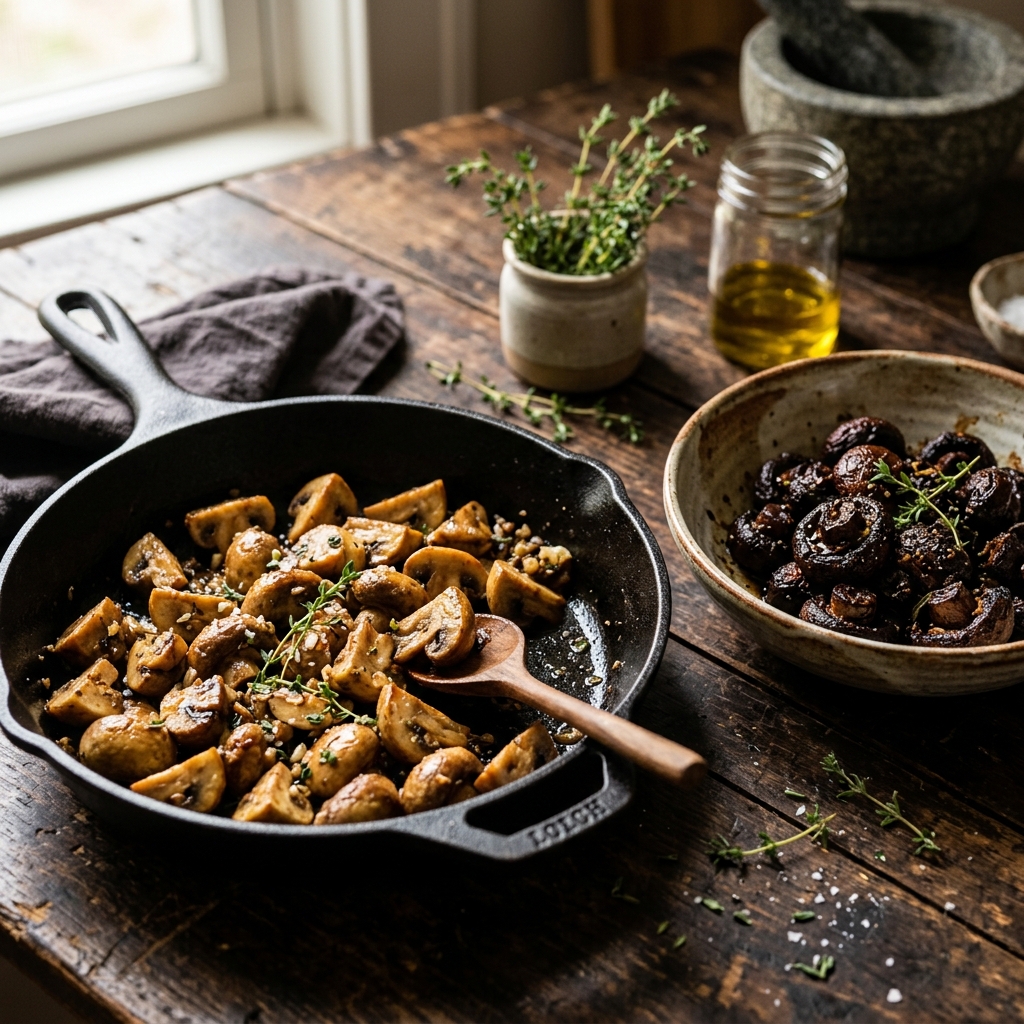
The Science of Cooking Button Mushrooms: 5 Best Methods
Edible mushrooms are a unique ingredient in the kitchen. Unlike meats, which consist of proteins that tighten and dry out under heat, or vegetables, which have cell walls made of cellulose that break down into mush, mushrooms are built on a structural network of chitin. This heat-resistant biopolymer means mushrooms are almost impossible to overcook. However, their unique biology also presents a major challenge: button mushrooms (Agaricus bisporus) are roughly **90% water**.
If you don't manage this water content correctly, your mushrooms will boil in their own juices rather than browning. To unlock their deep, savory potential, you need to understand the physics of fungal cooking. Here is the science behind the 5 best methods for cooking button mushrooms to absolute perfection.
1. The Classic Sauté (The Golden Standard)
If you want deep, savory flavor, a hard sauté is the way to go. The secret here is patience—mushrooms release a lot of water before they brown.
- How to do it: Heat a mix of olive oil and butter in a wide skillet over medium-high heat. Add sliced or quartered mushrooms. Do not crowd the pan and do not salt them yet. Let them release their moisture and evaporate. Once they start to turn golden brown, toss in minced garlic, thyme, and salt. Cook for another 2 minutes.
- Best for: Steak sides, topping burgers, or tossing into pasta.
The Science of the Sauté
Two critical rules govern a perfect sauté: do not crowd the pan and do not salt early.
If you pack too many mushrooms into a skillet, the massive volume of escaping water vapour has nowhere to go. It traps the heat, creating a dome of steam. Instead of sautéing, your mushrooms will boil, turning grey and rubbery. Similarly, salt is hygroscopic—it draws out water through osmosis. Salting early floods the pan with liquid immediately, dragging down the temperature. By keeping the pan spacious and dry, you allow the water to evaporate instantly. Once the water is gone, the pan's surface temperature shoots past 140°C, allowing the sugars and amino acids in the mushroom to brown and caramelize, developing rich umami compounds.
2. Oven Roasted (Hands-Off & Concentrated)
Roasting shrinks the mushrooms slightly, concentrating their earthy flavor and creating a delightfully chewy texture.
- How to do it: Toss whole or halved button mushrooms with olive oil, balsamic vinegar, salt, pepper, and a few whole garlic cloves. Spread them in a single layer on a baking sheet. Roast at 200°C (400°F) for about 20 minutes, tossing halfway through, until they are browned and tender.
- Best for: Meal prep, grain bowls, or a simple hands-off side dish.
The Science of Roasting
Oven roasting utilizes dry convection heat. The high ambient temperature (200°C) causes the mushrooms to sweat out water, which evaporates rapidly in the dry oven air. As the water content decreases, the mushroom shrinks, concentrating its natural **glutamic acid** (the amino acid responsible for the savory umami taste). The balsamic vinegar, which contains fructose and glucose, undergoes caramelization on the mushroom's surface, creating a sweet, acidic glaze that perfectly balances the deep, earthy richness of the concentrated fungus.
3. Creamy Garlic Stewed (The Comfort Food)
Mushrooms and dairy are a match made in heaven. This method creates its own rich sauce as it cooks.
- How to do it: Sauté whole button mushrooms in butter with garlic and shallots until cooked through. Pour in a splash of white wine (optional) to deglaze, let it reduce, then stir in heavy cream and let it simmer for a few minutes until thickened. Season with salt, pepper, and fresh parsley.
- Best for: Comforting side dishes, serving over toast, or as a rich steak sauce.
The Science of Stewing
Fungal cell walls are highly porous, acting like microscopic sponges. When cooked in a liquid, they absorb the surrounding flavors. Fat is an excellent solvent; the lipids in butter and cream dissolve and carry the fat-soluble flavor compounds from the garlic, shallots, and the mushrooms themselves directly into your taste buds. Furthermore, deglazing the pan with white wine is chemically crucial. The alcohol in the wine dissolves caramelized sugars and proteins (known as the *fond*) stuck to the bottom of the pan, incorporating those deep flavors back into the creamy sauce.
4. Air Fried (Quick & Crispy Edges)
If you want quick results with minimal fat, the air fryer does an excellent job of dehydrating the exterior for a nice texture.
- How to do it: Toss whole mushrooms with a little oil, soy sauce (for umami), and garlic powder. Air fry at 190°C (375°F) for 10–12 minutes, shaking the basket halfway through.
- Best for: A fast, low-effort snack or quick weeknight side.
The Science of Air Frying
An air fryer is essentially a supercharged, compact convection oven. The heating element, paired with a powerful fan, circulates high-velocity hot air directly around the mushrooms. This rapid airflow causes instantaneous evaporation of moisture on the mushroom's surface, effectively dehydrating the exterior layers to form a thin, slightly crispy "skin." Because the cooking time is short (10 minutes), the heat doesn't have time to dry out the interior core. The result is a beautiful texture contrast: a firm, dry exterior with a moist, plump, and juicy interior.
5. Stuffed (The Party Appetizer)
Because button mushrooms have a sturdy cap, they are perfect vessels for savory fillings.
- How to do it: Gently pop the stems out of whole mushrooms (save the stems and chop them up fine!). Sauté the chopped stems with garlic and onions, then mix with cream cheese, Parmesan, and breadcrumbs. Stuff the mixture back into the caps and bake at 190°C (375°F) for 15–20 minutes until the tops are golden and bubbly.
- Best for: Appetizers and party platters.
The Science of Stuffed Mushrooms
The structural integrity of a button mushroom cap is remarkably robust due to its chitinous cell walls. Unlike vegetable cups (such as hollowed-out tomatoes or zucchini) which collapse and turn watery under oven heat, the mushroom cap maintains its shape perfectly. The hollow cavity left by removing the stem acts as a natural crucible. During baking, the fats in the cheese filling melt and permeate the inner gills of the cap, seasoning the mushroom from the inside out, while the cap's walls hold the filling secure without leaking.
Summary: Choosing the Right Method
By understanding how mushrooms respond to heat and water, you can choose the method that best matches your target dish:
| Method | Key Effect | Best Texture |
|---|---|---|
| Sauté | Maillard Browning | Caramelized & Tender |
| Roasting | Water Evaporation & Condensation | Chewy & Earthy |
| Stewing | Lipid Absorption | Plump, Rich & Soft |
| Air Frying | Surface Dehydration | Crispy Skin, Juicy Core |
| Stuffed | Chitin Structural Support | Firm Vessel, Melty Interior |