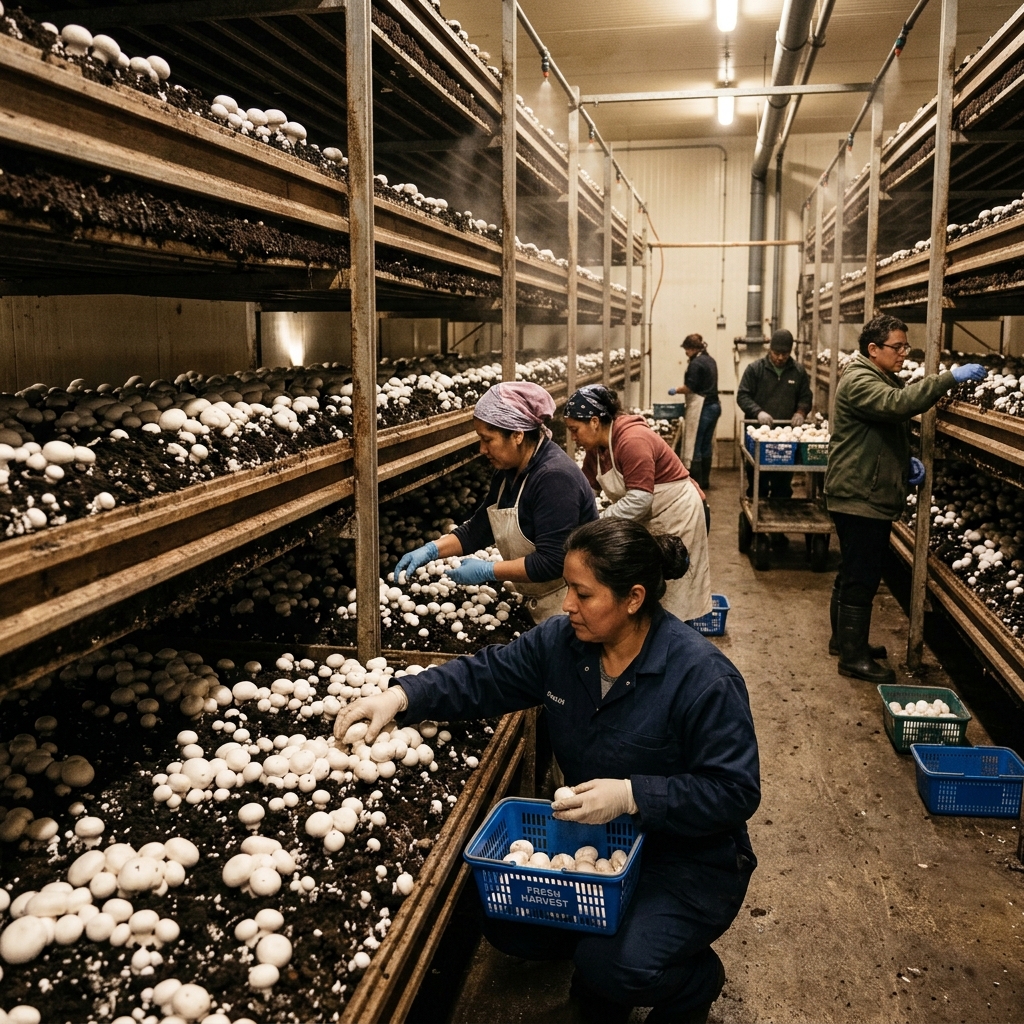
Why Mushroom Harvesting Still Defies Robotics: The Last Hand-Picked Crop
Here is a wild fact about the people who grow your mushrooms: in 2026, we live in an era where GPS-guided combine harvesters can strip an entire wheat field overnight, robotic arms can pick and sort tomatoes by ripeness in milliseconds, and AI-powered drones can inspect, spray, and monitor orchards across thousands of acres without a single human stepping foot outside. And yet, the humble white button mushroom — the most consumed mushroom on the planet, grown in controlled indoor environments with predictable temperature, humidity, and lighting — is still harvested almost entirely by human hands.
The Scale of the Problem: A Global Workforce of Hands
To appreciate why this matters, consider the sheer scale of the mushroom industry. The global mushroom market is valued at over USD 50 billion, with China producing roughly 75% of the world's supply and countries like India, the United States, the Netherlands, and Poland making up much of the rest. In India alone, mushroom production has grown from around 50,000 tonnes per year in 2010 to well over 2,50,000 tonnes annually today.
Every single one of those mushrooms was picked by a human hand. On a mid-size commercial farm like ours, a team of 15–20 trained harvesters works in rotating shifts during each flush, picking continuously for 6–8 hours a day. Across the global industry, hundreds of thousands of workers — predominantly women — perform this task daily, often in cool, dark, humid environments that are physically demanding and mentally exhausting.
The mushroom industry faces a 20% labour vacancy rate in many countries and annual worker turnover as high as 40%. Training a new picker to commercial speed and quality standards takes 3 to 6 months. The economic pressure to automate is enormous. So why hasn't it happened?
Challenge 1: Mushrooms Are Absurdly Fragile
The first and most fundamental obstacle is the extreme fragility of the mushroom fruiting body. Unlike an apple, a tomato, or even a strawberry, a button mushroom has no protective skin, no waxy cuticle, and no rigid cell walls. It is essentially a dense bundle of water-filled hyphae — fungal threads — held together by the flimsiest of biological architecture. Mushrooms are roughly 90% water by weight, and their cell walls are made of chitin rather than the cellulose found in plant cells, making them softer and more susceptible to mechanical damage.
When a mushroom is bruised — even slightly — the damaged cells release an enzyme called tyrosinase, which triggers a rapid oxidation reaction that turns the white flesh brown within minutes. This enzymatic browning is the same chemical process that turns a cut apple brown, but in mushrooms it happens far faster and is far more visible against the pristine white cap that consumers expect. A single fingerprint-sized bruise can render a fresh-market mushroom unsaleable, downgrading it from premium retail grade to processed-only grade and cutting its value by 50–70%.
Challenge 2: Chaotic, Unpredictable Growth Patterns
Row crops grow in neat, predictable lines. Fruit hangs from branches at roughly uniform heights. But mushrooms? They grow wherever they please.
On a typical compost bed, mushrooms emerge in dense, overlapping clusters of varying sizes, at random positions across the surface. Two mushrooms may grow so close together that their caps are physically touching or even fused. A mature mushroom ready for harvest may be surrounded on all sides by tiny pins that are only 24–48 hours old and must not be disturbed. The density, spacing, and maturity of mushrooms varies not just from bed to bed, but from square centimetre to square centimetre.
This presents a nightmare for computer vision systems. To successfully harvest, a robot must:
- Detect and identify individual mushrooms within a dense, white-on-white cluster, where caps overlap and cast shadows on each other.
- Assess maturity — is this particular mushroom 3 cm (too small), 4.5 cm (perfect), or 6 cm (overgrown)? — often from a single overhead camera angle where perspective distortion makes size estimation unreliable.
- Plan a collision-free path to reach the target mushroom without knocking into, crushing, or disturbing its neighbours.
- Execute the pick with a single, fluid motion that combines a downward approach, a gentle grip, a slight twist to break the mushroom free from the mycelium, and an upward lift — all while applying less than 2 Newtons of lateral force to avoid bruising.
Human pickers do all of this unconsciously. They assess clusters in a glance, reach into impossibly tight gaps with flexible fingers, and adjust their grip pressure in real time based on tactile feedback from the mushroom's resistance. A skilled picker doesn't just see the mushroom — they feel when it's ready to release, when a neighbour is in the way, when the cap is about to crack under pressure. This level of sensorimotor integration remains far beyond the reach of any commercially available robotic system.
Challenge 3: The Growing Environment Hates Electronics
Even if you solve the vision and gripping problems, you still have to make the hardware survive inside a mushroom growing room — and that environment is genuinely hostile to electronics.
Commercial mushroom rooms are maintained at 16–18°C with 90–95% relative humidity. The air is thick with moisture and CO₂. Condensation forms on every cold surface. The compost substrate releases ammonia, hydrogen sulphide, and other volatile compounds during the growing cycle. The rooms are deliberately kept dark to prevent premature cap opening. And the floor is often wet from regular watering of the casing layer.
Camera lenses fog up. Sensors corrode. Electrical contacts develop resistance. Circuit boards suffer from moisture-induced short circuits. Laser rangefinders scatter in the humid, particle-laden air. Even industrial-grade IP67-rated equipment struggles in these conditions over sustained periods. Human workers, by contrast, simply wear a fleece jacket and get on with it.
Challenge 4: The Infrastructure Was Built for People, Not Machines
The vast majority of commercial mushroom farms worldwide use a vertical shelving system — known as "Dutch shelving" — where growing beds are stacked 4 to 6 tiers high, with each tier approximately 30–40 cm of clearance above the compost surface. The aisles between shelving units are typically only 80–100 cm wide — just enough for a human to walk through sideways while reaching into the beds on either side.
Any robotic harvesting system must either:
- Fit within this existing infrastructure, which severely limits the size and reach of robotic arms, the number of cameras and sensors that can be mounted, and the manoeuvrability of the platform.
- Require the farm to rebuild its infrastructure, which costs hundreds of thousands of dollars and may reduce the total growing capacity per square metre — the very metric that vertical shelving was designed to maximise.
Most farms, especially in India and developing countries, simply cannot afford to retrofit their entire facility for a robot that hasn't yet proven it can match human picking speed and quality. It's a classic chicken-and-egg problem: robots aren't good enough because they can't practice in real farms, and farms won't adopt them because they aren't good enough.
Challenge 5: Speed — The Unforgiving Economics of the Flush
Perhaps the most underappreciated challenge is speed. Mushrooms don't wait. During a flush, a button mushroom can double in size every 24 hours. A mushroom that is the perfect 4 cm diameter at 6:00 AM may be an overgrown, gill-exposed 7 cm portobello by 6:00 PM if not harvested in time. The harvest window for premium-grade mushrooms is brutally narrow — often just 6–12 hours per mushroom.
On a commercial farm producing 10–15 tonnes per flush cycle, this means a harvesting team must pick tens of thousands of individual mushrooms per day, every day, during the flush window. At a typical rate of 30–35 picks per minute, a human harvester processes roughly 2,000 mushrooms per hour. The fastest robotic prototypes, operating under ideal laboratory conditions (single mushrooms, evenly spaced, perfect lighting), achieve 8–12 picks per minute — and that rate drops further in real-world conditions with dense clusters, variable lighting, and the need to navigate between tiers.
To match a single human harvester, a farm would need 3–4 robotic units operating simultaneously, each costing tens of thousands of dollars in hardware alone, plus ongoing maintenance in a corrosive environment. The economics simply don't work — yet.
The Current State of Robotics Research
Despite these challenges, the research community and several agritech startups are making progress. Notable efforts include:
- Mycionics (Canada) — developing an AI-powered robotic harvester that uses 3D machine vision to map mushroom beds and a custom soft-touch gripper to pick individual mushrooms. Their system has shown promising results in controlled trials.
- ASTRO (Penn State University, USA) — an automated system that combines overhead cameras with robotic arms mounted on rails above the growing beds. Focused on the US fresh-market button mushroom industry.
- EU-funded research — multiple European projects exploring soft robotics, pneumatic grippers, and AI-driven picking strategies specifically for Agaricus bisporus.
These systems are improving rapidly, but they share a common limitation: they work best on isolated, well-spaced mushrooms and struggle significantly with the dense, chaotic clusters that characterise real commercial production. The gap between laboratory performance and farm-floor reality remains wide.
Why This Matters: The Human Cost
The inability to automate mushroom harvesting has profound human consequences. Mushroom picking is physically gruelling work — harvesters spend hours bent over growing beds in cold, humid, dimly lit rooms. Repetitive strain injuries of the hands, wrists, and back are common. In many countries, mushroom picking is performed by migrant or seasonal workers who face precarious employment conditions.
In India, mushroom harvesting has become an important source of rural employment, particularly for women. At Dr. Dahiya Mushroom Farm, over 80% of our harvesting team is female, and for many of these women, mushroom picking provides their primary household income. The irony is that the very skill and dexterity that makes their work irreplaceable by machines is also what makes their labour undervalued — because it is categorised as "unskilled manual work" despite requiring months of training and years of experience to master.
Until robotic systems can match the speed, gentleness, and adaptability of human hands, the global mushroom industry will continue to depend on the people who do this extraordinary work — people whose fingers can distinguish between a mushroom that needs one more hour and one that is ready right now, who can reach into a cluster of thirty and extract exactly the right one without disturbing the rest, and who perform this act of remarkable precision thousands of times a day, every day, flush after flush.
The next time you pick up a pack of fresh mushrooms from the market, look at them closely. Every single one was touched by a human hand. In a world racing toward full automation, that is a genuinely remarkable thing.