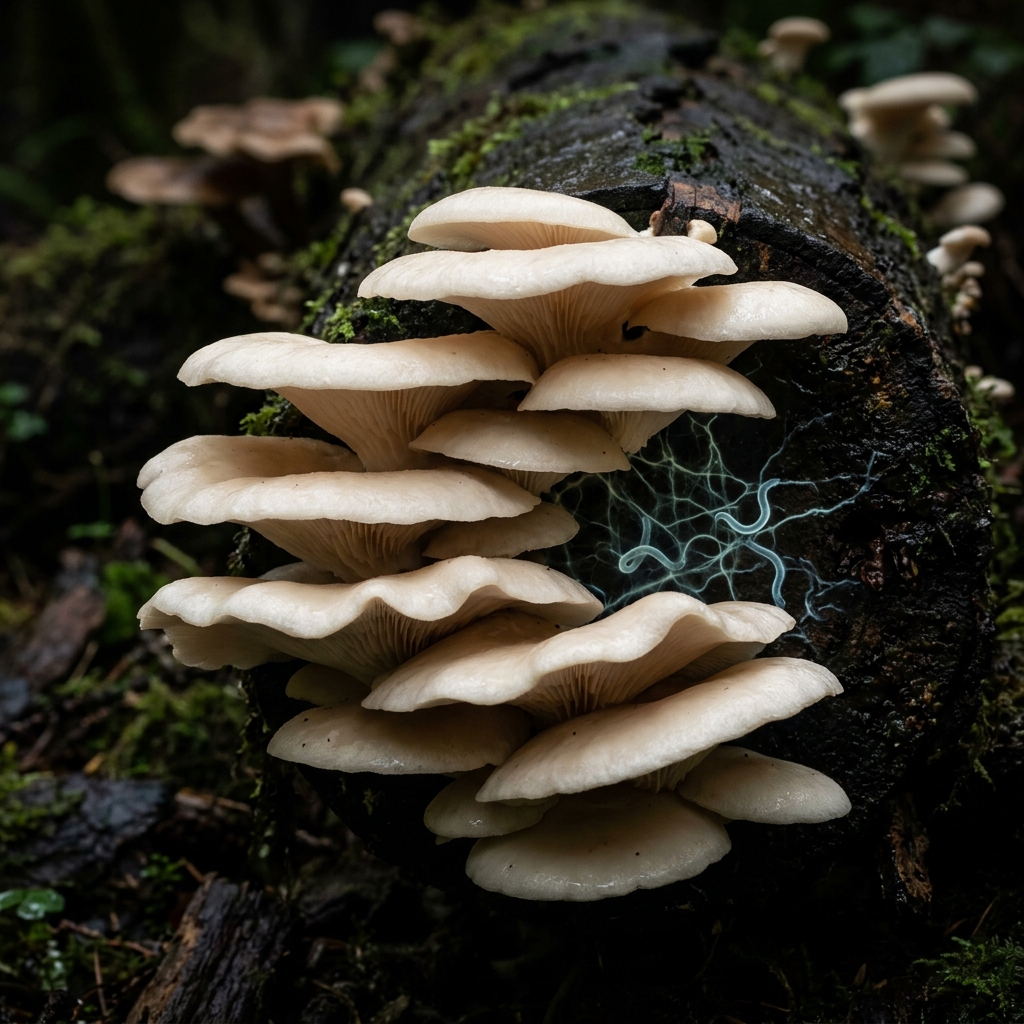
Oyster Mushrooms Are Carnivorous Predators That Kill With "Nerve Gas"
Here is a mind-blowing fact that will totally change how you look at them in the grocery store: the oyster mushroom — Pleurotus ostreatus — that beautiful, fan-shaped, velvety mushroom you toss into your stir-fry, your soup, or your weekend pasta — is a carnivorous predator. Not metaphorically. Not in some abstract biochemical sense. It is, in the most literal and violent meaning of the word, a killer that hunts, paralyses, and devours living animals.
Why Would a Mushroom Need to Kill?
To understand why oyster mushrooms evolved into predators, you need to understand their natural habitat and the fundamental nutritional challenge they face.
Oyster mushrooms are saprotrophic fungi — they feed primarily on dead and decaying organic matter, especially wood. In the wild, you'll find them growing in beautiful, overlapping shelf-like clusters on fallen logs, dead standing trees, and rotting stumps in temperate and subtropical forests around the world. They are one of the most efficient wood-decay fungi on the planet, capable of breaking down the tough lignin and cellulose that make up the structural framework of wood.
Wood is an excellent source of carbon — the energy currency of biology. But it has a critical nutritional deficiency: it is extremely poor in nitrogen. The carbon-to-nitrogen ratio (C:N ratio) in wood can be as high as 500:1, meaning there are 500 parts carbon for every 1 part nitrogen. For comparison, the ideal C:N ratio for fungal growth is around 30:1. This means that a fungus growing on wood has access to roughly 15–17 times less nitrogen than it ideally needs.
Nitrogen is essential for building proteins, enzymes, DNA, and all the cellular machinery that a living organism requires. Without sufficient nitrogen, the fungus cannot grow, reproduce, or even maintain its existing cellular structure. It faces a stark evolutionary choice: find alternative sources of nitrogen, or die slowly in a carbon-rich but nitrogen-starved environment.
The oyster mushroom's solution? Eat animals.
The Prey: Nematodes — The Most Abundant Animals on Earth
The animals that oyster mushrooms hunt are nematodes — microscopic, unsegmented roundworms that are, by almost any measure, the most abundant and successful animals on the planet. There are an estimated 60 billion nematodes for every human alive. They live in virtually every habitat on Earth — in soil, freshwater, seawater, hot springs, Antarctic ice, and inside the bodies of plants and animals as parasites.
In forest soil — exactly where oyster mushrooms grow — nematodes are extraordinarily abundant. A single handful of forest floor soil can contain thousands of individual nematodes from dozens of different species. They are typically 0.5 to 2 millimetres long, transparent, and worm-shaped, wriggling through the thin films of water that coat soil particles.
Crucially, nematodes are nitrogen-rich. Their bodies are packed with proteins, and their C:N ratio is approximately 10:1 — making them an extraordinarily concentrated nitrogen source compared to the nitrogen-depleted wood substrate. For the oyster mushroom, a nematode is essentially a tiny, self-propelling nitrogen capsule that delivers itself directly to the fungus's doorstep.
The Weapon: Toxocysts — "Nerve Gas in a Lollipop"
For decades, scientists knew that oyster mushrooms could kill nematodes, but the exact mechanism remained mysterious. Other nematode-trapping fungi — such as Arthrobotrys oligospora — use elaborate physical traps: sticky adhesive knobs, lasso-like constricting rings that snap shut around a worm's body in a tenth of a second, or three-dimensional adhesive nets. These are mechanical traps, like a spider's web or a Venus flytrap.
But Pleurotus ostreatus uses none of these physical structures. Instead, it deploys something far more sophisticated: chemical warfare.
In a landmark 2023 study published in Science Advances, a team of researchers led by Yen-Ping Hsueh at Academia Sinica in Taiwan finally identified the oyster mushroom's killing mechanism in stunning detail. The key structures are called toxocysts — tiny, fragile, lollipop-shaped globules that protrude from the surface of the fungal hyphae on short stalks.
Each toxocyst is essentially a microscopic chemical grenade:
- Shape: A spherical head (approximately 10–20 micrometres in diameter) mounted on a thin stalk attached to the hypha — giving it the distinctive "lollipop" appearance.
- Contents: The spherical head is filled with a concentrated solution of 3-octanone, a volatile organic ketone compound with eight carbon atoms.
- Trigger: The toxocyst is extraordinarily fragile by design. The slightest physical contact — such as a nematode brushing against it while crawling through the soil — causes the globule to rupture, releasing its chemical payload directly onto the worm's body.
The Kill Sequence: How It Happens
The entire predation event unfolds in a terrifyingly efficient sequence:
Step 1: Contact (0 seconds)
A nematode, crawling through soil in search of bacteria to feed on, brushes against a hypha of Pleurotus ostreatus. Its body makes contact with one or more toxocysts protruding from the hyphal surface. The fragile lollipop structures rupture on contact.
Step 2: Toxin Release (0–30 seconds)
The volatile 3-octanone is released directly onto the nematode's cuticle (outer skin). The compound rapidly penetrates the worm's body, targeting its sensory cilia — tiny hair-like structures on the nematode's nerve cells that function as environmental sensors. The 2023 research identified these cilia as the "Achilles heel" of the nematode — the primary entry point through which the toxin exerts its devastating effect.
Step 3: Calcium Catastrophe (30 seconds – 3 minutes)
The 3-octanone disrupts the integrity of the nematode's cell membranes, causing them to become abnormally permeable. This triggers a massive, uncontrolled influx of extracellular calcium ions (Ca²⁺) into the cytoplasm and mitochondria of the worm's nerve and muscle cells. Under normal conditions, cells maintain extremely low internal calcium concentrations — this tight regulation is essential for proper nerve signalling and muscle contraction. When the calcium floodgates open, the result is catastrophic:
- Hypercontraction: The muscles lock into a state of permanent, uncontrollable contraction — the nematode equivalent of a whole-body seizure.
- Neuronal death: The calcium overload triggers apoptotic (programmed cell death) pathways in the nerve cells, causing irreversible neurological damage.
- Systemic collapse: Within minutes, the nematode is completely paralysed and, shortly thereafter, dead.
Step 4: Invasion and Digestion (3 minutes – several hours)
Once the nematode is dead, the fungal hyphae grow toward and into the corpse. The hyphae penetrate the worm's cuticle, branch extensively inside the body cavity, and secrete digestive enzymes that break down the nematode's tissues into absorbable nutrients. The fungus extracts the nitrogen-rich compounds — primarily amino acids and small peptides — and transports them back through the mycelial network to fuel growth and reproduction.
The entire process, from first contact to complete digestion, can take as little as a few hours. What remains of the nematode is an empty, hollowed-out shell — a ghostly transparent husk threaded through with fungal hyphae.
The Specificity: Why 3-Octanone and Not Something Else?
The 2023 research revealed a fascinating detail about the chemistry: the length of the carbon chain in the toxin is critical to its effectiveness. The researchers tested a series of structurally related ketone compounds with different carbon chain lengths:
- 3-heptanone (7 carbons) — significantly less toxic to nematodes.
- 3-octanone (8 carbons) — maximum toxicity. The sweet spot.
- 3-nonanone (9 carbons) — reduced toxicity.
This suggests that 3-octanone's eight-carbon chain is precisely the right length to interact with specific molecular targets in the nematode's cell membranes — likely lipid bilayer components or membrane-associated ion channels. Evolution has fine-tuned this molecule over millions of years to be maximally lethal to the oyster mushroom's prey while remaining metabolically inexpensive for the fungus to produce.
Not Alone: The World of Carnivorous Fungi
Oyster mushrooms are not the only fungi that hunt animals. The fungal kingdom contains over 200 known species of nematode-trapping fungi, employing a remarkable diversity of predatory strategies:
- Adhesive nets (Arthrobotrys oligospora) — produces three-dimensional sticky nets that trap nematodes like a microscopic spider web.
- Constricting rings (Drechslerella anchonia) — forms ring-shaped traps that, when a nematode enters, swell inward within 0.1 seconds, strangling the worm in a death grip.
- Adhesive knobs (Monacrosporium cionopagum) — produces sticky knobs on short stalks that glue themselves to any nematode that touches them.
- Spore-based parasites (Harposporium) — produces spores that are ingested by nematodes and then germinate inside the worm's gut, killing it from within.
What makes Pleurotus ostreatus unique among these predators is its chemical-only approach. It doesn't build any physical trapping structures. It doesn't need to. Its toxocysts deliver a kill-on-contact chemical weapon that is faster, more energy-efficient, and arguably more elegant than any mechanical trap.
Why This Matters: Biocontrol and Agriculture
The carnivorous nature of oyster mushrooms is not just a fascinating piece of biology — it has profound practical implications for agriculture, including mushroom farming:
Natural Nematode Control
Plant-parasitic nematodes cause an estimated USD 173 billion in crop damage globally every year. They attack the roots of virtually every major food crop — rice, wheat, tomatoes, potatoes, soybeans, and many more. The discovery of the oyster mushroom's killing mechanism has opened up exciting possibilities for using Pleurotus species (or their purified toxins) as biological nematode control agents — a natural, chemical-free alternative to synthetic nematicides, which are toxic, expensive, and increasingly restricted by environmental regulations.
Mushroom Farm Pest Management
Nematodes are also pests in mushroom farming itself. Certain nematode species can infest compost beds and feed on mushroom mycelium, reducing yields and quality. The natural nematode-killing ability of oyster mushrooms is one reason why Pleurotus cultivation is often more resistant to nematode infestations than Agaricus bisporus (button mushroom) cultivation.
The Bigger Picture: Rethinking What Fungi Are
The carnivorous nature of oyster mushrooms challenges one of our deepest intuitions about the natural world. We tend to think of the living world in simple categories: plants make food from sunlight, animals eat other organisms, and fungi decompose dead matter. The oyster mushroom violates this tidy classification. It is simultaneously a decomposer (breaking down dead wood), a predator (hunting and killing nematodes), and a food source (for the humans who cultivate and eat it).
The next time you pick up a pack of oyster mushrooms at the grocery store, take a moment to appreciate what you're holding. Those beautiful, delicate, fan-shaped caps are not the gentle, passive organisms they appear to be. They are the fruiting bodies of a sophisticated predator — an organism that has spent hundreds of millions of years evolving microscopic chemical weapons capable of paralysing and devouring living animals with ruthless efficiency.
You're not just buying mushrooms. You're buying nature's most elegant assassin.