Over 60% of All US Mushrooms Come From a Single Tiny Town
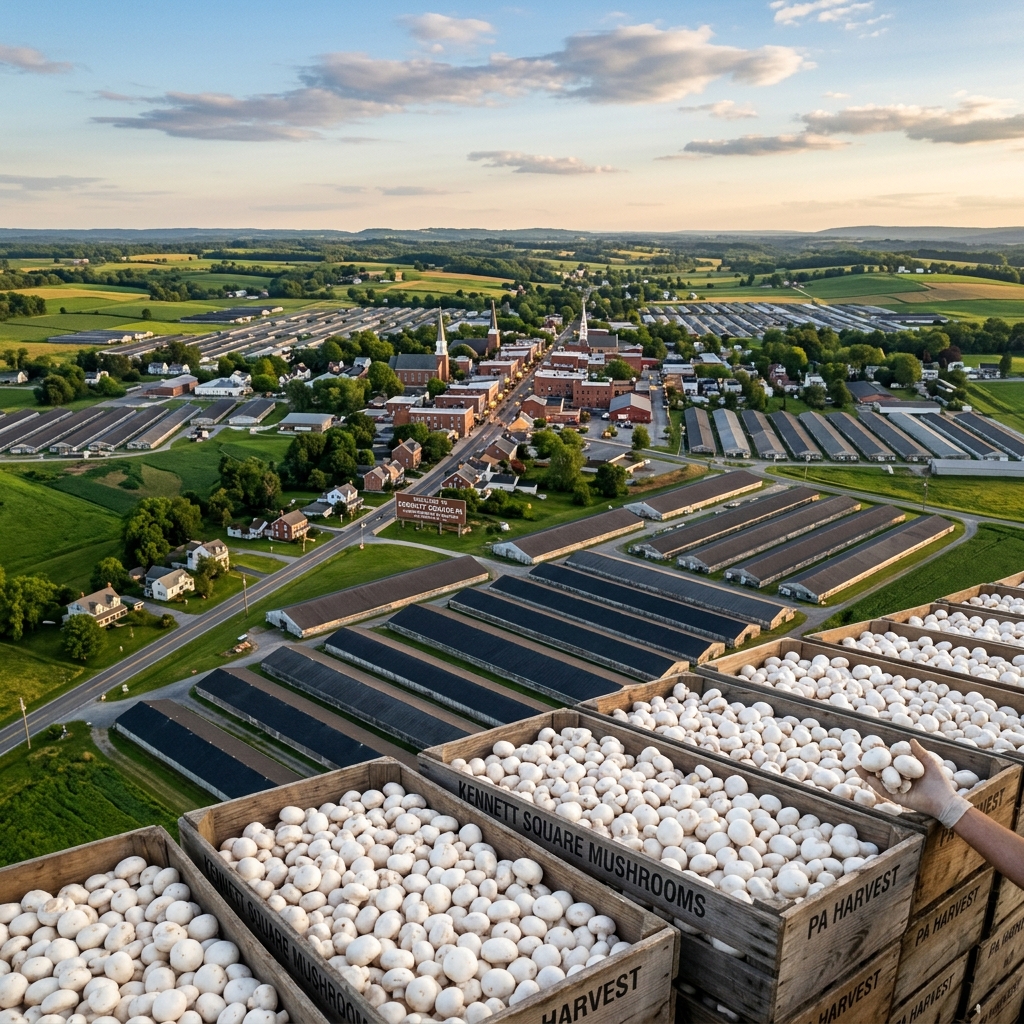
Imagine this: a single town — population under 6,500 people — produces more than 60% of every mushroom eaten across the entire United States of America, a country of 340 million people. Not a state. Not a region. A town. One you have almost certainly never heard of, unless you happen to live in southeastern Pennsylvania. Its name is Kennett Square, and it is — officially and unofficially — the Mushroom Capital of the World.
How It All Started: A Quaker Florist's Happy Accident (1885)
The story of how Kennett Square became the mushroom capital of the world begins — like so many great stories — with an accident, a bit of curiosity, and a lot of wasted space.
In 1885, a successful Quaker florist named William Swayne was growing carnations in heated greenhouses in Kennett Square. Like all greenhouse operators of that era, Swayne used raised wooden benches to hold his flower pots at a comfortable working height. But he noticed that the dark, humid, temperature-controlled space beneath those benches — typically several feet of dead, wasted space — was doing nothing useful. It was warm, damp, shaded from light, and constantly maintained at a steady temperature by the greenhouse heating system. In other words, it was the perfect environment for growing mushrooms.
Swayne imported mushroom spawn from England, hung burlap curtains from the undersides of his flower benches to create dark micro-chambers, and planted the spawn in beds of composted horse manure beneath his carnations. The mushrooms flourished. Within a few growing seasons, Swayne realised that the mushrooms growing under his flower benches were more profitable per square foot than the carnations growing on top of them.
From Greenhouse to Mushroom House
Encouraged by his success, Swayne built the first purpose-designed mushroom house in the area — a long, low, windowless building specifically engineered to maintain the dark, cool, humid conditions that button mushrooms (Agaricus bisporus) require. His son, J. Bancroft Swayne, expanded the operation further, adding a commercial spawn-production facility and a cannery for preserved mushrooms. By the early 1900s, the Swayne family had demonstrated that mushroom farming could be a serious, scalable, year-round agricultural enterprise — not just a greenhouse side project.
Word spread rapidly through the tight-knit Quaker farming communities of Chester County. Neighbouring farmers began building their own mushroom houses. The region's existing infrastructure — horse farms providing abundant manure for compost, proximity to the Philadelphia and New York City markets, and a well-developed rail network — made Kennett Square the logical epicentre of the emerging industry.
The Italian Immigrant Story
The second chapter of Kennett Square's mushroom story belongs to the Italian immigrant families who transformed a Quaker curiosity into an industrial powerhouse.
In the early 20th century, southern Chester County was home to a thriving stone quarrying industry. Many Italian immigrants — primarily from the Campania, Abruzzo, and Sicily regions of Italy — had come to the area to work in these quarries. As the quarrying industry began to decline, these workers and their families looked for new livelihoods. They found mushrooms.
Italian immigrant families brought several crucial advantages to the mushroom industry:
- Cultural familiarity with fungi: In contrast to mainstream American food culture of that era (which was deeply suspicious of mushrooms), Italian cuisine had a centuries-old tradition of mushroom foraging, cooking, and appreciation. These families understood mushrooms as food in a way that most Americans did not.
- Work ethic and family labour: Mushroom farming is extraordinarily labour-intensive — requiring constant monitoring, daily harvesting by hand, and round-the-clock attention to temperature, humidity, and air quality. Italian immigrant families — often working as multi-generational units — provided the dedicated, skilled labour force that the industry needed to scale.
- Entrepreneurial drive: Many Italian families started as hired workers on Quaker-owned mushroom farms, but within a generation, they had saved enough to buy or build their own operations. Names like Pia, Ferrante, Giorgi, Cardile, Basciani, and D'Amico became synonymous with the Kennett Square mushroom industry — and many of these family-owned businesses are still operating today, three and four generations later.
By the mid-20th century, the Italian-American families of Chester County had become the dominant force in American mushroom production. Their operations grew from small family farms into major industrial enterprises — while retaining the family-ownership structure that defines the industry to this day.
The Scale: By the Numbers
To appreciate just how concentrated the US mushroom industry is in this single tiny corner of Pennsylvania, consider these statistics:
- Production: The Chester County mushroom corridor produces approximately 500 million pounds of mushrooms per year — roughly 1.4 million pounds per day, or about 16 pounds of mushrooms per second, every second of every day, all year round.
- Market share: Pennsylvania as a whole accounts for approximately 69% of total US mushroom production by volume, and virtually all of Pennsylvania's production is concentrated in the Kennett Square area of Chester County.
- Crop value: The farm-gate value of the Pennsylvania mushroom crop exceeds $1 billion annually — making mushrooms the state's most valuable horticultural crop.
- Economic impact: When indirect and induced economic activity is included (processing, transport, equipment, compost, spawn, packaging, retail), the total economic impact of the Chester County mushroom industry exceeds $2.7 billion per year.
- Employment: The industry directly employs approximately 10,000 workers in Chester County — in a town whose total population is barely 6,500. The mushroom industry's workforce is significantly larger than the town itself.
- Growing space: Modern mushroom houses in the area are multi-story, climate-controlled buildings. A single mushroom house can contain 6–8 levels of growing beds stacked vertically, producing the equivalent output of dozens of acres of conventional farmland from a building footprint of less than half an acre.
Why Kennett Square and Nowhere Else?
It's a fair question: if mushroom farming doesn't require sunlight or arable land, why didn't the industry develop in dozens of places simultaneously? Why is it so concentrated in one tiny town? Several converging factors locked in Kennett Square's dominance:
1. First-Mover Advantage and Knowledge Clustering
Once the Swayne family demonstrated that commercial mushroom farming was viable, neighbouring farmers copied the model. Knowledge, techniques, and expertise accumulated locally. Mushroom-specific infrastructure — spawn production labs, compost yards, specialised equipment manufacturers, cold-chain logistics companies — grew up around the farms. Each new piece of infrastructure made it easier to start the next mushroom farm in the area and harder to start one elsewhere. This is the classic "industrial cluster" effect — the same economic dynamic that concentrated silicon chip manufacturing in Silicon Valley and diamond cutting in Antwerp.
2. The Compost Supply Chain
Button mushrooms require a very specific growing medium: pasteurised compost made primarily from horse manure, wheat straw, hay, corn cobs, and gypsum. Chester County's proximity to the horse farms of the Brandywine Valley (one of the densest concentrations of horse-breeding operations in America), plus its agricultural heritage, gave Kennett Square farmers access to virtually unlimited quantities of high-quality composting ingredients at minimal cost. Today, the region has massive, centralised composting operations that serve dozens of mushroom farms — a shared infrastructure that would take decades and billions of dollars to replicate elsewhere.
3. Market Proximity
Kennett Square sits roughly 35 miles southwest of Philadelphia and within a day's truck drive of New York City, Baltimore, Washington D.C., and Boston — collectively home to over 50 million consumers. Fresh mushrooms are highly perishable (they begin losing quality within 2–3 days of harvest), so proximity to major population centres is a critical competitive advantage. Farms in the Midwest or West would face significantly higher transportation costs and quality losses.
4. Climate
Chester County's temperate, humid climate with relatively mild winters reduces the energy costs of maintaining mushroom houses at the ideal growing temperature of 12–18°C (55–65°F). While modern mushroom houses are fully climate-controlled, the region's natural climate still provides an energy-cost advantage over operations in hotter or more extreme climates.
5. Labour Force
The Italian-American families established a deep pool of mushroom-farming expertise that has been passed down through generations. Today, the industry's workforce also includes a large and vital Latin American labour force — primarily from Mexico and Guatemala — who perform the demanding daily work of hand-harvesting mushrooms. This established, experienced labour pool is another form of infrastructure that would be extremely difficult to replicate in a new location.
The Mushroom Festival
Every September, Kennett Square celebrates its unique identity with the Mushroom Festival — a two-day event that has been running since 1986 and attracts over 100,000 visitors annually. The festival features:
- Mushroom farm tours (one of the only times the public can see the inside of commercial mushroom houses)
- A massive mushroom cook-off competition
- Fried mushroom eating contests
- A mushroom parade through the centre of town
- Mushroom-themed foods including mushroom soup, mushroom burgers, mushroom fudge, and — yes — mushroom ice cream
On New Year's Eve, while Times Square in New York drops a crystal ball, Kennett Square drops a giant illuminated mushroom cap to ring in the new year. The town's identity and the mushroom industry are inseparable.
The Lesson: Geography Is Not Destiny — Infrastructure Is
Perhaps the most remarkable thing about Kennett Square's dominance is that there is nothing geographically special about the town itself. It has no unique soil, no special water source, no exclusive mushroom-growing mineral. It's ordinary Chester County farmland. What makes it extraordinary is 141 years of accumulated infrastructure, expertise, and supply-chain integration — all traceable back to one florist who noticed some wasted space under his greenhouse benches in 1885.
The mushroom capital of the world was not chosen by nature. It was created by accident, built by immigrants, and locked in by economics. And today, every time an American eats a mushroom — on a pizza, in a salad, sautéed with steak — there is a better-than-even chance that it grew in the dark, in a multi-story building, in a tiny Pennsylvania town that most Americans have never heard of.