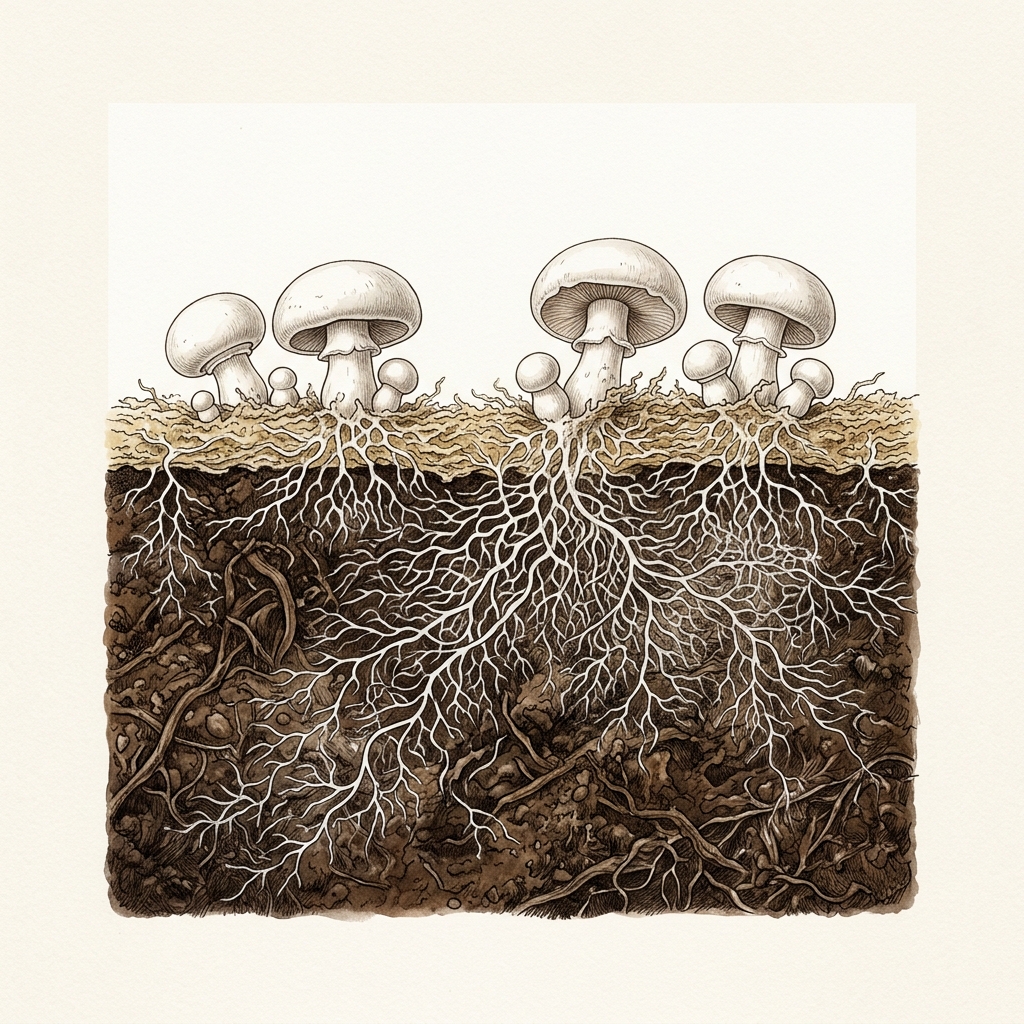
The Science of the "Casing Layer": How Farmers Trigger the Mushroom Harvest
When most people picture mushroom farming, they imagine dark rooms filled with rows of compost beds from which perfect white button mushrooms spring up, almost magically, day after day. The reality is far more fascinating — and far more deliberate. The mushrooms you buy at the market did not appear on their own. They were tricked into existence by a farmer who understands one of the most remarkable biological processes in agriculture: the science of the casing layer.
What Is Mycelium, and Why Does It Hide?
Before we can understand why the casing layer works, we need to understand what mycelium actually is. When you look at a mushroom growing out of the ground, you are only seeing the fruiting body — the reproductive organ of the fungus. It is the equivalent of an apple on a tree. The actual organism lives underground (or inside the compost, in a farm setting), and it is a vast, branching network of microscopic white threads called hyphae. Collectively, this web of hyphae is called the mycelium.
In the wild, mycelium can spread for enormous distances. The largest known organism on Earth is a honey fungus (Armillaria ostoyae) whose mycelium network covers over 2,385 acres of forest floor in Oregon, USA — roughly the size of 1,665 football fields. The network has been growing for an estimated 2,400 to 8,650 years.
In a controlled mushroom farm, the mycelium of Agaricus bisporus (the common button mushroom) is introduced into specially prepared compost. Here it has everything it needs — warmth, moisture, nutrients, and darkness — and it is perfectly happy to keep growing vegetatively, branching and feeding, without ever producing a mushroom. From the mycelium's perspective, there is no reason to reproduce. Life is comfortable.
This is the fundamental problem every mushroom farmer must solve: how do you convince a perfectly content organism that it needs to reproduce?
The Casing Layer: A Sterile Blanket That Changes Everything
The answer lies in a thin, unassuming layer of material that a farmer spreads over the top of the fully colonised compost. This is the casing layer, and despite its simplicity, it is arguably the single most important step in commercial mushroom production.
The casing layer is typically a mixture of:
- Peat moss (or coco peat) — a natural, spongy material with excellent water-holding capacity.
- Crusite or crushed limestone (calcium carbonate) — which raises the pH of the mixture to a slightly alkaline level (around pH 7.2–7.8).
- Water — the casing is thoroughly moistened before application to ensure it can deliver a steady supply of humidity to the developing mushroom pins.
This mixture is pasteurised (heat-treated) before use to kill any weed moulds, insect eggs, or competing micro-organisms that could contaminate the crop. It is then spread in a uniform layer, typically 3 to 5 centimetres thick, over the surface of the compost bed.
Why the Casing Layer Works: The Science
The casing layer performs several critical functions simultaneously, and understanding each one reveals just how cleverly the farming process mirrors natural conditions:
1. Moisture Reservoir
Mushrooms are roughly 90% water. During the explosive growth phase — when a tiny pin doubles in size every 24 hours — the developing fruiting body needs a constant supply of moisture drawn upward through the mycelium. The peat moss in the casing layer acts as a moisture battery, holding water that the farmer continuously replenishes through fine misting, and releasing it steadily to the growing pins.
2. Microclimate Transition Zone
The casing layer creates a humidity gradient between the wet, nutrient-rich compost below and the drier, CO₂-depleted air above. This gradient is the critical trigger. When mycelium reaches the top of the casing and encounters the sudden change from moist, CO₂-rich conditions to fresh, oxygen-rich air, it receives a powerful biological signal: "the surface is here — this is where spores can be dispersed." The mycelium responds by switching from vegetative growth (branching) to reproductive growth (forming mushroom primordia, or "pins").
3. Microbial Signalling
Research published in the Journal of Applied Microbiology has revealed that the casing layer harbours specific bacterial communities — particularly species of Pseudomonas — that produce volatile compounds which chemically signal the mycelium to initiate pinning. Without these microbial partners, even a perfectly prepared casing layer can fail to trigger fruiting. This is why experienced farmers never sterilise the casing layer completely (only pasteurise it); total sterilisation would kill the beneficial bacteria.
4. Physical Support
As the mushroom pins push upward, they need a firm but porous medium to anchor against. The casing layer provides exactly this — enough structural resistance to keep the mushrooms upright and uniform, while being porous enough that the delicate pins can push through without damage.
The Environmental Shock: Tricking Mycelium Into "Panic Mode"
Applying the casing layer alone is not enough. After the mycelium has grown through the casing (a process called casing colonisation, which takes about 7–10 days), the farmer delivers a carefully timed environmental shock that simulates the arrival of autumn or an approaching cold front. This is the final trigger that switches the fungus into full reproductive mode.
The shock consists of three simultaneous changes:
- Temperature drop: The growing room temperature is lowered from approximately 24–25°C (75°F) down to 16–18°C (60–64°F) over a period of 24–48 hours. This simulates the seasonal cooling that tells the fungus winter is approaching.
- CO₂ reduction: During the vegetative growth phase, the rooms are kept relatively sealed, allowing CO₂ from the respiring mycelium to build up to around 5,000–8,000 ppm. At pinning time, the farmer opens fresh air dampers, flushing the room with outside air and dropping CO₂ to 800–1,200 ppm. The sudden oxygen surge tells the mycelium that it has access to the open atmosphere — ideal for spore dispersal.
- Increased humidity: The relative humidity is raised to 90–95% and maintained there. This prevents the tiny, vulnerable pins from drying out during their first hours of life.
From the mycelium's biological perspective, this combination of signals is unmistakable: "the season is changing, conditions are right for spore release, and if I don't reproduce now, I may not survive." The mycelium responds by rapidly channelling all of its energy into producing fruiting bodies — the mushrooms we harvest.
Pinning: The First Signs of Life
Within 3–5 days of the environmental shock, the first pins — tiny white bumps barely 2–3 millimetres across — begin to appear on the surface of the casing layer. These are the primordia, the embryonic mushrooms. At this stage, they are incredibly fragile. A sudden draft, a spray of water directly onto the pins, or a temperature fluctuation of even 2°C can kill them or cause deformed growth.
Over the next 5–7 days, the pins double in size roughly every 24 hours, rapidly developing caps, stems, and the characteristic veil that covers the gills on the underside. When the cap reaches the ideal diameter — typically 3–5 cm for commercial button mushrooms — and the veil is still intact (not yet torn to expose the gills), the mushrooms are ready for harvest.
Flushes: Why Mushrooms Come in Waves
One of the most fascinating aspects of mushroom farming is that the crop does not come all at once. Instead, mushrooms appear in distinct flushes (also called "breaks"), typically 7–10 days apart. Each flush is slightly smaller than the previous one as the nutrients in the compost are gradually depleted.
- First flush: The largest and highest-quality harvest, producing 40–50% of the total crop yield.
- Second flush: Approximately 25–30% of total yield, with slightly larger but fewer mushrooms.
- Third flush: Around 15–20% of total yield. Quality begins to decline, and the risk of contamination increases.
- Fourth flush and beyond: Diminishing returns. Most commercial farms terminate the crop after the third flush and begin a new cycle with fresh compost.
Between flushes, the farmer "rests" the growing room — allowing the mycelium to recover, recolonise the casing, and build up energy reserves for the next burst of fruiting. This rest period is carefully managed with slightly elevated temperatures (20–22°C) and reduced watering.
Why This Matters for the Industry
The casing layer technique is not just an interesting piece of science — it is the foundation of the entire global button mushroom industry, which is worth over ₹50,000 crore (USD 6 billion) worldwide. Without the casing layer, commercial mushroom farming as we know it would simply not exist. Every button mushroom, cremini, and portobello you have ever eaten was produced using this exact method.
At Dr. Dahiya Mushroom Farm, we prepare our own casing mixture in-house, carefully controlling the pH, moisture content, and pasteurisation temperature to ensure consistent, high-yielding crops batch after batch. Understanding the science behind the casing layer is one of the first things we teach in our mushroom farming training programme — because mastering this single step separates hobby growers from successful commercial farmers.